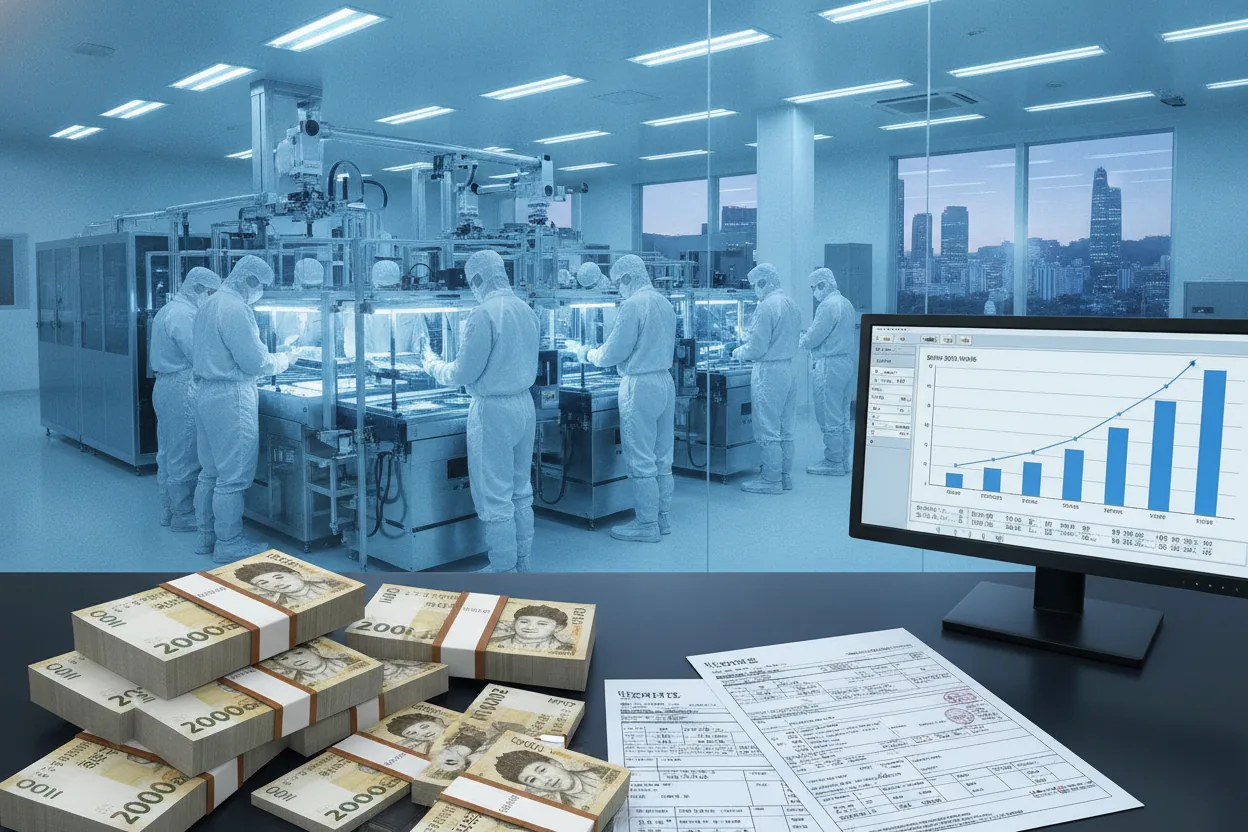
South Korea's Export Engine: Semiconductor Dominance in the KOSPI Economy
South Korea's exports for the first 20 days of July 2026 hit $54.9 billion, the highest 20-day figure in the country's recorded trade history, with semiconductors as the primary driver. Yet the KOSPI has been consolidating rather than surging, which raises a real question: is this record print finally the quantitative trigger that forces institutional repositioning into the index's two most dominant, most crowded large-cap chip names?
- Samsung Electronics holds roughly 34 to 36% share of the global DRAM market, making it the single largest beneficiary of rising memory chip prices.
- SK Hynix supplies the majority of HBM3E chips used in NVIDIA's H100 and H200 AI accelerators, giving it direct exposure to global AI infrastructure spending.
- The KOSPI IT sector, dominated by these two companies, carries a combined free-float market cap exceeding 400 trillion Korean won.
- South Korea's semiconductor exports crossed $100 billion in full-year terms in 2022, then collapsed in the 2023 down-cycle. Any recovery milestone since then carries real structural weight for KOSPI valuation.
- The Ministry of Trade's 20-day preliminary release covers the first 20 working days of the month and historically tracks within 3 to 5% of the final monthly figure.
The structural link between chip export volumes and KOSPI performance is essential context for any international investor parsing Korean equity data. When semiconductor exports re-accelerate, it's not merely a macro signal. It directly reprices the two largest index constituents and shifts foreign investor positioning in KOSPI futures and ETFs. Investors who ignore this transmission mechanism will consistently misread KOSPI momentum turning points.
Record $54.9 Billion in July 1 to 20 Exports: The Semiconductor Catalyst Behind the Number
South Korea's total exports for the first 20 days of July 2026 reached $54.9 billion, the highest 20-day figure ever recorded, according to data published by Chosunbiz citing the Ministry of Trade, Industry and Energy. Semiconductor shipment values accelerated sharply relative to the same period in 2025. The record print lands at a moment when the KOSPI has been consolidating after a strong first-half run, and the export data gives institutional investors a quantitative anchor to justify reallocation into the index's most crowded large-cap tech positions heading into August earnings season.
- Total July 1 to 20 exports of $54.9 billion, the highest 20-day figure in South Korea's recorded trade history, surpassing previous peaks set during the 2022 commodity and chip boom.
- Semiconductor exports were the primary contributor to year-on-year growth in the preliminary July data, reflecting continued strength in AI server DRAM and HBM demand cycles.
- SK Hynix consensus operating profit estimates already pointed to a strong Q2 2026 result before this data dropped. The export print reinforces the upside scenario ahead of the late-July earnings release.
- Samsung Electronics remains the largest single line item in semiconductor export value by DRAM and NAND volume scale, despite lagging SK Hynix on HBM ramp yield rates.
- Foreign investor net buying of KOSPI equities in recent sessions looks likely to continue through the July 25 options expiry window, with the record export headline providing a clear narrative anchor.
The $54.9 billion figure carries a policy dimension too. The Bank of Korea's rate-setting committee meets in August and will fold this trade data into its growth and current account forecasts, which reduces the probability of a near-term rate cut that some fixed-income participants had been pricing in. For KOSPI equity investors, the record export print consolidates the case for continued earnings momentum in the semiconductor sector through at least Q3 2026. SK Hynix is positioned as the primary single-stock beneficiary given its HBM concentration and the proximity of its earnings release. Samsung Electronics is the index-weight story: any improvement in its HBM yield rates adds a second leg to the trade that the July export data has already set in motion. SK Hynix wins the near-term positioning trade. Samsung Electronics is the asymmetric upside call for KOSPI investors willing to wait on yield rate progress.