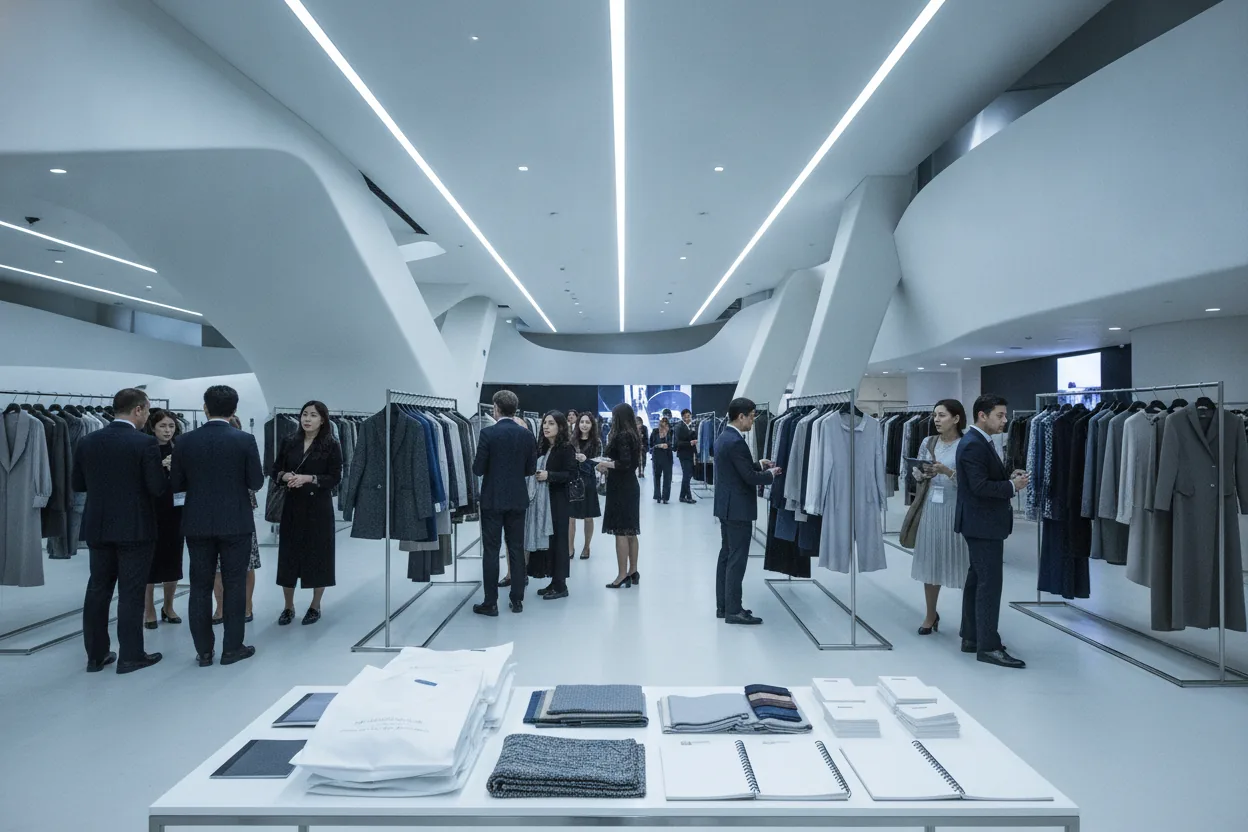
Ninety nine buyers from 23 countries spent six days at Dongdaemun Design Plaza and walked away having agreed only to discuss ordering $7.54 million worth of Korean fashion. Not sign for it. Not pay for it. Just talk about it. That gap between talking and buying is worth sitting with: why would a trade show built around non binding conversations count as a success, and what does four seasons of steady growth in that number actually prove? Seoul's government built this trade show the way Korean industrial policy built semiconductors and cars: infrastructure first, content later, with a runway show generating buzz on top of a wholesale matchmaking operation underneath. A number that small shouldn't carry a success story on its own. Four seasons of steady growth behind it are what do the work, and the rest of this piece explains why.
Seoul Fashion Week 2026 F/W posted 1,772 business consultations and USD 7.54 million in order consultations, edging past the previous season's USD 7.45 million. This isn't really a fashion story. It's a case study in how the Seoul city government treats a creative sector exactly like Korean industrial policy has always treated any sector it wants to scale: build the infrastructure first, let the content follow. The numbers are small by global trade standards. The trajectory is the actual story, and the next section breaks down what that infrastructure looks like on the ground.
The Ratio Behind the Business Model: Ninety Nine Buyers, Twenty Three Countries
Four Seasons of Order Consultation Growth
Order Consultations, USD Millions
$6.13M
2025 S/S
$6.71M
2025 F/W
$7.45M
2026 S/S
$7.54M
2026 F/W
Roughly 23% cumulative growth across four seasons
Source: Seoul Fashion Week official season reports
Ninety nine buyers. Twenty three countries. That works out to something like four buyers per country on average, flying in or sending representatives to a mid sized convention hall in eastern Seoul to sit through structured meetings with 74 Korean brands over three dedicated trade days at the DDP Design Lab. This isn't Paris Fashion Week with its editors, celebrities, and street style photographers. It's a wholesale matchmaking operation dressed in runway clothing.
The distinction matters because it tells you where the actual revenue logic sits. Seoul Fashion Week runs a public facing runway program that generates buzz, and a separate, quieter trade show that generates dollars. The order consultation figure comes exclusively from the trade show side, the buyer to brand meetings, not from ticket sales or media impressions. The Seoul Metropolitan Government isn't staging a spectacle and hoping commerce trickles down from it. It's running a sourcing fair with a fashion show bolted on as the marketing hook.
Compare this to how Korea has historically launched export categories. Samsung didn't become a semiconductor giant because Korean chips looked good in a showroom. Hyundai didn't crack the American car market on brand mystique alone. Both scaled because government backed infrastructure, cheap capital, and export incentives lowered the cost of a foreign buyer saying yes. DDP does the same job for apparel, just at a fraction of the capital intensity. A government owned venue, subsidized logistics for participating brands, and a guaranteed pipeline of vetted international buyers remove the two biggest frictions a small Korean fashion label would otherwise face alone: who do I show this to, and how do I get it in front of them without flying to Milan.
That removal of friction, not any single order total, is the actual export product Seoul is building. It matters more to a struggling brand than one season's headline number, which is also why that number shouldn't be read on its own. The next section looks at four seasons of it together.
Four Consecutive Seasons of Growth Beat One Headline Number
Seoul Fashion Week 2026 F/W by the Numbers
|
99 Buyers |
23 Countries |
74 Korean Brands |
|
1,772 Business Consultations |
3 Trade Days at DDP |
$7.54M Order Consultations |
Source: Seoul Metropolitan Government, Seoul Fashion Week 2026 F/W event data
USD 6.13 million in 2025 S/S. USD 6.71 million in 2025 F/W. USD 7.45 million in 2026 S/S. USD 7.54 million in 2026 F/W. Three consecutive seasons of growth, roughly 23 percent cumulative across four seasons of tracking. No single season looks dramatic. Together they describe something Korean policy planners care about far more than a viral spike: a repeatable curve.
One big season can be a fluke: a single large buyer, a favorable exchange rate, a lucky trend cycle. Four seasons of sequential growth means the matchmaking infrastructure itself is improving, not that Korean fashion suddenly got more fashionable. Seoul City has had years to refine which buyers get invited, how consultations are scheduled, which brands get placed in front of which markets. That kind of operational learning compounds slowly, and it rarely reverses quickly.
Here's the counterintuitive part. Korea's most globally visible fashion export channel isn't runway prestige, it's government logistics. HYBE and the K pop system export emotional attachment and monetize merchandise and concerts off the back of it. Seoul Fashion Week is doing something closer to what Korea's textile and garment sector did in the 1970s and 80s, aimed at design forward brands instead of subcontracted manufacturing. Different tool, same instinct: build the pipeline before worrying about the story.
That changes the risk profile compared to a typical fashion narrative. If a K pop group loses relevance, the commercial machine around it can stall overnight. If one season of Seoul Fashion Week underperforms, the multi season trend line barely moves, because the value sits in standing buyer relationships and venue infrastructure, not in any single brand's momentary heat. That durability is the whole point of building infrastructure instead of chasing hits, and it's also what makes the system worth something concrete to an individual brand, not just to the city's growth chart.
A Small Seoul Label Gets Something Rare From This System
How Seoul Fashion Week Converts Infrastructure into Orders
Step 1: Government builds venue and logistics at DDP Design Lab
↓
Step 2: 99 vetted buyers from 23 countries are brought in
↓
Step 3: Runway show generates public buzz and media attention
↓
Step 4: Buyers and 74 brands hold structured trade meetings
↓
Step 5: Result: $7.54M in order consultations, up from $7.45M last season
Source: Analysis based on Seoul Fashion Week event structure
Take a hypothetical but representative case: a ten person Seoul based label that has never exported outside a handful of Southeast Asian pop up stores. Getting in front of even five international wholesale buyers on its own means trade show fees, travel, translation, and months of cold outreach with no guaranteed meetings. At Seoul Fashion Week's DDP trade show, that same brand sits across from vetted buyers who flew in specifically to source Korean apparel, inside meetings the city government organized and subsidized. What's being sold here isn't clothing. It's reduced friction.
Divide the 1,772 consultations logged this season across the 74 participating brands and you get something like 24 meetings per brand on average, though the real distribution is almost certainly uneven, with established labels absorbing more buyer attention than newer entrants. Even so, that average gives a rough sense of density. Few small or mid sized apparel brands anywhere in the world get access to that volume of qualified international buyer contact in a single week without paying trade show fees that would eat most of a season's margin.
Larger, already globally distributed Korean brands need this system less, since they can afford their own showroom presence in Paris or New York. The infrastructure is disproportionately valuable to the mid tier label: big enough to have a real collection but too small to self fund international buyer outreach. That's presumably by design. Seoul City isn't trying to help brands that have already made it. It's trying to manufacture the next cohort of exporters, the same way industrial policy here has always aimed at the tier just below self sufficiency rather than the tier already at the top.
The open question is what happens once a brand graduates. Does Seoul Fashion Week's buyer network keep servicing a label once its exports reach a scale where it can negotiate direct relationships and skip the consultation format entirely? If the answer is no, the system is a permanent bridge for a rotating set of mid sized brands. If the answer is yes, DDP starts to look less like a launchpad and more like a standing distribution channel that Korean fashion brands never quite outgrow, a dependency dressed up as infrastructure. Either way, the $7.54 million figure that opened this piece was never really the point. The point is whether Seoul has built a machine that keeps producing exporters season after season, and four straight seasons of growth say, so far, that it has.
This article is for informational and educational purposes only and does not constitute financial, investment, or legal advice. Views expressed are analytical observations and should not be relied upon for personal financial decisions. Consult a qualified financial advisor before making investment decisions.