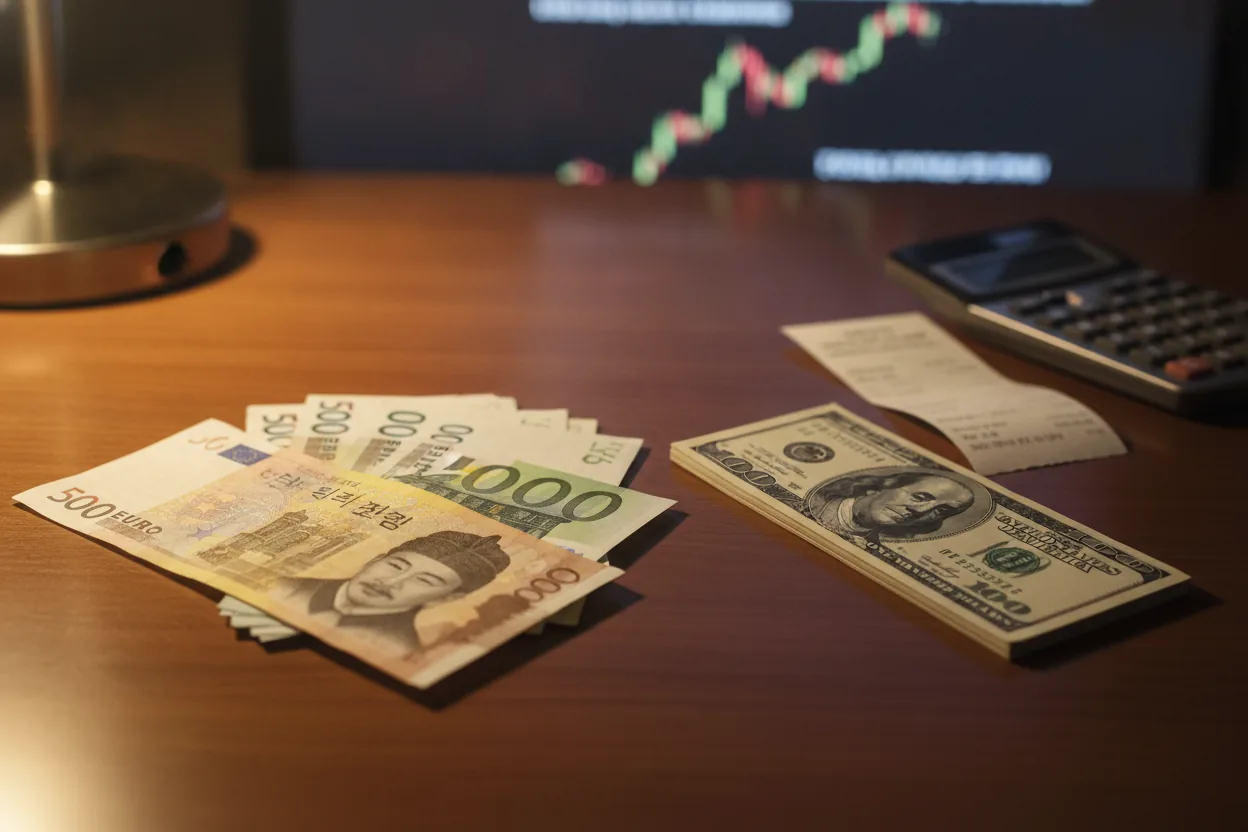
Why does buying a Korean stock from abroad involve more than one fee?
A single FX conversion on a direct KOSPI trade under €25,000 can sting more than people expect, before any commission even gets added, depending on the broker's minimum conversion charge. Compare that to holding $10,000 in a Korea ETF for an entire year: $59 total. Once you stack trade commissions, FX spreads, minimum conversion charges, and custody friction on top of each other, which route actually costs less? And does trading frequency flip the answer?
- Trade commission: many global brokers charge per-share fees, something like $0.005 to $0.02 per share with a $1 minimum, when you're buying US-listed proxies or routing into Korean markets.
- FX conversion spread: conversion fees across major brokers range from roughly 0.02% to 0.9% of trade value. The spread itself can end up costing more than the commission.
- Minimum FX charges: even low-percentage conversion fees often carry a floor, so a single trade can incur a flat minimum charge that varies by broker rather than a fixed dollar amount.
- Multi-currency account access: some brokers require a separate KRW-denominated account structure, while others only allow USD-based wrappers around Korean exposure.
- Settlement and custody friction: direct KOSPI access through a local sub-custodian adds administrative steps that ETF holders never have to think about.
This is exactly why so many international investors skip won-denominated shares and buy the packaged alternative instead. Let's get into the ETF route.
How do these direct-trading costs compare to holding a Korea ETF?
Line up the actual numbers and the comparison gets concrete fast. A Korea-focused ETF bundles the FX conversion, trading commissions, and custody work into one annual expense ratio, charged as a percentage of assets rather than per transaction.
- iShares MSCI South Korea Capped ETF (EWY): over $26 billion in assets under management, with an expense ratio of 59 basis points a year.
- First Trust South Korea AlphaDEX Fund (FKO): a relatively small fund by assets, charging a higher expense ratio than EWY, using an alternative weighting methodology.
- WisdomTree Korea Hedged Equity Fund (DXKW): charges 58 basis points a year and holds around 50 Korean companies while hedging won currency exposure.
- Broad international index funds elsewhere: the cheapest developed-market ETFs run as low as 0.03% to 0.07%, which tells you how much more emerging-market replication costs issuers.
- Direct trade example: a broker charging a 0.9% conversion fee on a trade under €25,000 generates a real FX cost on a single transaction, before any commission is even added.
Here's a simple comparison. A $10,000 direct purchase of a KOSPI stock through a broker charging 0.4% FX markup costs roughly $40 in conversion alone, plus a separate per-share commission on top. Hold that same $10,000 in EWY for a full year and you pay $59 in expense ratio, covering every underlying trade, FX conversion, and custody arrangement the fund performs on your behalf. If you're planning to hold Korean exposure for more than a few months, the ETF's annual charge usually beats the one-time FX hit alone on a comparable direct purchase. Trading frequency changes this math considerably, though, as the next section shows.
Does trading frequency change which option costs less?
The picture shifts for active traders. Make frequent entries and exits into individual KOSPI names and you pay the FX spread every single time, since each conversion back and forth triggers the fee again. A buy-and-hold ETF investor pays the expense ratio once a year regardless of how many times the fund rebalances internally, because that cost already sits embedded in the 58 to 80 basis point range quoted above.
- Single conversion cost: a buy-and-hold EWY investor pays the 59 basis point expense ratio once annually, with no repeated FX charges.
- Repeated FX exposure: an active trader moving in and out of KOSPI names multiple times a year pays the 0.02% to 0.9% conversion spread on every round trip.
- Break-even point: at a 0.4% FX markup, two round-trip conversions in a year already approach the 58 to 80 basis point range charged by EWY or FKO.
- Internal rebalancing: EWY and FKO absorb their own portfolio turnover costs inside the quoted expense ratio. Nothing extra gets passed to shareholders per trade.
Trading frequency tells you when the ETF wins on cost. It doesn't tell you whether the fund itself is a good vehicle, and that depends on scale, liquidity, and what the fund actually holds.
Does the choice of fund matter beyond the headline fee?
Fund choice matters well beyond the number printed on the fact sheet. EWY's scale gets it tighter bid-ask spreads and deep liquidity, which lowers the hidden cost of entering or exiting a position compared to a thinly traded fund like FKO. Index methodology differences change what you actually own, too: a capped fund and a factor-based fund can diverge sharply in sector exposure despite charging nearly identical fees.
- EWY liquidity: over $26 billion in assets under management supports tighter bid-ask spreads than smaller peers.
- FKO scale: under $10 million in assets means wider spreads and higher hidden trading costs despite a comparable 80 basis point fee.
- EWY methodology: the MSCI Korea 25/50 Index applies issuer-level caps (no single issuer group exceeding 25%, and groups above 5% limited to a combined 50%), but Samsung Electronics and SK Hynix together still make up roughly 40-45% of assets, with Samsung Electronics alone around 22%.
- FKO methodology: the AlphaDEX approach reweights holdings using factor screens, producing different sector exposure than a capped index fund.
These methodology differences lead straight into the question of currency risk, which none of the fee or liquidity comparisons above touch at all.
How does currency hedging change the calculation?
Currency hedging adds another layer to the decision. DXKW's hedged structure strips out won fluctuation, which matters a lot during periods when the Bank of Korea's policy rate diverges sharply from the US Federal Reserve and the won swings against the dollar. A direct KOSPI investor holding unhedged won exposure carries that currency risk permanently. An unhedged ETF like EWY passes the same risk through to shareholders, just without charging extra for it.
- DXKW hedged exposure: charges 58 basis points a year and holds around 50 Korean companies while stripping out won currency fluctuation.
- EWY unhedged exposure: charges 59 basis points a year but passes won currency risk directly to shareholders.
- Policy rate divergence: gaps between the Bank of Korea policy rate and the US Federal Reserve rate drive the won swings that hedged funds are built to offset.
- Direct trader exposure: if you hold unhedged won positions directly, you carry that currency risk permanently, with no fee-based offset available.
Hedging decisions still assume a fund exists that holds what you actually want. That assumption doesn't always hold up.
When does direct access remain the only option?
None of this means direct access is the wrong call. If you're targeting a specific KOSPI name unavailable in any ETF wrapper, there's no substitute for direct trading regardless of the FX cost, because the expense ratio comparison only works when the goal is broad Korean market exposure rather than a single stock pick.
- Smaller-cap industrial suppliers: many KOSPI-listed names in this category sit outside EWY, FKO, and DXKW holdings entirely.
- EWY coverage limits: a capped, large-cap-weighted index doesn't replicate exposure to niche or small-cap Korean issuers.
- FKO coverage limits: under $10 million in assets constrains how many names the fund can hold at meaningful weight.
- Direct trading necessity: FX conversion costs of 0.02% to 0.9% become unavoidable once you need a specific stock rather than broad market exposure.
So here's the actual answer to the opening question: there's no single cheaper route between direct KOSPI trading and a Korea ETF. Broad exposure favors the lower, bundled cost of a fund like EWY at 59 basis points a year. Frequent trading erodes that advantage fast through repeated FX spreads. And any target outside the fund's holdings removes the comparison entirely, leaving direct trading as the only route, FX fees and all.