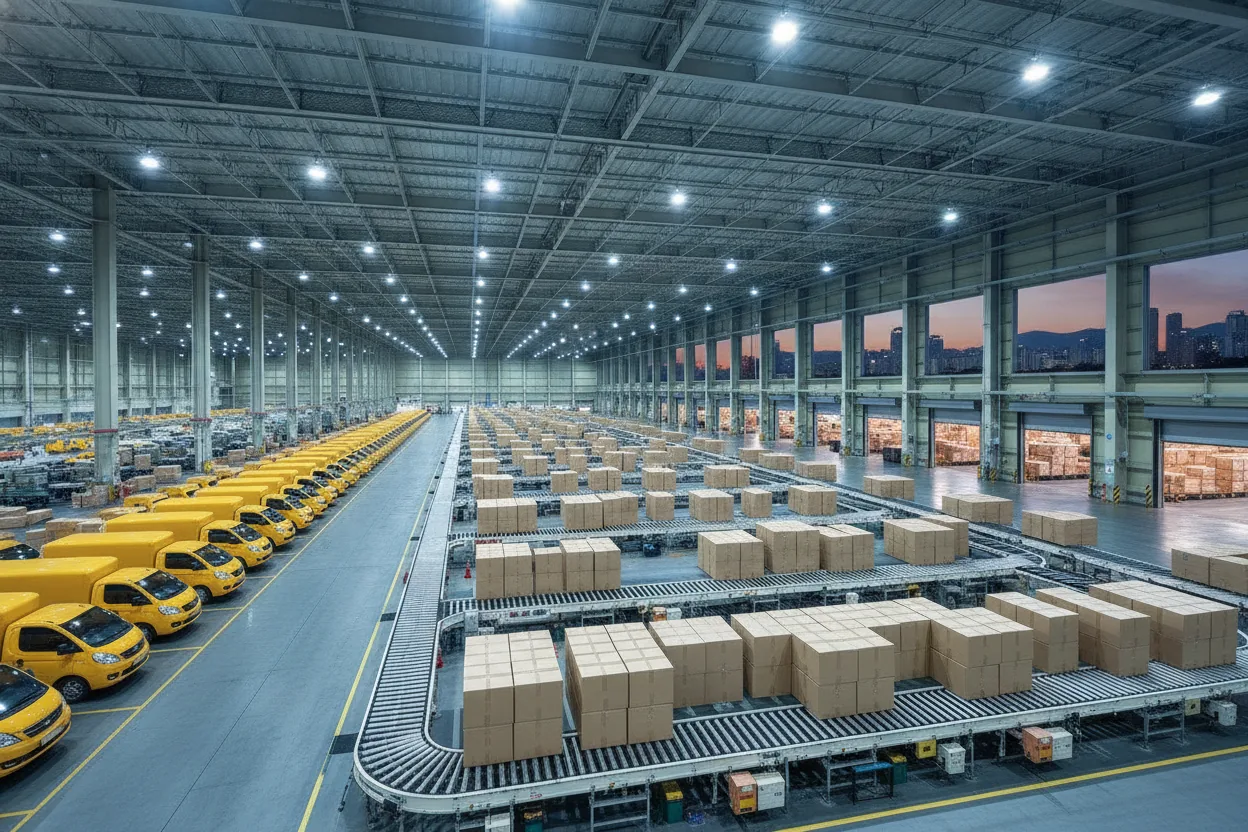
Coupang spent roughly 6 billion dollars building a logistics network across a country the size of Indiana, and the easy conclusion is that this is Korea's Amazon story, fast delivery turning into fat margins the way it eventually did in Seattle. The filings say something else. Operating margin on the core commerce business has sat in the 2 to 4 percent range for years, a company running a high volume, low margin logistics operation that happens to also sell goods. If rocket delivery was never the profit engine, something else in this business has to be doing the work. That's the question worth digging into.
The common read on Coupang is simple: it's the Amazon of South Korea, a copy-paste growth story that imported Seattle's playbook and ran it through Seoul's density. Not wrong, exactly, but it misses the part that actually matters to anyone holding the stock or watching the sector. Coupang's dominance in Korea was never primarily a retail story. It was a logistics real estate story, and the retail business paid for it. That distinction explains why the margins look the way they do, why Farfetch and the Taiwan expansion matter more than any single earnings call suggests, and why the next phase of this company looks less like Amazon and more like something Korea hasn't quite produced before.
Rocket Delivery Speed and Thin Operating Margin
Coupang Core Commerce Operating Margin Trend
Operating Margin Range, Product Commerce Business (Percent)
Margin stays confined to a 2 to 4 percent band across quarters, drifting without a clear upward trend, consistent with a fixed cost logistics structure rather than margin expansion.
Source: Coupang company filings, as referenced in article
Walk into any conversation about Coupang and someone brings up Rocket Delivery within the first thirty seconds. Next day, often same day, delivery across a nation where roughly 80 percent of the population lives in dense urban clusters. The assumption that follows is predictable: fast delivery equals happy customers equals strong margins. Amazon proved that formula could eventually work at scale, so people assume Coupang rides the same curve.
The actual numbers complicate that story quite a bit. Coupang has been profitable on a GAAP basis since 2023, itself a milestone few foreign-backed Korean companies have reached, but operating margin on the core Product Commerce business has stayed low by retail standards, sitting in the 2 to 4 percent range and drifting a bit from quarter to quarter. That's not a company printing money off delivery speed. It's a company running a high volume, low margin logistics operation that happens to also sell goods.
The mechanism here is structural, not cyclical. Coupang built and owns its fulfillment centers and its truck fleet, branded internally as Coupang Logistics Services, specifically to avoid depending on third party logistics providers like CJ Logistics or Lotte Global Logistics. That vertical integration is the moat everyone cites. It's also a fixed cost structure that eats margin every single quarter regardless of volume, because warehouses and trucks don't scale down when demand softens. Coupang chose to carry that weight permanently in exchange for control over delivery speed, and the market has rewarded the choice with revenue growth rather than margin expansion.
What the Amazon comparison leaves out is that Amazon's profit engine is AWS, a cloud business with software margins subsidizing a retail business with grocery store margins. Coupang has no equivalent cash cow quietly humming in the background. Its closest attempt is Coupang Eats plus the advertising business layered on top of its marketplace, both growing but neither close to the scale needed to meaningfully lift blended margins. So where is Coupang actually finding profit, if not in the warehouse? Somewhere else entirely: the membership fee sitting on top of the delivery promise.
Wow Membership Scale and Pricing Power Limit
How Coupang's Logistics Model Shapes Its Profit Path
Step 1: Build Owned Fulfillment Centers and Truck Fleet
Coupang Logistics Services replaces reliance on CJ Logistics or Lotte Global Logistics
Step 2: Fixed Costs Lock In Regardless of Volume
Warehouses and trucks do not scale down when demand softens
Step 3: Rocket Delivery Speed Becomes the Customer Hook
Same day and next day delivery drives adoption, not direct profit
Step 4: Wow Membership Fee Captures the Value
Recurring subscription revenue sits on top of the delivery promise and offsets thin commerce margins
Source: Analysis derived from article narrative on Coupang Logistics Services and Wow Membership
That membership fee is the next place worth looking. Casual observers assume Wow Membership, Coupang's answer to Amazon Prime, functions as a simple subscription tax on a captive market. Korea has roughly 52 million people, and market estimates put Wow Membership subscribers somewhere north of 23 million, meaning close to half the country pays Coupang a recurring fee. On paper that's Netflix-level lock-in.
The reality underneath is less comfortable for Coupang than the headline suggests. In April 2024, Coupang raised the Wow Membership monthly fee from 4,990 won to 7,890 won, a jump of nearly 58 percent. That single pricing decision triggered one of the more visible consumer backlash cycles in recent Korean ecommerce history, including a formal complaint filed with Korea's Fair Trade Commission over how the company communicated the price change to existing subscribers. Coupang weathered it. Subscriber churn ran lower than many analysts predicted. But the episode revealed something important: Wow Membership pricing power isn't infinite, and Coupang knows it.
Why did subscribers stay despite a price hike that size? Habit formation combined with a lack of equally fast alternatives, honestly, more than pure brand loyalty. Naver's commerce ecosystem, built around its dominant search engine and Naver Pay, offers breadth but not the same delivery guarantee. Lotte On and Shinsegae's SSG.com have tried competing on price rather than speed and have largely lost share doing it. Coupang's logistics investment created a situation where switching away means accepting slower delivery, and Korean consumers, raised on same-day expectations for over a decade now, treat delivery speed as closer to a utility than a perk.
That dynamic cuts both ways for Coupang's long-term position. The fee increase boosted average revenue per user meaningfully, which shows up directly in the improved profitability the company reported through 2025 and into 2026. But it also means Coupang burned through one of its easiest growth levers. Raise the fee again too soon and the attrition that didn't materialize this time might not stay dormant. The company needs growth from somewhere other than the existing Korean subscriber base, and that gap is exactly what makes the Farfetch acquisition worth a closer look.
Farfetch Distressed Asset and Luxury Growth Vector
Coupang by the Numbers: Scale Versus Margin
$6B
Spent building logistics network across Korea
2 to 4%
Core commerce operating margin range
52M
Total population of South Korea
23M+
Estimated Wow Membership subscribers, near half the country
Source: Figures cited in article: market estimates and company filings
When Coupang acquired the London-based luxury company Farfetch out of its 2024 financial collapse, a lot of market watchers reacted with skepticism bordering on confusion. Farfetch had filed for a form of insolvency protection after years of losses, and the assumption was that Coupang bought a distressed brand name for parts, maybe for the tech stack, nothing more.
The numbers suggest otherwise. Farfetch brought Coupang access to more than 1,400 luxury brand partnerships and a customer base in Europe and the United States that has essentially nothing to do with Rocket Delivery logistics. That's the point. Coupang's domestic growth rate has been decelerating as the Korean ecommerce market matures, visible in the company's own revenue growth slowing from explosive rates above 20 percent annually in 2021 and 2022 down to high single digit or low double digit growth by 2025 and 2026. Korea only has so many households, and Coupang already reaches most of them.
Luxury resale and luxury retail run on fundamentally different unit economics than grocery delivery and household goods, which is Coupang's bread and butter domestically. Margins per transaction on luxury goods can run meaningfully higher than on the diapers and instant noodles that make up a large share of Rocket Delivery volume. Folding Farfetch into Coupang's existing logistics and payments infrastructure, assuming that integration goes smoothly, gives the company a second growth path that doesn't depend on squeezing more revenue out of an already saturated home market.
Does this make Coupang a luxury ecommerce company now? Not remotely. Farfetch remains a small fraction of total revenue. But it signals a strategic admission Coupang rarely states outright on earnings calls: the Korean market alone can't carry the company's valuation expectations forever. Taiwan is where that admission gets tested against actual operating conditions.
Taiwan Market Entry and Korea Playbook Transfer
The easy assumption about Coupang's move into Taiwan, where it entered the market in 2021 but didn't launch Rocket Delivery service there until October 2022, and has kept expanding fulfillment infrastructure since, is that the company is simply copying its Korean playbook onto a new island market with similar density. Taiwan has roughly 23 million people concentrated heavily around Taipei, which does look structurally similar to Korea's urban clustering pattern on a map.
Execution has proven harder than the map suggests. Taiwan's existing ecommerce landscape already had entrenched players, PChome and Momo Shopping among them, with their own delivery networks built over more than a decade. Coupang entered as the outsider rather than the incumbent disruptor it was in Korea, and building warehouse density from scratch in a foreign regulatory environment costs differently than doing it at home with full knowledge of every local permitting process and labor market quirk.
Coupang hasn't disclosed detailed standalone profitability figures for its Taiwan operation in recent filings, and that silence tells you something on its own. When a company breaks out granular performance data for a business line, it's usually because that performance supports the growth narrative. When a segment stays folded into broader international results without a clear profitability breakout, the reasonable read is that it hasn't yet reached the point management wants to highlight. Not a criticism of the strategy, to be fair. Early-stage international logistics expansion is expensive everywhere, and Amazon took years to turn individual non-U.S. markets profitable. Taiwan is a multi-year bet, not a proven second leg of growth yet.
What Taiwan really tests is whether Coupang's core competitive advantage, the logistics moat, transfers across borders at all. In Korea, Coupang had a decade-long head start and billions in invested capital before competitors understood what they were up against. In Taiwan, it's building that moat in public, against incumbents who watched exactly how Coupang won at home and have had years to prepare a defense. The outcome says more about Coupang's actual exportable advantage than any Korean quarterly earnings report, and that result is what gets weighed against how the market currently prices the stock.
Amazon Comparison Narrative and Cash Flow Reality
Investors watching CPNG often anchor to the Amazon comparison when thinking about valuation, implicitly assuming Coupang deserves a similar multiple expansion story as it scales, the idea that today's thin margins are just the price of tomorrow's dominance. That narrative has driven real stock price momentum at various points since the March 2021 IPO, one of the largest listings by a foreign company on the New York Stock Exchange in recent memory.
Operating cash flow tells a steadier, less dramatic story than the narrative implies. Coupang has generated positive free cash flow consistently since around 2022, a genuine achievement for a company of its scale and age, and that cash is what actually funded the Farfetch acquisition and the continued Taiwan build-out without heavy new debt issuance. Coupang built that cash flow the slow way, warehouse by warehouse, not through a software margin business like Amazon's AWS.
The tension underneath all of this is whether the market should price Coupang as a logistics infrastructure company, which tends to command modest multiples reflecting high fixed costs and thin margins, or as a growth company, which tends to command premium multiples reflecting network effects and scalability. Coupang sits structurally closer to the former than the Amazon comparison suggests, yet it often trades on sentiment closer to the latter.
That gap answers the question this piece opened with. Rocket Delivery was never going to be the profit engine, and it still isn't one: the 2 to 4 percent operating margin on core commerce proves that. The actual engine is the Wow Membership fee funding a logistics network that keeps Korean customers locked into speed they can't get elsewhere, while Farfetch and Taiwan test whether that model earns a growth multiple outside Korea or only ever justifies an infrastructure one. Nobody, including Coupang itself, has settled that question yet. But the filings make clear which story the business is actually living inside right now.
This article is for informational and educational purposes only and does not constitute financial, investment, or legal advice. Views expressed are analytical observations and should not be relied upon for personal financial decisions. Consult a qualified financial advisor before making investment decisions.