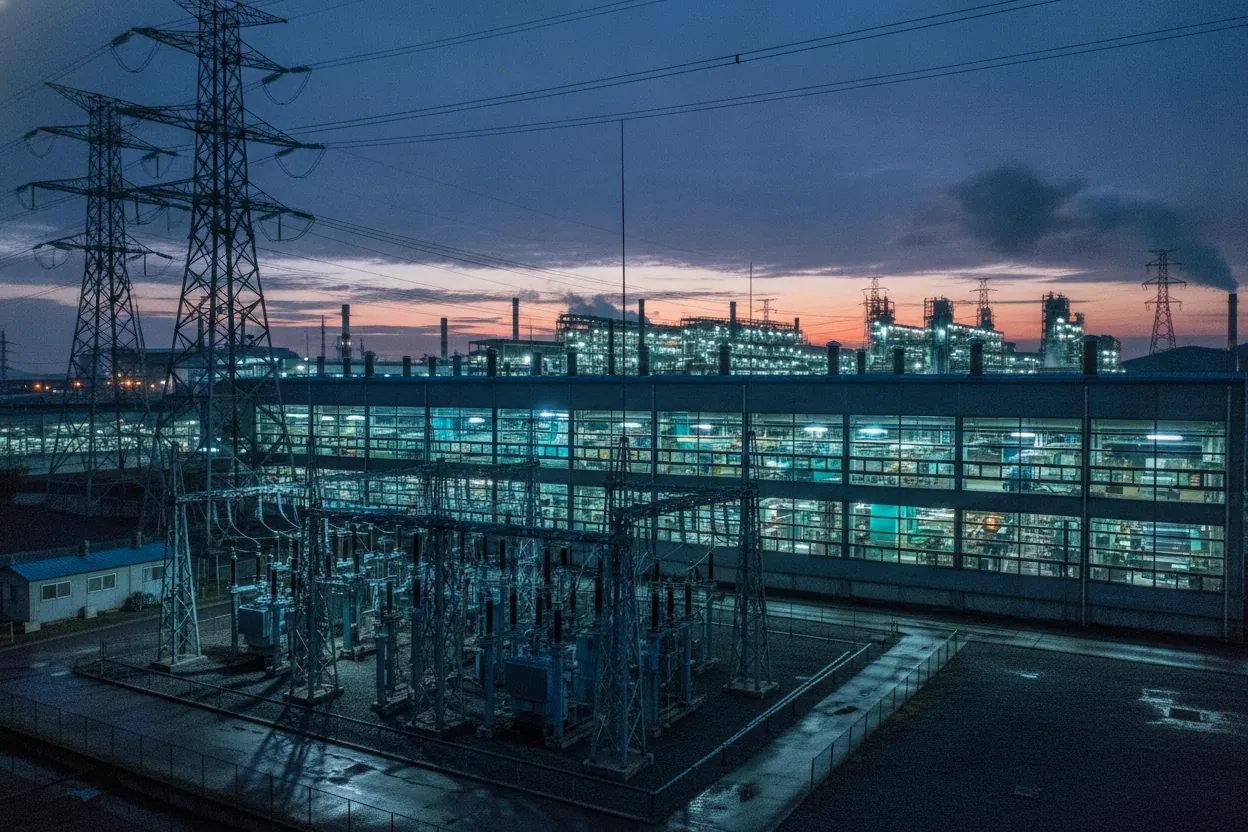
Why does Korea's industrial electricity pricing matter to KOSPI investors?
Korea's industrial electricity rate has climbed to a level that reportedly puts it above the United States and China and closer to France. That's a reversal of the cheap-power model that built the country's export economy in the first place. KEPCO calls this a correction and still posts a deficit. Manufacturers call it a political tariff with more hikes on the way, which raises a real question: can Korea's own solar, battery, and transformer makers turn this cost pressure into their next source of demand?
KEPCO, the state-run utility that sets and distributes power pricing, points out that Korea's rates remain below the OECD average, and frames the current level as a correction rather than a crisis. Manufacturers see it differently. One industry figure quoted in reporting on the issue put it bluntly: it's hard to tell anymore whether these are industrial rates or political rates, and since KEPCO is still running a deficit, more hikes are likely, with the burden falling again on industrial users.
Here's why that matters structurally. Korea's industrial base, companies listed across the KOSPI in steel, petrochemicals, semiconductors, and shipbuilding, was built on a specific competitive formula. Choi Jun-young, senior adviser at law firm Yulchon, frames it this way: competitive manufacturing needs cheap labor, abundant resources, or well-built infrastructure. Korea never had cheap labor or abundant natural resources. Low electricity cost was the substitute for all of it. Choi Kyu-jeong of the Korea Chamber of Commerce and Industry's green energy support center puts the comparison plainly: Korea's electricity is no longer cheap against other manufacturing-heavy competitors.
There's a macro layer underneath the tariff debate too. South Korea's energy sector still imports the overwhelming majority of its fuel. At current spot prices, the country's annual fossil fuel import bill across the whole energy sector runs into a substantial multiple of other major national expenditures, by this author's estimate well above annual debt repayments, food imports, and defense spending combined. That import dependency is the real reason KEPCO keeps running deficits and keeps coming back for rate increases: fuel costs get set in dollars on global markets, not in Seoul.
So the pricing structure industrial users are now objecting to isn't some policy accident. It's the visible result of an import-heavy fuel mix meeting a utility that's absorbed losses for years. The next question is what that absorption means for manufacturers and for renewable stocks: does it make renewables a new cost burden stacked on top of the tariff, or a way to hedge against it?
Are renewables a cost burden or a hedge for manufacturers?
The common assumption among industrial players is that renewables are a cost add-on, a compliance expense layered on top of already-rising power bills. The numbers suggest the opposite calculation is becoming more relevant. Renewable energy makes up a relatively small share of Korea's electricity generation, among the lowest of the OECD countries. That low base means the marginal cost of new renewable capacity is increasingly competitive against a generation mix still dominated by large, centralized fossil and nuclear plants carrying high fuel costs and limited operational flexibility.
For manufacturers weighing whether to invest in on-site solar, power purchase agreements, or corporate renewable procurement, the logic has shifted from environmental compliance to direct cost hedging. A company locked into KEPCO's industrial tariff is exposed to every future rate hike tied to KEPCO's deficit and to global fuel price swings. A company that secures its own renewable generation, or contracts directly with a renewable developer, pulls part of its cost base out of that cycle entirely.
That shift raises a further question: does Korea have the domestic industrial base to supply its own renewable buildout, or would it have to import that capacity too?
Does Korea's industrial base already supply what the renewable buildout needs?
A natural assumption is that a push into renewables would pull investment away from Korea's traditional manufacturing sector, a straight trade-off between old industry and new energy. The research points to overlap instead. Global Energy Monitor's research on Korea's renewables target, which calls for tripling capacity toward 100GW, notes that Korea already holds several domestic industrial advantages for building that capacity. Korea has world-class solar panel production capacity, so expanding capacity keeps the investment inside domestic supply chains instead of funding imports. Korean battery makers, already central to the EV supply chain, are positioned to supply the storage renewable grid integration needs. And Korea is one of the world's leading exporters of high-voltage transformers, a component that's become a global bottleneck constraining renewable buildout in plenty of other countries.
A push toward 100GW of renewables would route a large share of investment directly into KOSPI-listed industrial names that already export these components, not just into new entrants. That changes how investors should read the renewables-versus-manufacturing-competitiveness framing in domestic debate. It's not strictly a trade-off between two sectors, because some of the heaviest industrial users of electricity are also suppliers into the renewable buildout itself. Whether that supply-side advantage actually translates into lower costs depends on how the power market itself is regulated.
Will market reform decide who benefits from the renewable buildout?
It would be reasonable to assume that building more renewable capacity automatically lowers costs for industrial users once that capacity comes online. The RAP report adds a structural caveat here. Korea's electricity market and regulatory frameworks were designed for the legacy system of large centralized plants, not for distributed renewable generation. That means the current tariff dispute and the renewables expansion debate are connected at the regulatory level, not just the cost level. Market reform, how power gets priced, traded, and dispatched, will decide whether renewable capacity actually lowers costs for industrial users or just adds a new layer of complexity on top of KEPCO's existing deficit problem.
For investors tracking KOSPI industrial and utility names, the practical takeaway is to separate two different exposures. There are companies whose cost base is purely a function of KEPCO's industrial tariff path, which stays upward given KEPCO's deficit trajectory. And there are companies positioned on the supply side of the renewable transition, in solar manufacturing, battery production, and transformer exports, where rising domestic renewable targets turn into order volume rather than cost pressure. Korea's cheap-power advantage isn't coming back: the fuel import bill and KEPCO's deficit make that clear. The open question this post set out to answer is whether the same companies paying the higher tariff can also profit from building the replacement system. The supply-side advantages in solar, batteries, and transformers suggest that for a specific set of KOSPI-listed manufacturers, the answer is yes, provided market reform lets that capacity translate into lower costs rather than new regulatory friction.