Clarifying what a circuit breaker actually does on KOSPI
By mid-2026, Korea's exchange had reportedly logged a rising number of sidecar activations and circuit breakers for the year. If that pace holds up, it's unusually high, even next to 2008, the crisis year everyone still uses as the worst-case benchmark. Most coverage treats each halt as proof the market caught itself before falling further. But on 15 October, KOSPI had already dropped past 8% before the breaker even triggered. So the real question is whether the pause stops a selloff, or just delays it to the next 20 minutes.
Before that threshold kicks in, Korea leans on a lighter tool called a sidecar. A sell-side sidecar fires automatically once KOSPI 200 futures drop 5% or more within a five-minute window, freezing program trading on KOSPI-listed shares for five minutes. It targets computer-driven, algorithmic selling specifically, not the whole market.
Both tools run on the same logic: interrupt forced or automated selling long enough for an auction to reset the order book. Neither one is built to reverse a repricing driven by fundamentals, like a reassessment of semiconductor earnings or AI infrastructure spending. If you treat the halt as a floor under prices, you're reading the mechanism wrong. It buys time, not value, and that distinction should shape how you read the next alert on your screen. The rest of this post works through the record to answer that question directly.
Reviewing what happened on 15 October 2026
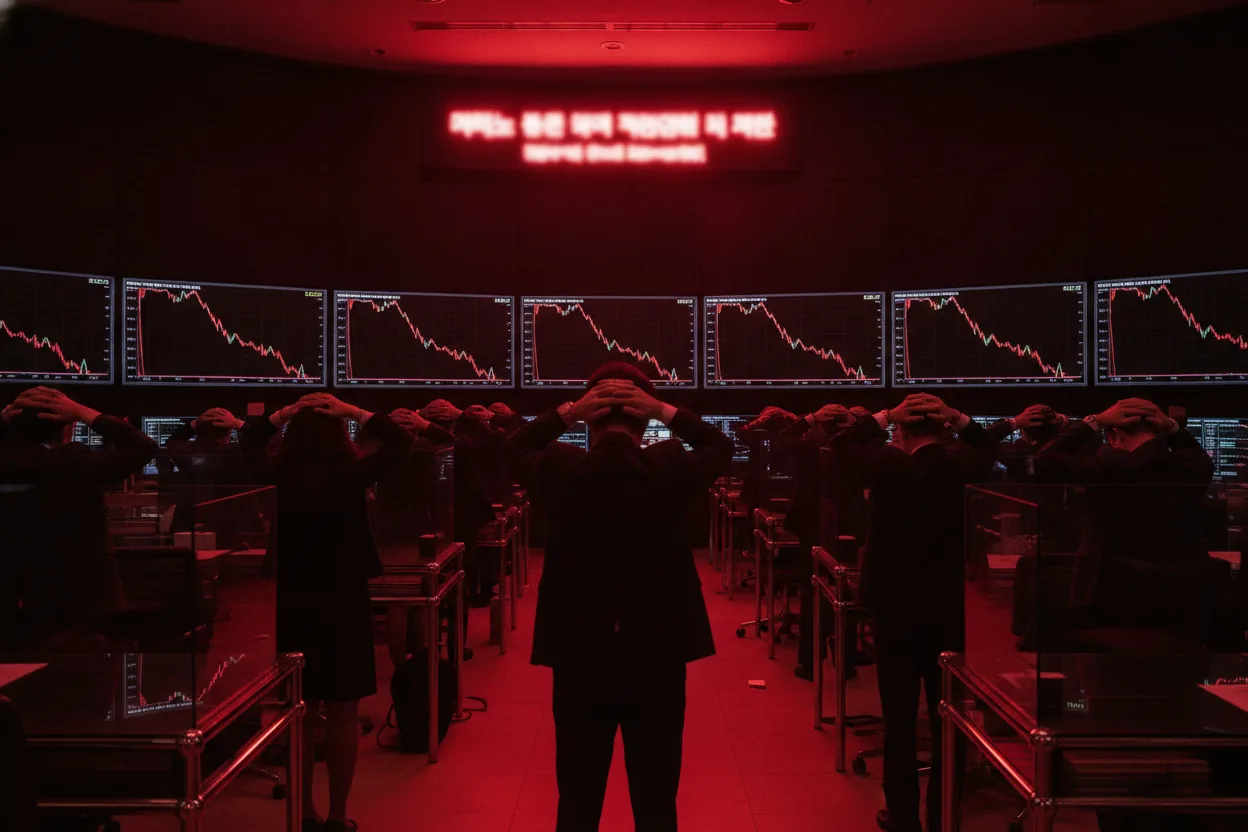
The easiest way to test that claim, that the halt buys time rather than value, is against the actual numbers from 15 October. Shortly after noon, both KOSPI and KOSDAQ had fallen more than 8% from the prior close, triggering simultaneous circuit breakers. Trading froze for 20 minutes on both markets, followed by the standard 10-minute auction.
By the close, KOSPI finished at 5,554.22, down 454.59 points, or 7.57%. KOSDAQ ended at 760.82, down 7.65%. Both indices closed slightly better than the 8% threshold that triggered the halt, so the pause did line up with a partial recovery. But this wasn't a technical glitch. Semiconductor shares drove the repricing pressure, and they carry outsized weight in Korean indices thanks to Samsung Electronics and SK Hynix's combined share of KOSPI market cap.
It wasn't an isolated event either. Around early July 2026, KOSPI reportedly dropped toward the 8,000 level and the KRX activated a sell-side sidecar as the index opened sharply lower and kept falling, suspending program trading for five minutes. Over the first half of 2026, the KRX activated sidecars and circuit breakers more often than in prior years, by some accounts approaching or exceeding the activity seen during the 2008 financial crisis. If you're tracking Korean volatility, the old 2008 benchmark may no longer be the right baseline. Risk models built around it as the worst case are worth revisiting.
Weighing whether the pause prevents panic or just postpones it
Both events, 15 October and early July, point to the same pattern: the halt interrupts selling after the damage is already priced in, not before. The assumption that a 20-minute halt calms a market rests on the idea that investors use the pause to reconsider and reverse course. But on 15 October, KOSPI had already fallen more than 8% before the halt triggered. The damage that mattered to portfolio values had already happened before the circuit breaker activated. The halt interrupted the mechanics of further automated selling, not the repricing decision investors had already made.
The early July sidecar makes the same point from a different angle. It suspended program trading for five minutes while the index was still falling, and KOSPI kept falling afterward. The sidecar slowed the rate of decline from algorithmic and program-driven orders, but it didn't stop the human and institutional selling that resumed once trading reopened. The mechanism is sequential, not corrective. It changes the pace of price discovery, not the direction.
There's also a structural gap most domestic coverage skips over. A Korean trading halt doesn't stop US-listed Korean ETFs from trading. Those instruments keep moving, often with wider bid-ask spreads and bigger premiums or discounts to their underlying KOSPI or KOSDAQ net asset value, during the exact window when the home market is frozen. If you're holding a Korea-focused ETF in New York during a KOSPI circuit breaker, that halt isn't protecting you. You're exposed to a market pricing Korean risk without a live underlying index to anchor it, which can produce bigger swings than the halted market itself sees.
Put together, the record supports a specific conclusion: circuit breakers redistribute the timing of a decline rather than eliminating it. The 20-minute pause and the 10-minute auction give exchange systems and large institutional desks a window to recalibrate order flow. They don't touch the fundamental catalyst, whether that's semiconductor demand concerns or AI infrastructure capex questions. If you're using the halt as a signal that the worst is over, flip it around: it's really a signal that the market needed a forced pause to process an 8% move, and that itself tells you something.
Applying this to how you trade around Korean volatility events
If the halt only redistributes timing rather than stopping a decline, the practical question is what to do with that gap. For investors holding direct KOSPI or KOSDAQ exposure, it's a sequencing issue: a circuit breaker tells you the index has already fallen past 8%, so by the time the halt shows up on your screen, the price move that matters has largely happened. Waiting for the reopening auction to decide whether to add or reduce a position means acting after the main repricing, not during it.
For investors holding Korea exposure through US-listed ETFs, pay close attention to that gap between the halted domestic market and the continuously trading ETF. During the 15 October circuit breaker, KOSPI and KOSDAQ both froze for 20 minutes, but any ETF tracking those indices on a US exchange kept trading, with spreads likely widening given the lack of a live underlying price. That's the moment premiums and discounts to net asset value can drift furthest from fair value, and it's also the moment with the least reliable pricing for anyone trying to enter or exit. Set wider limit orders, or just stay out of those ETFs entirely during a known KOSPI halt window.
The frequency pattern matters for position sizing too. With sidecar and circuit breaker activity in 2026 running ahead of prior years, including the 2008 crisis period some still use as a reference point, Korean equity volatility has shifted from an occasional tail event to something closer to a recurring feature of the trading calendar. If you hold semiconductor-heavy portfolios tied to Samsung Electronics and SK Hynix, expect sidecar and circuit breaker events to keep showing up around AI capex headlines. Don't treat each one as a standalone shock.
None of this makes the mechanism useless. A forced 20-minute pause does prevent a specific failure mode: a self-reinforcing algorithmic selling cascade with nothing to break it. What it doesn't do, and this is the answer to the question this post opened with, is change the fundamental price level the market settles on once trading resumes. The pause delays a selloff's mechanics by minutes; it doesn't stop the selloff. The investors actually using the tool correctly are the ones who size positions and set orders before the next 8% move, not the ones waiting for the halt to tell them it already happened.