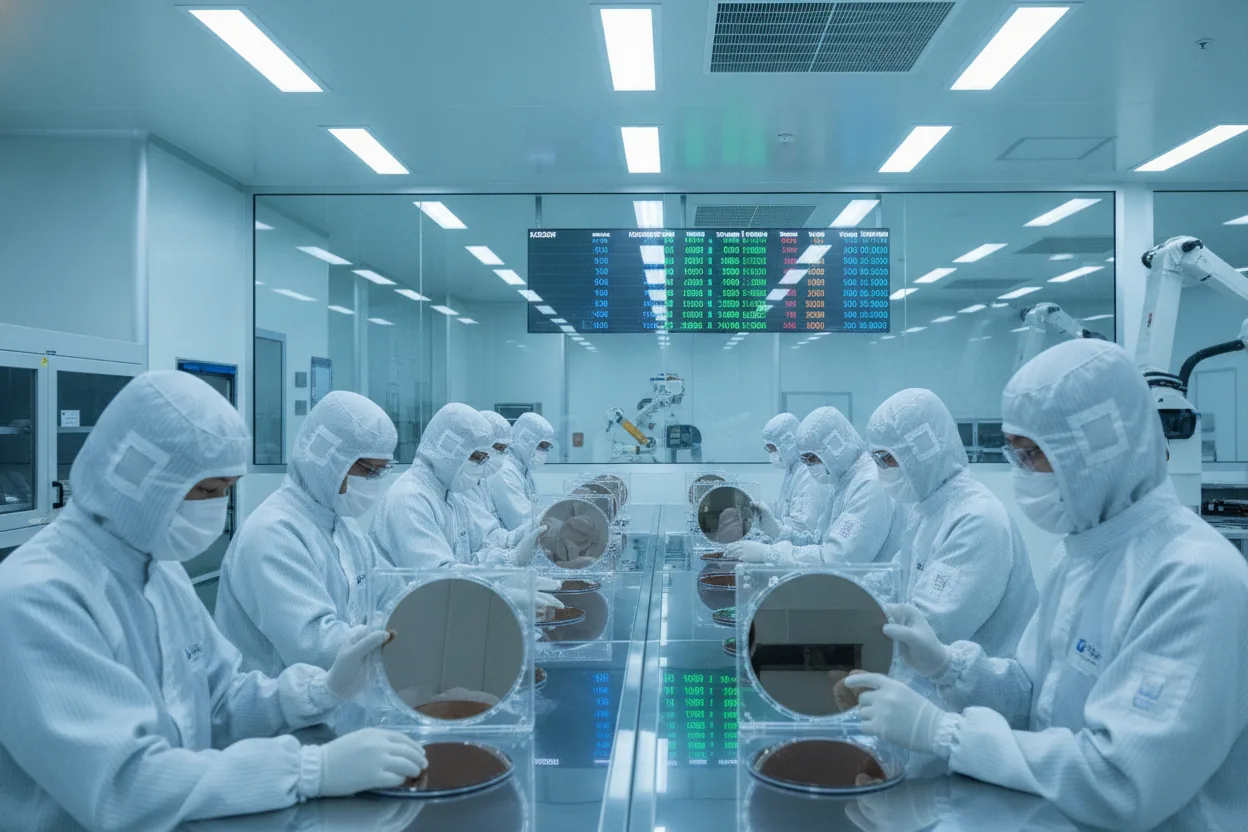
South Korea's Semiconductor Sector and Its Outsized Weight on KOSPI
Samsung Electronics and SK Hynix together control nearly 30% of KOSPI's total market capitalization, which means South Korea's 3.7% GDP print in 2026, driven almost entirely by semiconductor exports, is less a national headline than a direct earnings signal for the index itself. The question for international investors is whether the structural barriers that have historically kept foreign positioning below peak levels are finally being dismantled fast enough to let outside capital capture the re-rating before it completes.
- Semiconductors contribute roughly 20% or more of South Korea's annual export revenue, making it the single largest category by value
- Samsung Electronics and SK Hynix together account for close to 47% of KOSPI's weight by market cap
- SK Hynix supplies high-bandwidth memory to Nvidia's H-series and Blackwell GPU platforms, a direct line into global AI infrastructure spending
- South Korea's 3.7% GDP growth in 2026 sits comfortably above what analysts estimate as the IMF's global growth forecast of around 3% for the same period, though precise figures vary by source
- Foreign net buying on KOSPI has historically accelerated in quarters when semiconductor export data surprises to the upside. That pattern was visible in both Q1 and Q2 2024.
KOSPI is, in practical terms, a leveraged bet on the global semiconductor cycle. A 3.7% GDP print backed by chip exports is about as clean a confirmation as you get that the cycle is still expanding. For international investors, this macro data point validates a Korea overweight, particularly in memory and advanced packaging names where capacity constraints are still keeping pricing power intact. The GDP confirmation arrives while foreign positioning in Korean memory names remains below peak 2021 levels, which means upside participation is still on the table for investors who act on this data rather than wait for the crowd.
Current Market Developments Amplifying the GDP Growth Signal
Several things are happening at once in July 2026, and they're all pointing in the same direction. SK Hynix has confirmed it is targeting a U.S. ADR listing this year, a move that would dramatically expand its accessible investor base among American institutional funds that currently cannot hold Korean-listed shares directly. At the same time, the Korean won-dollar foreign exchange market is moving toward near-24/7 trading coverage, a structural reform that reduces settlement friction for international capital entering and exiting Korean equities. That change directly addresses a complaint global fund managers have raised about KOSPI for years.
- SK Hynix's planned U.S. ADR listing in 2026 would give American mutual funds and ETFs with domestic-only mandates a clean path to HBM exposure through a U.S.-traded instrument, no workarounds required
- Won-dollar trading extending toward 24/7 coverage, aligning South Korea's FX infrastructure with developed market standards and checking a box that MSCI upgrade discussions have repeatedly flagged
- Korean space materials stocks rallying on SpaceX public listing news, with domestic suppliers of lightweight structural components and satellite materials drawing fresh institutional interest tied to the global new-space supply chain
- Apple's rollout of a privacy-focused AI architecture is generating real downstream demand for on-device memory chips. Samsung and SK Hynix are the primary suppliers for Apple's device stack, so this is not an abstract tailwind.
- Analyst price target revisions for Korean memory names in July 2026 brokerage notes, reinforced by the GDP data and SK Hynix's ADR ambition landing in the same window
Each of these threads connects back to the same core dynamic: global capital wants access to Korea's semiconductor supply chain at the exact moment that supply chain is producing GDP-level results, and Korean regulators and corporations are actively clearing the structural barriers that historically kept foreign participation subdued. The SK Hynix ADR, if it closes, would rank among the most significant cross-listing events in Korean corporate history. The near-24/7 FX reform signals that policymakers understand the direct relationship between market accessibility and sustained foreign inflows. These aren't cosmetic changes.
The space materials rally is worth noting as a secondary narrative, even if it's smaller in scale. Korean industrial companies supplying materials for satellite structures and launch vehicles are gaining analyst visibility as SpaceX moves toward a public listing, because a listed SpaceX pulls its entire supplier network into coverage. That includes Korean component makers who have largely flown under the radar. It's a smaller position-sizing story than semiconductors, but it represents a genuine broadening of the KOSPI thesis beyond the memory cycle.
Apple's privacy AI announcement matters here because it signals continued capital expenditure on device-level AI processing, which needs denser, faster LPDDR memory. Regulatory pressure on cloud AI in the U.S. and EU is pushing more computation toward the device edge, and that architectural shift is structurally bullish for on-device memory demand through at least 2027. Samsung and SK Hynix sit squarely in the path of that spending.
The 3.7% GDP figure is the macroeconomic confirmation of a set of corporate and policy developments, the SK Hynix ADR push, the FX trading reform, Apple's AI hardware cycle, that are converging in July 2026 to make Korea one of the more compelling single-country equity stories in Asia. Investors using this GDP release as their entry signal are arriving two quarters after the fundamentals started building, but the structural tailwinds remain intact enough that the trade isn't crowded out. The confluence of a GDP beat, an ADR catalyst, and an FX accessibility upgrade in the same quarter is a rare alignment. Historically, that combination precedes a sustained re-rating of Korean equities by foreign institutions. At this point, the risk of missing that re-rating is greater than the risk of entering at current levels.