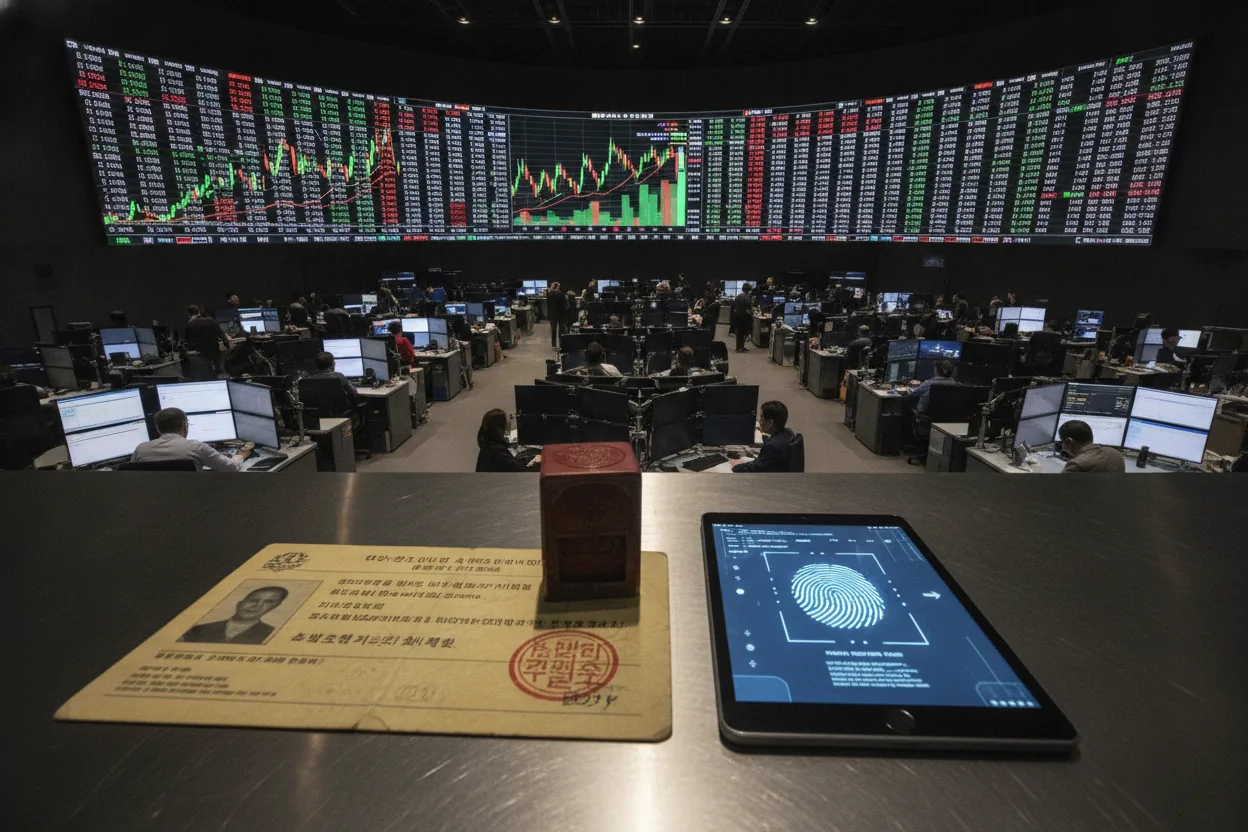
What the Foreign Investor Registration ID Was and Why It Mattered
For 31 years, ever since KOSPI first opened its doors to foreign capital in 1992, any overseas investor who wanted to buy so much as a single share had to get a government-issued RegNo first. Korea has now scrapped that rule entirely. So what fills the gap? What's the new gatekeeper for foreign money flowing into names like Samsung Electronics and SK Hynix?
The system existed because Korea originally capped how much of any single company foreigners could own. When regulators first designed the rules, they set a total foreign ownership ceiling plus an individual investor ceiling for each listed stock, and they needed a way to track compliance name by name. The RegNo was that tracking tool, the thing that made the caps actually enforceable.
- 1992: KOSPI opens to foreign investment for the first time.
- A 10 percent total foreign ownership cap applied per listed stock at inception.
- A 3 percent individual foreign investor cap applied per listed stock.
- Every foreign buy or sell order required an FSS-issued RegNo before it could go through.
- The FSS monitored all of this in real time through FIMS, the Foreign Investment Management System.
For three decades, this registration requirement was simply the price of entry. Want exposure to Samsung Electronics or SK Hynix or any other KOSPI name? Get your RegNo first. And it worked, at least for what it was built to do: the FSS could track ownership against those caps in real time through FIMS, which explains why the requirement survived so long even as it turned into a well-known headache, one that made Korea's market feel more bureaucratic than its regional rivals. It did the job as a compliance tool. But it aged badly, and eventually became a competitive liability, the kind of thing rival Asian exchanges could point to when making their pitch against Korea.
That liability is exactly what regulators moved to fix next.
The RegNo Waiver: Who Qualifies and What Changed
In January 2023, the Financial Services Commission announced it would scrap the mandatory registration rule entirely, pointing to the need to draw more overseas investment into Korean equities. The FSC framed this as part of a broader push to improve market access ahead of index reclassification reviews, and instead of ripping the band-aid off all at once, it rolled the change out in phases. The upshot: most foreign investors trading KOSPI today never have to touch an FSS-issued RegNo before placing an order.
Verification duties didn't disappear, they moved. Standing proxies and custodian banks now confirm investor identity, using methods that line up with international practice: an institutional identifier for entities, passport checks for individuals.
- January 2023: the FSC announces it will abolish the registration requirement.
- Standing proxies and custodian banks become the new identity verification gatekeepers.
- Institutional investors get identified through LEI codes instead of a RegNo.
- Individual foreign investors go through passport-based verification instead of registration paperwork.
- Korea positions the whole reform as part of its push for reclassification consideration by global index providers.
So here's the concrete answer: the RegNo is gone as a pre-trade requirement, full stop. The gatekeeper role has moved from a government filing to the brokerage and custodian chain. That kills one of the longest-standing structural complaints international funds have had about Korea, and it shifts the real bottleneck from pre-trade paperwork to execution speed and settlement infrastructure. Foreign institutional investors come out ahead here, clearly. KOSPI investors should read this as a genuine structural upgrade, one that strengthens Korea's case for future index reclassification. This isn't a cosmetic policy tweak.