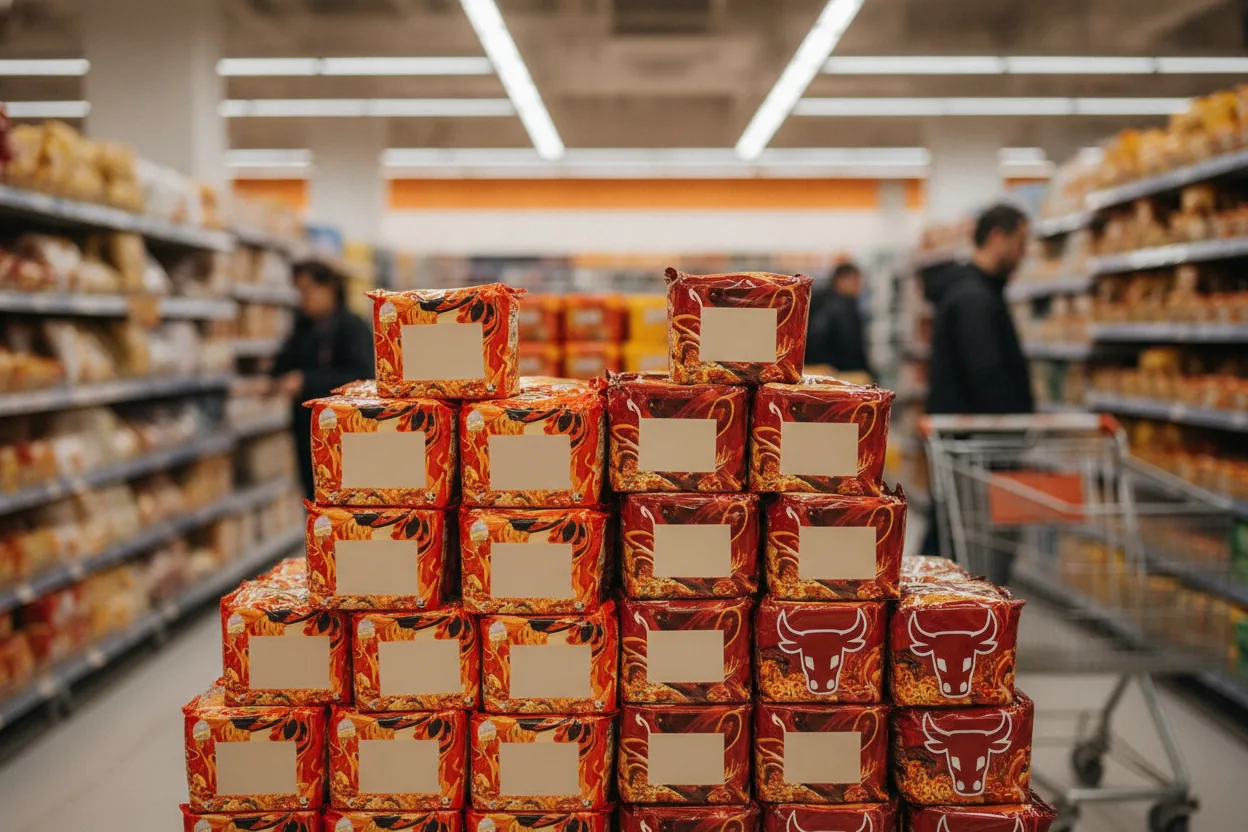
Nongshim controls more than half of Korea's domestic instant noodle market and has run a Los Angeles factory since 2005. Yet it's Samyang, with widely cited figures putting its US market share around 11 percent and analysts projecting more growth ahead, that Wall Street keeps writing notes about. Korea's food industry was built to feed Koreans first and export whatever was left over, but a shrinking population and a birth rate near 0.75 children per woman flipped that design inside out. Overseas shelves aren't the side hustle anymore. They're the business. The company with less domestic dominance, less legacy infrastructure, and a smaller marketing budget is winning the race Nongshim was supposed to win by default. What Buldak figured out that Shin Ramyun didn't explains why, and it explains why nearly every major Korean food company is now making the same bet.
South Korea's food exports, grouped under the government label K Food Plus, reportedly hit a record 13.62 billion dollars in 2025, up 5.1 percent from the year before and marking the tenth straight year of growth. That streak isn't an accident of currency swings or one viral product going viral again. It's what happens when a domestic market gets so saturated and so demographically hollowed out that Korean food companies stop having a rational choice. Build growth machines abroad, or don't grow at all. The interesting question isn't whether Korean noodles are popular overseas. It's which company is winning that popularity, and why the answer breaks almost every rule about how Korean corporate hierarchy is supposed to work.
Why Is Samyang Beating Nongshim In Its Own Category?
US Instant Noodle Market: Samyang vs Nongshim
|
SAMYANG 11% US market share Growth projected ahead |
NONGSHIM 50%+ Korea domestic share Exports remain the upside, not the core |
Despite smaller size and less legacy infrastructure, Samyang leads the overseas race that Nongshim's dominance and 2005 LA factory were expected to win.
Source: Source: Industry analyst estimates cited in article
Shin Ramyun is reportedly sold in dozens of countries, backed by decades of Nongshim's distribution infrastructure and a Los Angeles factory that's been running since 2005. Nongshim also holds a domestic market share north of 50 percent. On paper, Nongshim should be the company riding the K Food wave hardest.
Instead, Samyang gets the analyst notes. Samyang's Buldak line, the fire noodle that turned eating without water into a social media dare back in 2014, has basically become what foreign consumers picture when they think "Korean instant noodles." Samyang's export revenue now makes up the overwhelming majority of its total sales. That's a structural inversion: the overseas market isn't a growth appendage bolted onto the real business, it is the real business. Nongshim still pulls most of its revenue domestically, with exports as the upside story rather than the core one.
So why did the smaller, less resourced company win the export race? Buldak showed up already packaged as content. Nobody had to run a campaign explaining why it was different. Teenagers in Jakarta, Riyadh, and Ohio did that work themselves, filming their own suffering and posting it. Shin Ramyun sells on the promise of authentic Korean spice done well. Buldak sells on the promise of a dare you can post. One is a product story. The other is a distribution mechanism that happens to be edible, and that difference is exactly why Samyang, despite its smaller size, holds an estimated 11 percent of the US market, with analysts projecting further gains over the next several years.
Is The K Food Boom Really About Food At All?
K Food Plus Exports: A Decade of Uninterrupted Growth
Illustrative growth trend leading to record 2025 exports (10th straight year of growth)
$9.8B
2021
$11.0B
2022
$12.0B
2023
$13.0B
2024
$13.62B
2025
Up 5.1% year over year, tenth consecutive year of growth
Source: Source: K Food Plus government export data, as reported in article
Samyang's export led model isn't a one off. It's the clearest early version of a shift the rest of the industry is now copying. Ottogi's Jin Ramen sits in nearly every Korean household, yet CEO Hwang Sung-man told shareholders in March 2025 that the company would prioritize global markets, targeting 1.1 trillion won, roughly 746 million dollars, in overseas sales by 2030. Nongshim has reportedly signaled the same emphasis heading into 2026. Generic corporate language anywhere else. In Korea's context, it reads like a confession.
Here's the confession: Korea's domestic food market isn't growing, and it isn't going to. Korea's population started shrinking in absolute terms years ago. Its birth rate remains among the lowest of any OECD economy, sitting around 0.75 to 0.8 children per woman depending on the year and measure. Fewer people will be around to eat instant noodles at home twenty years from now, full stop. A food company that only sells domestically isn't managing a business anymore. It's managing decline.
Same structural pressure that pushed Samsung into semiconductors for the world instead of appliances for Seoul. Same pressure that pushed HYBE to build global idol pipelines instead of chasing local pop stars. K Food isn't just a cultural export riding the coattails of K pop and K drama, though that halo effect is real and Korean trade officials have documented it themselves. K Food is what happens when a shrinking domestic consumer base forces every serious Korean company toward the same conclusion at roughly the same time: grow outward or shrink in place.
- Ottogi's overseas sales target sits at 1.1 trillion won by 2030
- Nongshim's 2026 strategy carries an explicit global expansion mandate
- Samyang's US share is already in the low double digits, and some analysts see it climbing further by 2028
Three companies, three different scales of ambition, all diagnosing the same problem back home. 0.75. That's roughly where Korea's birth rate sits, and it's the number underwriting every one of these strategies.
Does Premiumization Explain The Export Numbers?
Korean Food Giants: Domestic Strength vs Global Ambition
| Company | Domestic Position | Global Strategy / Target |
|---|---|---|
| Samyang | Smaller domestic share | Exports are majority of total sales; ~11% US share |
| Nongshim | 50%+ Korea market share | Exports as upside; signaled global emphasis for 2026 |
| Ottogi | Jin Ramen in nearly every household | Targeting $746M overseas sales by 2030 |
Source: Source: Company statements and market data cited in article
A shrinking birth rate explains why Korean companies had to look abroad. It doesn't explain why they're making more money per unit once they get there. That part comes down to price. A pack of Buldak noodles sells in a US grocery store for roughly two to three dollars, several multiples of what the equivalent pack costs at a Korean discount mart. That gap isn't a markup slipped past unsuspecting foreign shoppers. It reflects a real repositioning: instant noodles marketed in the West as a specialty snack rather than a subsistence staple.
Macquarie's research note framed the growth thesis around premium instant noodles with strong product differentiation, language that tells you exactly where the margin sits. In Korea, instant noodles are a commodity, fought over on tens of won of shelf price difference. Abroad, they're a discretionary snack purchase, competing not against other noodles but against chips and candy near the checkout counter.
This is why export growth and domestic stagnation coexist just fine inside the same company's earnings report. A Korean noodle maker doesn't need Korean households to eat more noodles. It needs American, Southeast Asian, and Middle Eastern households to accept a higher price for something they've started treating as premium rather than basic. The tenth consecutive year of K Food Plus export growth, reaching 13.62 billion dollars in 2025, is less a story about volume and more a story about successfully renegotiating what a bowl of instant noodles is allowed to cost outside Korea.
What Happens When Every Domestic Player Chases The Same Exit?
Premiumization solves the margin question for now. It doesn't solve what happens once every Korean noodle maker is chasing the same premium shelf space abroad at the same time. Walk into a Costco outside Seoul today and the export shelf display for Buldak, Shin Ramyun, and Jin Ramen sits closer to the entrance than it did five years ago, a small retail signal of a much bigger reallocation of corporate attention. When Nongshim, Ottogi, and Samyang have each emphasized overseas growth as a central strategy in recent statements, that's not three independent business decisions. It's one industry hitting the same ceiling at the same time.
The risk underneath this convergence is competitive crowding in a handful of the same target markets, mainly the United States, Southeast Asia, and parts of the Middle East. If every major Korean noodle company scales US distribution at once, the fight shifts from Korea versus the world to Korean company versus Korean company on foreign shelf space, and that could compress margins even as headline export revenue keeps climbing. Growth abroad doesn't automatically mean profitable growth abroad, especially once shipping, tariffs, and localized manufacturing costs enter the picture.
There's also a currency angle worth watching. Export revenue denominated in dollars and other foreign currencies gets translated back into won, so a weaker won can flatter reported export growth even when underlying unit volumes haven't moved. Some portion of that 5.1 percent annual increase in K Food Plus exports likely reflects exchange rate movement rather than pure demand growth, though isolating the exact split requires data Korean trade ministries don't break out cleanly. That ambiguity doesn't undercut the broader trend, but it deserves to be named rather than smoothed over.
This is what separates Samyang's current position from Nongshim's default advantage. Nongshim had the domestic dominance, the distribution network, and a decade's head start in Los Angeles. Samyang had a product that consumers turned into content without being asked, and it built its business model around exports from day one instead of treating them as a bonus line item. Nongshim, Ottogi, and Samyang's other competitors are all trying to replicate that outward facing model now, at the same time, which means the next phase of the K Food boom gets decided less by who can grow overseas and more by who can do it profitably once the shelf fills up with rival Korean brands.
This article is for informational and educational purposes only and does not constitute financial, investment, or legal advice. Views expressed are analytical observations and should not be relied upon for personal financial decisions. Consult a qualified financial advisor before making investment decisions.