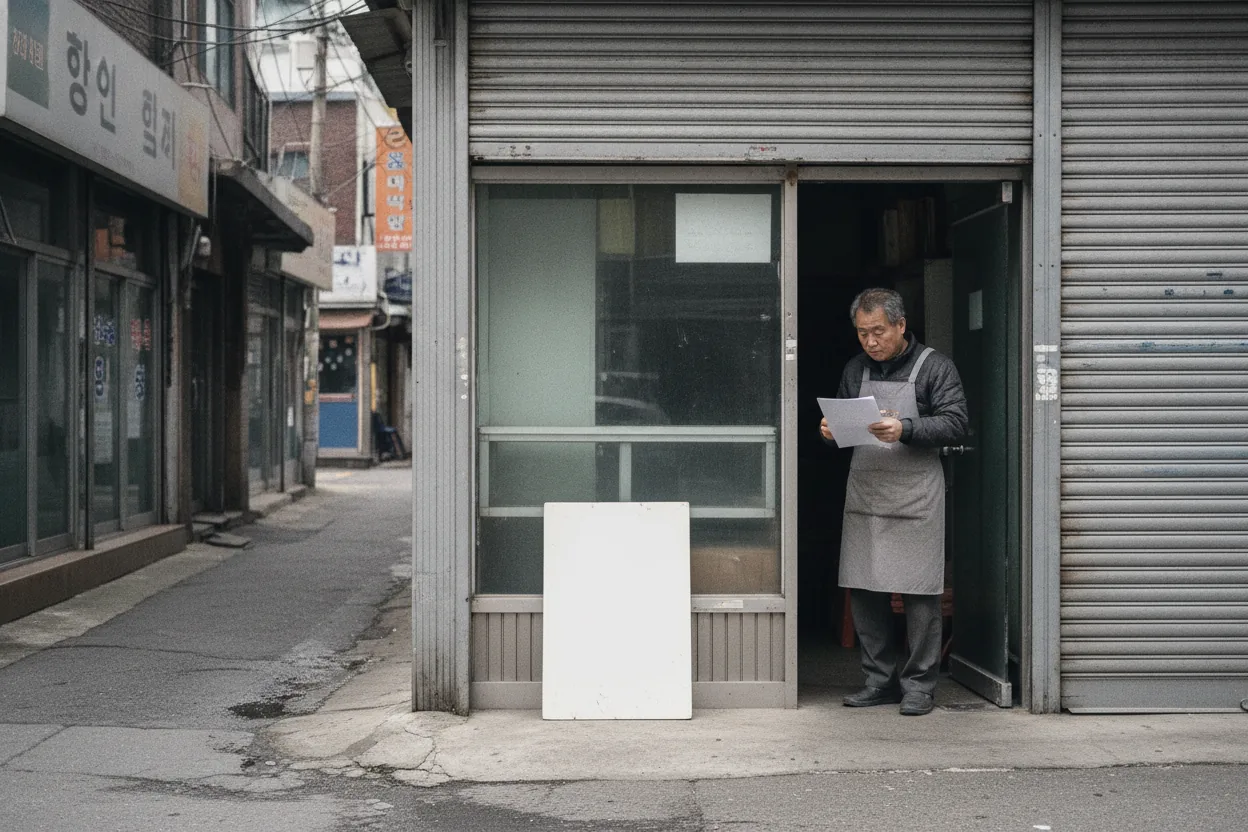
South Korea's minimum wage has climbed from around 6,470 won in 2017 to 10,700 won today, and business closures have climbed right along with it, concentrated almost entirely among the self employed. A wage floor meant to guarantee workers a livable income is instead functioning as a slow filter on who gets to survive as an owner. The law treats a franchisee splitting margin with a headquarters company the same as a corporation that sets its own prices. The 3.7 percent increase for 2027 looks tiny next to a decade of compounding, so why does it still dominate headlines every July as if it were the whole story?
Because the number itself was never really the argument. The real fight is over who eats the difference between what a small business can afford and what the law now requires it to pay. Korea's minimum wage debate looks like a labor policy fight on the surface. Underneath, it's a referendum on an entire generation of self employed shopkeepers who took on debt to open a business, and who now find the wage floor, rent, and delivery app fees quietly squeezing them out of existence.
The Wage Number Gets Headlines, But It Misses The Real Mechanism
Korea Minimum Wage Trajectory, 2017 to 2027
Source: Source: Minimum Wage Commission, article data
Every July, the Minimum Wage Commission announces a figure, and every July, the same two camps restate the same two positions. Labor representatives call the increase insufficient against inflation. Employer representatives, usually speaking through the Korea Federation of SMEs or the Korea Enterprises Federation, call it unsustainable for small business owners already underwater. Both sides are technically correct, which tells you the number itself explains almost nothing.
What actually determines whether 10,700 won breaks a business is the ratio between that wage and the business's fixed cost structure, particularly commercial rent and platform commissions, stacked on top of labor costs that have compounded for over a decade. Korea's minimum wage has more than doubled since 2017. That trajectory, not the marginal 3.7 percent bump this year, is what reshaped who can run a small business in Korea and who can't. Look at the timeline. The wage jumped 16.4 percent in 2018 under the Moon administration's income led growth policy, a shock that self employed owners still point to as the moment the math stopped working for a lot of convenience stores and small restaurants. Every increase since has been smaller in percentage terms, but it stacks on a base that keeps climbing, and the businesses absorbing it haven't grown their revenue at the same pace. Where that accumulated cost actually lands is the real question, because it doesn't land evenly.
Business Closures Show Where The Cost Actually Lands
Where the Wage Cost Actually Lands
Source: Source: Article analysis of Korea's small business cost structure
You'd expect a rising minimum wage to hurt large employers most, since they carry bigger payrolls full of workers near the floor. In Korea, it runs the opposite direction. Self employed proprietors, the owner operators of convenience stores, cafes, hair salons, small restaurants, are the ones closing at an increasing rate. They typically have no wage buffer left once labor costs rise.
Business closure filings in Korea have trended upward for several consecutive years, a pattern widely reported across National Tax Service data and small business associations, even though the exact annual count varies by source and category. What stays consistent is the direction: more closures, not fewer, concentrated heavily among self employed operators running businesses with fewer than five employees. This segment has almost no room to negotiate rent, no leverage over delivery app commissions, and no way to pass a wage increase onto customers without losing them to a nearby franchise chain that can absorb costs at scale.
Franchise convenience stores like CU and GS25 show the asymmetry clearly. The store owner is technically self employed, but operates under a franchise agreement that dictates supply costs, promotional pricing, and often store hours, while the headquarters company keeps most of the pricing power. When the wage floor rises, the franchisee absorbs the labor cost increase directly, while the franchisor's margin structure barely moves. The wage law treats both sides as equally responsible market actors. Only one side actually holds the pricing lever.
Restaurants and cafes face a version of the same squeeze through the delivery platform. Coupang Eats, Baemin, and Yogiyo together dominate food delivery in Korea, and their commission structures, Baemin and Coupang Eats currently charge about 9.8 percent and Yogiyo about 9.7 percent of order value, plus advertising fees for placement, sit on top of labor costs that just rose again. A small restaurant owner facing a higher wage bill can't simply raise menu prices without losing delivery ranking, because platform algorithms often favor lower priced listings. The owner gets squeezed from two directions at once: wage floor rising on one side, delivery commission economics capping price increases on the other. Neither the wage law nor the commission structure causes this alone. What sits underneath both is what makes the collision unavoidable for so many owners.
Structural Debt Explains Why The Wage Floor Hits So Hard
2018 Shock vs 2027 Hike: Same Headline, Different Weight
|
2018 INCREASE
+16.4%
Income led growth policy shock; owners still cite this as the turning point
|
2027 INCREASE
+3.7%
Small on paper, but stacked on a base that already doubled since 2017
|
Source: Source: Minimum Wage Commission historical data, article analysis
You'd think a business owner facing higher labor costs just adjusts prices, staffing, or hours until the math works again. Here's the part that rarely makes it into wage negotiation coverage. A significant share of Korea's self employed sector isn't really operating a business, it's servicing debt taken out to open one. Retirement in Korea's corporate system often arrives earlier than in comparable economies, frequently in the early to mid fifties, and workers pushed out of salaried jobs commonly use severance payouts and loans to open a franchise store or small restaurant. Self employment has become an informal second career track more than a genuine entrepreneurial choice.
The sector is optimizing for debt repayment, not growth. A business owner who took out a loan to open a fried chicken franchise at age 54 isn't primarily thinking about expansion. He or she is servicing a monthly loan payment, and every wage increase competes directly against that repayment schedule. When the wage floor climbs 3.7 percent, it doesn't land on a healthy small business sector experimenting freely with pricing and staffing. It lands on a sector already carrying elevated debt loads, a pattern the Bank of Korea and financial regulators have flagged repeatedly regarding self employed loan delinquency.
Delinquency rates among self employed borrowers have trended upward in recent Bank of Korea commentary, and while the precise figures shift by quarter and reporting method, the consistent signal across financial regulators is concern, not reassurance. This is the mechanism that turns a modest statutory wage increase into a closure. It's not that 10,700 won is an unreasonable hourly rate on its own. The wage sits on top of a debt structure, a rent structure, and a platform fee structure that together leave almost no margin for absorbing anything additional.
There's a policy tool meant to address exactly this problem, and it reveals the limits of top down wage setting. The government has debated a differentiated minimum wage by sector for certain low productivity industries, a proposal raised almost every year at the Minimum Wage Commission and rejected almost every year, largely because labor groups argue it would formalize a two tier wage system that stigmatizes certain jobs. Korea keeps a single national wage floor, applied uniformly whether the employer is a Samsung subsidiary or a single owner noodle shop in a shrinking provincial town. That uniform rule keeps producing wildly uneven outcomes depending on which side of the debt and platform equation a business happens to sit on. The wage floor itself isn't the real point of leverage.
The Commission Keeps Negotiating The Wrong Variable Each Summer
You'd think fixing the minimum wage fight means finding the right percentage, some number that satisfies labor without breaking small business. The evidence points somewhere else entirely: the policy debate keeps arguing about the wrong variable. The Minimum Wage Commission negotiates a single percentage point each summer as if that number were the primary lever determining small business survival, and headlines follow the same script every year, framing the fight as labor against employers.
But the businesses actually closing aren't closing because 10,700 won is unreasonable pay for an hour of work. They're closing because they were structurally exposed the moment they signed a franchise agreement, took out a retirement loan, or built a revenue model dependent on a delivery app's algorithm. The minimum wage increase is just the most visible trigger pulled on a structure built years earlier.
That's why the July headline keeps missing the story. The 3.7 percent figure will get debated again next summer, and the same two camps will restate the same two positions, but the franchise contracts, the delivery commissions, and the retirement debt cycle will still be the actual determinants of who survives. Until those three get negotiated directly, the annual wage number will keep taking the blame for closures it didn't primarily cause.
This article is for informational and educational purposes only and does not constitute financial, investment, or legal advice. Views expressed are analytical observations and should not be relied upon for personal financial decisions. Consult a qualified financial advisor before making investment decisions.