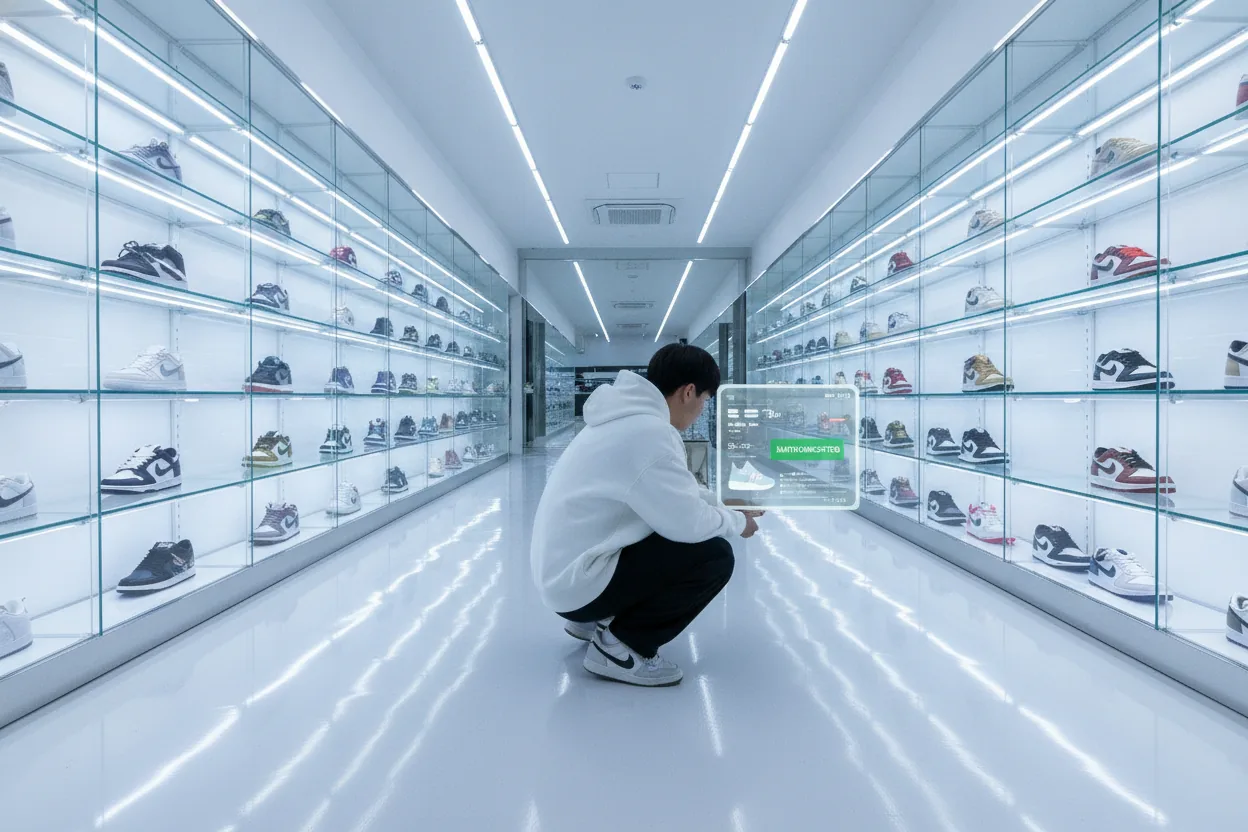
Korea's domestic used goods market expanded tenfold in under two decades, from roughly 4 trillion won in 2008 to a projected 43 trillion won by 2025. That trajectory was never supposed to happen in a country where buying new was practically a social requirement. The infrastructure that made resale credible didn't emerge from some organic shift in taste. It came from a deliberate architectural choice: intercept the transaction before it closes, not after a complaint is filed. That one decision separated Korea's resale economy from every comparable market, and it raises the question this post works to answer: how did one platform turn a trust problem into a financial exchange, and what does that reveal about where Korean capitalism is actually heading.
The Authentication Engine Driving Everything
Korea's Used Goods Market Growth: 2008 to 2025
Korea's Used Goods Market Growth: 2008 to 2025
Market size in trillion Korean Won (₩)
Source: Article data; projected 2025 figure
Every resale market eventually collides with the same problem. The buyer can't see the seller, can't touch the product before paying, and can't easily recover losses if the item turns out to be fake. In the US and Europe, companies addressed this through reputation systems, third-party inspection networks, and lengthy dispute pipelines. Korea compressed that entire process by centralizing authentication before the transaction closes.
KREAM, a Naver subsidiary, built its model around mandatory verification. Every item passes through KREAM's authentication center before it reaches the buyer. KREAM doesn't list and hope. It intercepts. That single design choice converted what would have been a peer-to-peer gamble into something closer to a guaranteed delivery from a retailer. For Korean consumers who grew up with the kind of service expectations that Coupang normalized, receiving an unverified luxury item isn't an acceptable outcome. KREAM understood that before most of its competitors did.
The global luxury resale market sat at roughly 32.5 billion dollars in 2024, with projections toward 50 billion dollars by 2030, and authentication is consistently cited as the primary growth driver in that forecast. What Korea layered on top of authentication was density and speed. The country is geographically compact, digitally saturated, and heavily urbanized, so listing-to-sale cycles collapse. For high-demand sneakers or limited-edition watches, that window can shrink to seconds. No Western resale operation currently replicates that velocity at scale.
Authentication without speed still leaves money on the table. KREAM combined both, which is what separated it from local competitors like Bunjang, a platform built on broader categories and a looser verification model. Sellers who want price certainty and buyers who want product integrity have a clear reason to choose KREAM. That isn't symmetry by accident.
Who Actually Uses KREAM and Why It Matters
How KREAM's Authentication Model Works: Step by Step
How KREAM's Authentication Model Works: Step by Step
Every transaction is intercepted before it closes
Seller Lists Item
Seller posts a limited-release sneaker, watch, or streetwear item on KREAM with an asking price.
Buyer Commits to Purchase
Buyer selects item and submits payment. Funds are held. The transaction is NOT yet complete.
KREAM Intercepts: Authentication Center
Item is routed to KREAM's physical authentication center. Experts verify authenticity before anything ships to the buyer.
Key DifferentiatorPASS
Item verified as authentic. Proceeds to shipping.
FAIL
Item flagged as counterfeit. Buyer refunded. Seller penalized.
Guaranteed Delivery to Buyer
Buyer receives authenticated item. Trust is built into the architecture, not filed as a complaint afterward.
Source: Article description of KREAM's transaction architecture
Building that authentication engine would have meant little without a user base primed to value it. KREAM's users skew toward Koreans in their 20s and early 30s, people who engage with limited-release culture around sneakers, streetwear, and increasingly watches and small leather goods. This demographic doesn't think of resale as a compromise. Buying on KREAM signals something different from buying at retail: it signals you understood the market early enough to move when others missed it.
That psychology matters structurally. In an economy defined by compressed competition, where entrance into the right university, the right company, and the right neighborhood all require demonstrating correct judgment ahead of peers, acquiring a sold-out item through the secondary market is a form of social proof. KREAM turned that psychology into a mechanic. The price display shows real-time transaction data, which means every visit to KREAM is also a quiet check on whether you're reading the market correctly.
Broader survey data reinforces how mainstream this has become. When more than 60 percent of Korean consumers across a wide age range report purchasing secondhand luxury, the buyer is no longer a niche profile. The median urban Korean adult is the buyer. Brands tracking Korean consumer sentiment have started adjusting their own resale strategies in response, because ignoring the secondary market means ignoring where price discovery actually happens for many SKUs. The brands still waiting for this dynamic to reverse are losing the narrative one transaction at a time. KREAM's users are not a subculture. They are the market.
Conspicuous Consumption, Rewired
Resale Platform Comparison: KREAM vs Competitors
Resale Platform Comparison: KREAM vs Competitors
Key structural differences across major resale platforms
| Feature | KREAM (Korea) | Bunjang (Korea) | Western Platforms |
|---|---|---|---|
| Authentication | Mandatory, pre-sale | Loose / optional | Third-party / post-sale |
| Transaction Model | Centralized intercept | Peer-to-peer | Peer-to-peer |
| Category Focus | Sneakers, luxury, streetwear | Broad categories | Broad categories |
| Transaction Speed | Seconds (high-demand items) | Hours to days | Days |
| Market Size (2025) | ₩43T projected (Korea total) | Subset of ₩43T | $32.5B global (2024) |
| Dispute Resolution | Built into architecture | Post-complaint pipeline | Lengthy dispute pipeline |
Source: Article data and market context
Source: Article data and market context
Korea's relationship with luxury consumption has always been intense, but the underlying driver has shifted. The original conspicuous consumption wave, peaking roughly from the mid-2000s through the 2010s, was about broadcasting arrival through visible newness. A new bag from a flagship store on Apgujeong carried a specific signal that a secondhand version of the same bag simply couldn't replicate. That logic held until resale operations made condition verification credible and until the cultural script around luxury started to change.
What changed the script was economic pressure combined with structural design. As household debt climbed and asset inflation made discretionary spending harder to justify on a monthly salary, the secondhand market offered a sensible alternative: acquire the object, but pay market rate rather than retail markup. KREAM and competitors like Bunjang made the financial logic visible through transparent pricing. When a buyer can see exactly what the last ten transactions for a specific bag model looked like, the retail price stops functioning as an anchor.
There's also a resale arbitrage layer operating underneath the consumption story. A meaningful segment of KREAM's active users isn't buying to keep. They're buying to hold and relist, timing the market the way an equity trader times a position. Watches and jewelry show the highest price appreciation patterns in this behavior, based on observable transaction data. The buyer who purchased a specific Rolex reference through KREAM two years ago and relisted it after a supply contraction didn't experience luxury as consumption. They experienced it as a position.
Korea compressed the global luxury cycle by building infrastructure that made this kind of behavior systematic rather than occasional. The country's structural extremes, the same density and competitive intensity that produced record low birth rates and one of the world's most concentrated plastic surgery districts in Gangnam, also produced the conditions for a resale market that operates more like a financial exchange than a secondhand shop. KREAM isn't an anomaly inside Korean capitalism. It's a logical product of it.
What the 43 Trillion Won Number Actually Signals
The projection of a 43 trillion won domestic used goods market is large enough to demand a closer reading. That figure spans all secondhand categories, not luxury alone, so it includes electronics, furniture, clothing, and the enormous volume moving through general resale operations like Carrot Market. Luxury resale sits inside a smaller but disproportionately valuable slice of that total. The relevant question isn't the absolute size but the growth rate compression: a tenfold expansion in roughly 17 years suggests the structural drivers, urbanization, digital penetration, trust infrastructure, shifting attitudes toward ownership, are not early stage. They are mature and self-reinforcing.
Naver's decision to back KREAM through direct ownership reflects exactly this read. Naver doesn't acquire companies to participate in trends. It acquires infrastructure. Owning the authentication layer of Korea's luxury resale market means owning a toll position on every high-value secondhand transaction that passes through it. As the market grows toward its projected ceiling, that toll position compounds. Korea, with a population of roughly 51 million, is running a market trajectory that outpaces its demographic weight by a significant margin.
The growth also creates a pressure point for traditional luxury retail. Department stores and brand boutiques in Korea spent years cultivating the idea that the authorized retail channel is the only credible one. KREAM's authentication model challenged that directly, making the secondary market equally credible on product integrity while offering more competitive pricing on many items. The brands that have adapted are using resale data as market intelligence. The ones that haven't are watching their grip on price narrative loosen one KREAM transaction at a time.
This brings us back to the question posed at the outset. The trust problem wasn't solved by changing how Koreans feel about secondhand goods. It was solved by building a system that made trust irrelevant to the transaction, because verification happens before money moves. KREAM turned that architecture into a toll position, Naver turned that toll position into infrastructure, and Korea's structural intensity turned the whole apparatus into a financial exchange operating at the speed of a retail platform. Traditional retail loses pricing authority. Naver compounds. That asymmetry isn't a trend. It's the new structure of the market.
This article is for informational and educational purposes only and does not constitute financial, investment, or legal advice. Views expressed are analytical observations and should not be relied upon for personal financial decisions. Consult a qualified financial advisor before making investment decisions.