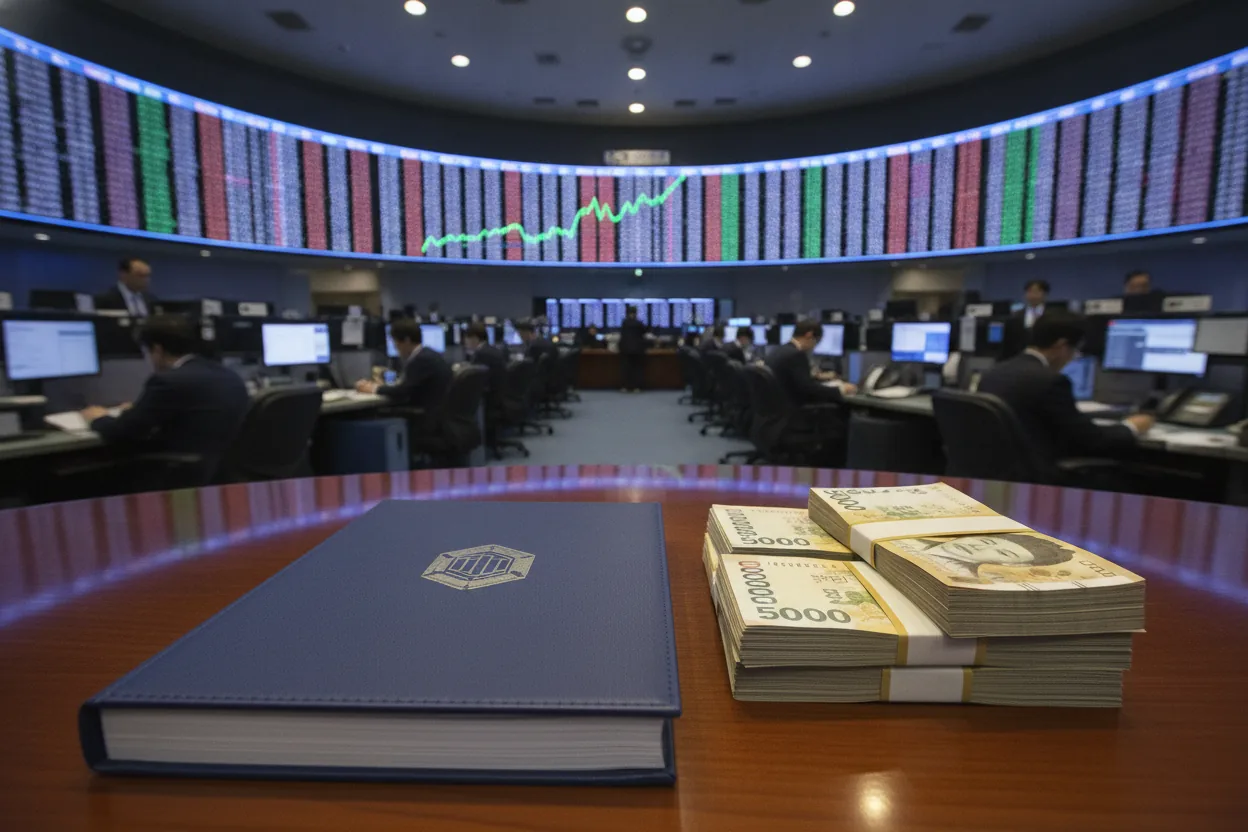
The National Pension Service and Its Outsized Role in KOSPI Stability
Korea's National Pension Service spent the first six months of 2026 as a consistent net seller of KOSPI stocks, threatening to remove the one domestic institutional floor that foreign investors treat as a credible signal of valuation support. For a fund managing over 1,000 trillion won, the world's third-largest pension fund, that sustained selling raised a pointed question: if NPS exits, what anchors Korean equity valuations at all? Now, with pension funds turning net buyers in July at precisely the moment KOSPI suffered a single-session plunge of roughly 7%, severe enough to trigger the sell-side sidecar circuit breaker, international investors need to figure out whether this reversal marks a durable structural re-engagement or a one-month rebalancing blip that leaves Korean equity risk unanchored again.
- NPS manages over 1,000 trillion won across domestic equities, foreign equities, bonds, and alternatives
- Domestic equities sit at roughly 15 to 16% of total NPS portfolio allocation under the current medium-term investment plan
- NPS was a consistent net seller of KOSPI stocks from January through June 2026, which spooked retail and foreign investors who depend on that domestic institutional floor
- Pension funds collectively, NPS plus smaller occupational schemes, represent the single largest category of domestic institutional investors by KOSPI market value held
- KOSPI's 12-month forward price-to-earnings ratio has stayed near historically depressed levels, the kind of range at which NPS historically increases domestic equity exposure under its valuation-sensitive rebalancing rules
The mechanical nature of NPS rebalancing is actually what gives it credibility that discretionary fund buying typically lacks. The fund isn't making a market call. It's following a formula. That's precisely why its return to net buying carries weight for international investors assessing KOSPI downside risk: it signals that domestic institutional support has re-engaged at current index levels, giving investors a concrete reference point for positioning rather than a vague hope that sentiment improves. With KOSPI's forward multiple near multi-year lows and those rebalancing rules firmly in place, NPS's renewed presence is the most reliable domestic anchor KOSPI investors have seen since late 2025. For anyone sizing Korean equity risk, that distinction matters quite a bit.
Pension Funds Turn Net Buyers in July as KOSPI Faces Semiconductor Selling Pressure
That shift from theoretical stabilizer to actual buyer materialized in July 2026. Pension funds became net buyers of KOSPI stocks for the first time this year, according to Yonhap News Agency, ending the six-month selling streak described above. The timing landed in the middle of genuine turbulence: KOSPI dropped roughly 7% in a single session, a move severe enough to activate the sell-side sidecar circuit breaker, which is a fairly rare event signaling that program selling has accelerated past the thresholds normal market conditions produce. Foreign investors were also testing the rally in semiconductor names, and their net selling in that sector piled additional pressure onto a benchmark index that is heavily weighted toward chipmakers. Samsung Electronics and SK Hynix together account for over half of KOSPI market capitalization, so when foreign flows turn negative on semis, the index feels it immediately.
- Pension funds recorded net purchases of KOSPI-listed equities in July 2026, their first monthly net buying position since December 2025
- KOSPI fell roughly 7% in a single session, triggering the sell-side sidecar, a circuit mechanism activated when the futures-to-spot price gap accelerates program selling beyond a defined threshold
- Samsung Electronics and SK Hynix, which together account for over 50% of KOSPI market capitalization, faced renewed foreign selling as semiconductor cycle concerns resurfaced
- NPS, which had drawn real concern from market participants over the possibility of tens of trillions of won in additional selling, reversed course and became a net absorber of shares in July, per Maeil Business Newspaper reporting
- Foreign investors stayed net sellers in the semiconductor segment during this period, with the domestic pension fund bid acting as a partial offset to those outflows
What this creates is a market structure where domestic institutional demand is absorbing supply that would otherwise push index prices lower. The critical question from the outset, whether NPS re-engagement is durable or just a one-month rebalancing artifact, now has a partial answer rooted in the fund's own rules. Because NPS rebalancing is formulaic rather than discretionary, and because KOSPI's forward earnings multiple remains near multi-year lows, the conditions that triggered July buying haven't gone away. That makes the domestic institutional floor more credible than at any point in the first half of 2026. For investors holding or adding to Korean equity exposure, it's a specific and testable basis for reassessing downside risk rather than simply waiting to see whether foreign flows eventually stabilize on their own.