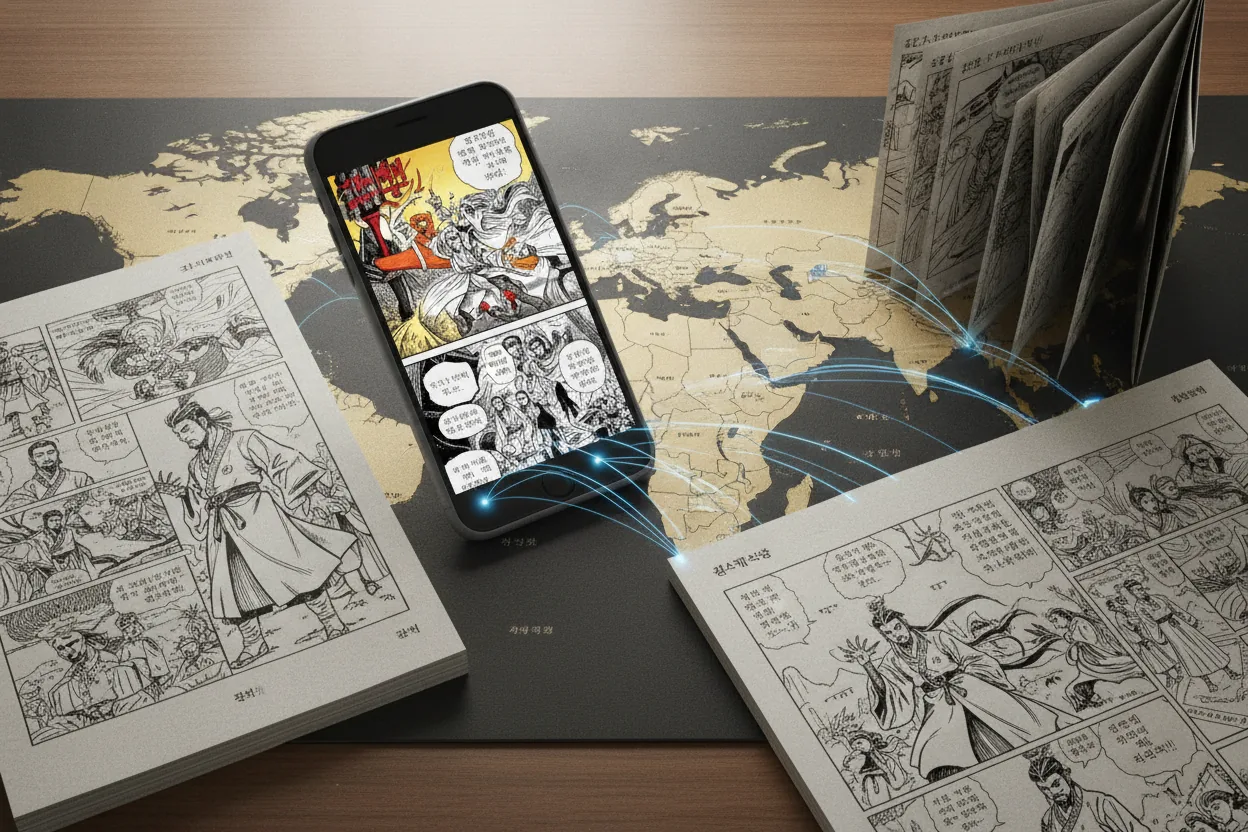
The webtoon industry now reaches markets in more than 100 countries, and no other country operates a comparable content system at that scale. Not Japan, not the United States, not some coalition of both. But that reach was never designed as a cultural export program. It was the accidental output of a mobile-native comics format that matured on smartphones before Western media companies even recognized what was being standardized. The question the industry still hasn't answered is whether the creator economics holding that pipeline together can survive the global ambition built on top of them.
That position is the product of a specific sequence: early mobile internet penetration in Korea, a comics culture that was already massive but undermonetized, and operators who moved fast enough to establish format dominance before Western media companies understood what was being built. The result is a content pipeline that now feeds dramas, films, games, and merchandise with pre-validated story assets. What Korea built is not just a publishing format. It is a global IP origination system with no direct competitor.
The Platform Nobody Else Built
The Korean Webtoon IP Pipeline: From Comic to Global Franchise
The Korean Webtoon IP Pipeline: From Comic to Global Franchise
Source: Article: Korean Webtoons: How One Country Owns Global IP
Source: Article: Korean Webtoons: How One Country Owns Global IP
Naver Webtoon, operating as Webtoon Entertainment in international markets, became a publicly listed company on the Nasdaq in June 2024. That listing mattered beyond the valuation headline. It forced a level of financial disclosure that confirmed what industry observers had been tracking for years: Webtoon Entertainment had accumulated a user base spread across North America, Europe, Southeast Asia, and Latin America at a scale no other webtoon operator had approached. LINE Manga holds strong in Japan, and regional competitors exist across Southeast Asia, but none of them operates with global infrastructure the way Naver Webtoon does. That gap is the structural core of Korea's current content advantage.
Kakao also operates in this space through Kakao Webtoon and the Kakao Entertainment content arm, including its international properties. The domestic Korean market has two major operators competing for creator talent and reader attention, which has kept production volume high and quality standards competitive. What looks like a two-player domestic market is actually the engine room for a global distribution system that only Naver Webtoon currently controls at scale outside Korea.
Why didn't Japan build this first? Japan has the world's largest comics tradition, a global fandom infrastructure built over decades, and the economic weight to fund expansion. The answer sits partly in format. Japanese manga is a print-first medium that digitized reluctantly. Korean webtoon was born vertical scroll, mobile native, and episodic in a way designed for smartphone consumption. By the time the global smartphone market matured, the Korean format fit the screen perfectly. Japan was retrofitting. Korea was already there.
What the Naver Webtoon platform actually produces is a data advantage that compounds over time. Every reader interaction, completion rate, and genre preference logged on a global webtoon operation feeds back into decisions about which IP gets developed next. That is not how traditional publishing works. It is closer to how Netflix makes original programming decisions, except the raw material is cheaper to produce and the global rights are cleaner. Naver wins on infrastructure; every other regional operator wins only on locality.
Why Webtoon Drama Adaptations Keep Winning
Major Webtoon Platform Comparison: Naver, Kakao, and LINE Manga
Major Webtoon Platform Comparison: Naver, Kakao, and LINE Manga
| Dimension | Naver Webtoon | Kakao Webtoon | LINE Manga |
|---|---|---|---|
| Global Reach | 100+ countries | International presence | Japan stronghold |
| Primary Market | North America, Europe, SE Asia, Latin America | Korea, international | Japan |
| Listed on Exchange | Nasdaq (June 2024) | No | No |
| Global Infrastructure | Full scale | Partial | Regional only |
| IP Adaptation Role | Primary pipeline | Active domestic | Limited |
Source: Article: Korean Webtoons: How One Country Owns Global IP
Source: Article: Korean Webtoons: How One Country Owns Global IP
That infrastructure advantage becomes most visible in the adaptation pipeline. Drama adaptations are not incidental to the webtoon story. They are the proof mechanism. When a webtoon title converts into a streaming hit, it validates three things at once: the story concept has cross-format appeal, the audience base was real and transferable, and the IP is worth developing further into games, merchandise, and sequel content. Each successful adaptation raises the perceived value of the entire webtoon catalog sitting behind it.
Consider what the process actually looks like from a production standpoint. A webtoon running on Naver Webtoon or Kakao Webtoon with a large active readership is already a market-tested asset before a single episode is filmed. Reader comments, episode engagement curves, and fan community activity give producers signal about which story arcs land and which characters generate attachment. A drama production team adapting that webtoon is not starting blind. They are working from a creative asset that has already been stress-tested against a live audience, often for years, which removes a specific category of development-stage risk that kills projects before cameras roll.
Several titles have made this conversion visible enough to track as a pattern rather than individual luck. Solo Leveling, originally a webtoon adaptation of a web novel serialized on KakaoPage (and initially on Munpia), became a globally tracked anime and live action project. Itaewon Class, True Beauty, and Yumi's Cells all moved from webtoon page to streaming screen with audience followings already intact. Each of those titles expanded into merchandise and regional licensing after the adaptation amplified its profile. The pattern is consistent enough that Korean drama studios now treat the webtoon catalog as a primary sourcing pipeline, not an occasional option.
Compressing the IP Development Cycle
How Korea Built Global Webtoon Dominance: Key Phases
How Korea Built Global Webtoon Dominance: Key Phases
Approximate timeline of structural shifts
Source: Article: Korean Webtoons: How One Country Owns Global IP
Source: Article: Korean Webtoons: How One Country Owns Global IP
The adaptation advantage is sustained by a development pace that compresses what Western entertainment industries treat as multi-year cycles into something much shorter. A webtoon can launch, build an audience, attract a drama deal, begin production, and reach a global streaming platform inside a timeframe that major Hollywood studios spend just in option negotiations. That compression reflects the structural tightness of the Korean content ecosystem, where Naver Webtoon, Kakao Entertainment, CJ ENM, and Studio Dragon all operate within a relatively small geographic and relational network.
None of those companies operates in isolation. Cross-investment, content licensing, and talent sharing create a system where IP moves fast between formats because the friction between companies is lower than it appears from outside. A webtoon creator signed to Kakao Webtoon is not far, structurally, from a drama production team that Kakao Entertainment can mobilize. Western equivalents of this integration exist, but they tend to be siloed by corporate boundary and union contract in ways that slow the cycle considerably.
There is a counterintuitive pressure built into this system. Because the webtoon-to-drama pipeline is now well understood and commercially proven, the volume of adaptations has increased sharply. More volume means more competition for the top streaming slots, more pressure on production budgets, and eventually a quality distribution problem where a large number of adaptations compete for a fixed amount of audience attention. Korea has been managing this dynamic domestically for several years. The global version of that dynamic is only beginning to play out, and Naver Webtoon will determine which IP surfaces and which gets buried.
The speed advantage is real, but it creates a structural dependency: the system needs a continuous supply of quality original webtoon content to sustain the pipeline. Creator economics, Naver Webtoon fee structures, and the long-tail question of how mid-tier creators get compensated are not minor operational details. They are load-bearing elements of the entire IP machine. A platform that extracts too aggressively from its creator base will find the pipeline thinning at exactly the wrong moment.
What Owning the Global Webtoon Layer Actually Buys Korea
Control of the distribution layer is what makes the creator economics question so consequential. Whoever controls that layer shapes what gets discovered, what accumulates audience, and therefore what becomes valuable enough to develop further. Korea's position as the operator of the only global webtoon platform means Korean IP gets a structural advantage in the discovery phase that no amount of creative talent alone can replicate. A Thai webtoon creator or a Brazilian writer can publish on Naver Webtoon, but the algorithmic and curatorial weight still concentrates where the platform's core competency was built.
The economic stakes extend well beyond content. Webtoon IP that successfully converts into drama, then into global streaming, then into licensed merchandise and games, generates a revenue stack that multiplies the original creator payment by an order of magnitude. Korea's government content agencies have been explicit in tracking this multiplier as a policy target. The Korea Creative Content Agency frames webtoon IP development in terms of national export value, which means Naver Webtoon's infrastructure is being treated as strategic economic infrastructure, not simply as a commercial venture.
The honest tension here is that global scale requires global creator supply to sustain it. Naver Webtoon has been actively recruiting non-Korean creators and localizing its experience across languages for several years. Whether a platform built on Korean content sensibility can genuinely globalize its creative supply chain without diluting the specific aesthetic and narrative qualities that made Korean webtoon IP attractive in the first place remains an open question. Japan's manga industry maintained global influence by staying structurally Japanese. Korea is attempting something different: platform universalism layered over a Korean content core. Naver and Kakao Entertainment benefit most from getting that balance right. Korean creators whose work built the catalog lose most if it tips wrong.
That is the same tension raised at the start: whether the creator economics holding the pipeline together can survive the global ambition built on top of them. The answer will not come from a government press release. It will come from which titles Naver Webtoon surfaces in 2027 and 2028, and whether the creators supplying that catalog are still economically motivated to fill it.
This article is for informational and educational purposes only and does not constitute financial, investment, or legal advice. Views expressed are analytical observations and should not be relied upon for personal financial decisions. Consult a qualified financial advisor before making investment decisions.