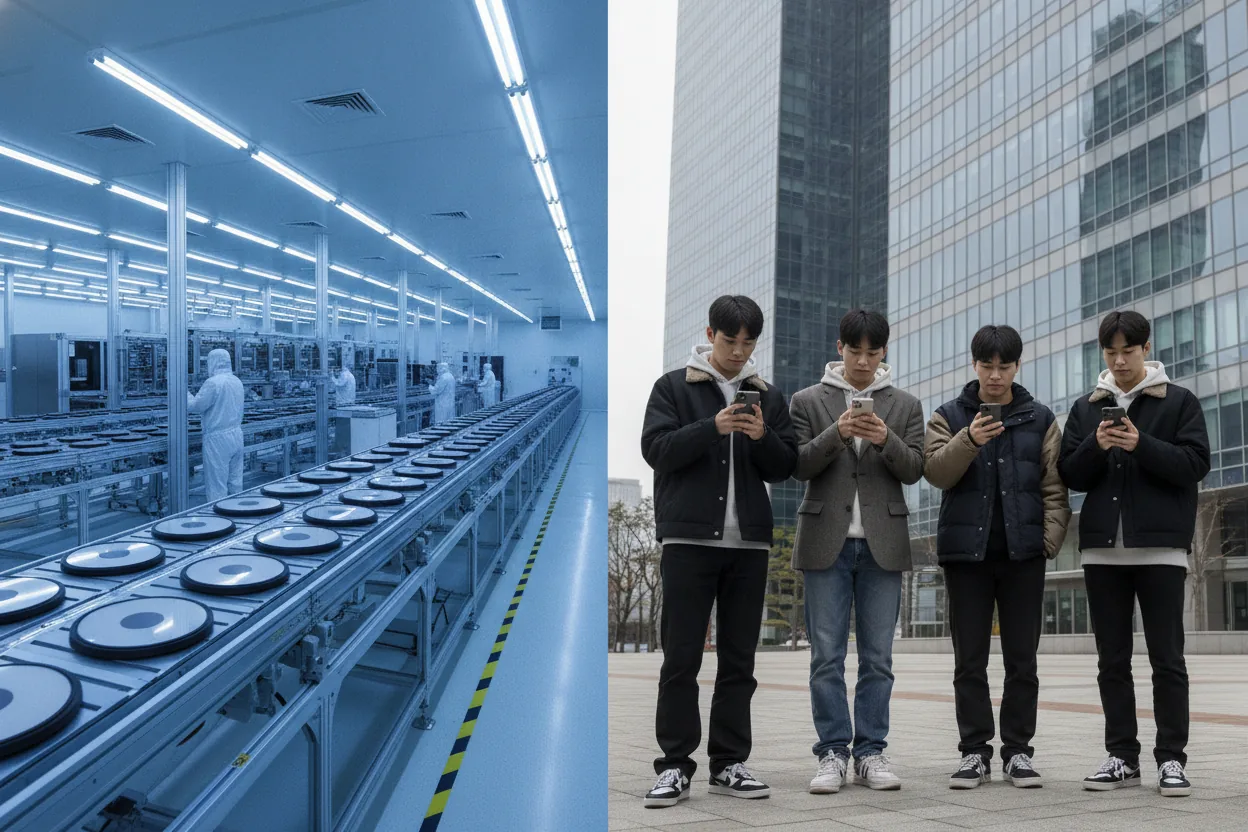
South Korea's Semiconductor-Driven Economy and Its Structural Employment Divide
Samsung Electronics quarterly operating profit collapsed to below 500 billion KRW in 2023, then rebounded above 10.4 trillion KRW by Q2 2026. That's a recovery so violent it has pushed KOSPI near 2,920 and made South Korea's benchmark index look like a broad economic success story. Except youth unemployment is running at 7.5 percent, roughly double the headline rate, and net manufacturing jobs actually shrank by 12,000 positions year-on-year even as semiconductor exports surged 18 percent. So the real question for international investors is whether this is a genuine economic recovery, or a two-stock rally with a structural employment crisis underneath it, one that limits how far and how broadly the KOSPI can actually run.
- Samsung Electronics Q2 2026 operating profit of approximately 10.4 trillion KRW, recovering from the cycle trough in 2023 when quarterly profit fell below 500 billion KRW
- SK Hynix benefiting directly from HBM3E shipments to Nvidia, with HBM now representing over 30% of SK Hynix DRAM revenue
- South Korea total semiconductor export value running at an annualized pace above 130 billion USD entering mid-2026, driven almost entirely by AI memory demand
- Youth unemployment (ages 15 to 29) stuck near 7.5%, approximately double the headline unemployment rate of roughly 3.1%, though figures vary by methodology
- Semiconductor fabs are so capital-intensive that the sector generates surprisingly few direct jobs relative to its contribution to GDP, which is the core tension here
The gap between semiconductor-led GDP expansion and actual youth job creation reflects a concentration risk that KOSPI investors need to price carefully. When a single sector generates headline growth while domestic consumption and services employment stagnate, the equity rally stays narrow. Consumer-facing sectors including retail, food and beverage, and non-tech manufacturing remain under real pressure from weak wage growth. Samsung Electronics and SK Hynix together represent over 50% of KOSPI index weight, which means the market is essentially a semiconductor proxy, not a diversified economic barometer. That structural vulnerability doesn't disappear just because the earnings recovery narrative sounds compelling right now.
South Korea's Q2 2026 GDP Print and Current KOSPI Market Reaction
Statistics Korea released the preliminary Q2 2026 GDP estimate showing quarter-on-quarter growth of 0.6%, matching consensus and reversing the flat 0.1% reading from Q1 2026. The rebound was driven almost entirely by exports, with semiconductor shipments doing the heavy lifting, while private consumption crept up only 0.3% quarter-on-quarter. Household debt pressures and subdued wage growth outside tech kept consumers cautious. KOSPI responded with measured optimism, trading near 2,920 on July 25, 2026, up from approximately 2,870 at the start of the month.
- Q2 2026 GDP growth of 0.6% quarter-on-quarter against the Bank of Korea's full-year 2026 forecast of 1.9%, which still requires a meaningful H2 acceleration to hit
- Semiconductor export volume growth at approximately 18% year-on-year in Q2 2026, per Korea Customs Service data
- Samsung Electronics shares near 75,000 KRW on July 25, 2026, a long way back from the 52-week low near 49,000 KRW hit in late 2024 during the memory oversupply trough
- SK Hynix above 220,000 KRW, near 12-month highs, with continued HBM allocation commitments from Nvidia supporting the stock through the rest of 2026
- Net manufacturing job creation down 12,000 positions year-on-year in June 2026, despite the semiconductor output surge
Foreign investors were net buyers of KOSPI equities in the week ending July 25, purchasing approximately 850 billion KRW on a net basis, concentrated in Samsung Electronics and SK Hynix. That's consistent with the global rotation back into AI supply chain names after strong earnings from US hyperscalers. The Bank of Korea heads into its August policy meeting on a narrow path: the GDP print reduces immediate pressure to cut aggressively, but weak youth employment and subdued consumption give the central bank cover to deliver one additional 25 basis point cut before year-end if inflation stays anchored near 2%. For KOSPI investors, the setup is clear enough. Semiconductor stocks are carrying the market. A broadening into domestic demand names like Hyundai Department Store, BGF Retail, and KT&G requires evidence that wage growth and youth hiring are actually accelerating. The Q2 data has not provided that evidence. Investors who chase the KOSPI headline move without hedging single-sector concentration are taking on semiconductor cycle risk, just with a broad economic recovery label on the tin.