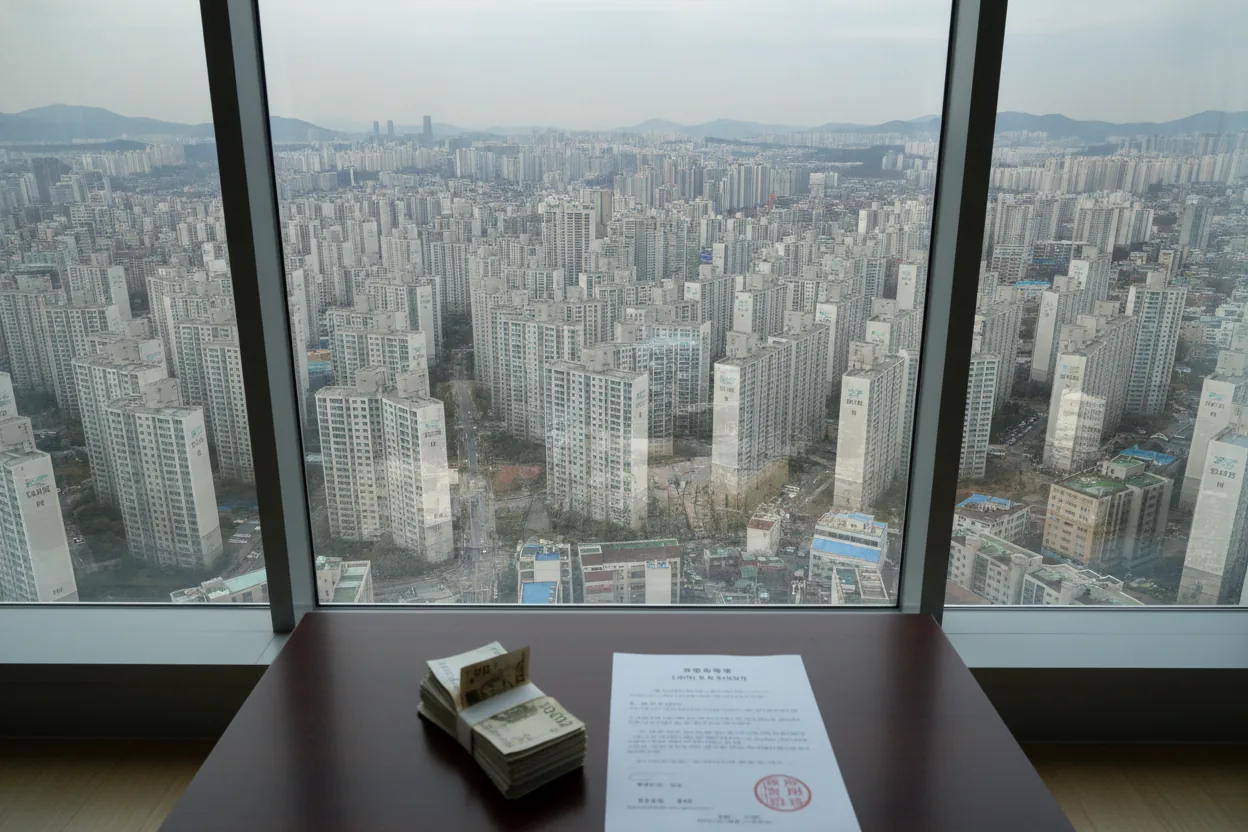
South Korea's Property Market and Its Weight on KOSPI Sentiment
Japan's property bubble lost more than 60% of its value after 1991 and took a full decade of near-zero growth with it. South Korean President Lee Jae-myung is now invoking that collapse by name to justify tightening loan-to-value ratios and capping debt service ratios across Seoul's most expensive districts, where apartments already exceed 2 billion won. The question KOSPI investors have to answer is whether this policy signal marks the start of a managed deceleration that large diversified financials like KB Financial and Shinhan can absorb, or the opening move of a credit tightening cycle that hits construction pre-sales and mid-tier mortgage lenders hard enough to reprice the 15% of index weight sitting in Korean financial stocks.
- KB Financial Group carries a mortgage loan book that some analysts estimate exceeds 100 trillion Korean won, positioning it among the largest residential lenders in the country
- Seoul apartment prices rose roughly 10% year-on-year through the first half of 2025, then started showing signs of deceleration in late 2025 and into early 2026
- The Bank of Korea raised its base rate by 25 basis points to 2.75% at its July 2026 meeting, the first hike since January 2023
- Construction and real estate together represent approximately 8% of KOSPI market capitalization, with GS Engineering and Construction and Hyundai Engineering and Construction among the most rate-sensitive names in that group
- Korea's jeonse system, a lump-sum deposit rental arrangement unique to South Korea, creates leveraged exposure to property values for millions of households that have very little equity buffer to absorb a correction
The structural link between property prices, household debt, and bank credit quality means any government signal on real estate carries immediate market implications well beyond the construction sector. KOSPI financial stocks, accounting for over 15% of index weight, respond directly to shifts in property regulation, loan-to-value adjustments, and debt service ratio caps set by the Financial Services Commission. For international investors benchmarking against the MSCI Korea index, understanding this property-finance nexus is basically a prerequisite for reading Korean equity direction. Large diversified financials with fee income buffers hold a real structural advantage over mortgage-concentrated regional lenders when policy tightening cycles begin, and the current trajectory favors exactly that positioning.
President Lee's Japan Warning and What It Means for Korean Policy Now
President Lee Jae-myung has publicly invoked Japan's catastrophic 1990s property collapse as justification for intervening in South Korea's real estate market, and that framing carries direct KOSPI consequences for construction and financial stocks. Japan's land price bubble peaked around 1991, then lost more than 60% of its value over the following decade, wiping out bank capital, suppressing consumption, and delivering what became known as the Lost Decade of near-zero growth. Lee is drawing a straight line to current conditions in South Korea, arguing that without coordinated action to cool speculative demand and expand housing supply, Korea risks a comparable structural correction with lasting macroeconomic damage. That's not rhetorical flourish. That's a policy brief.
- Lee's administration has signaled tighter loan-to-value ratios in high-price districts, specifically targeting Seoul's Gangnam, Seocho, and Songpa zones where average apartment prices exceed 2 billion won
- A proposed public housing expansion under a government-backed build program targets 300,000 new units over five years, drawing on Land and Housing Corporation balance sheet capacity
- The Financial Services Commission is reviewing further reductions to the Debt Service Ratio cap, currently set at 40% for high-debt borrowers in regulated zones, with a potential tightening to 35% under active discussion
- KOSPI-listed construction names including Hyundai Engineering and Construction and DL E&C saw share price pressure in July 2026 as policy tightening expectations weighed on pre-sale project pipelines
- KB Financial Group and Shinhan Financial Group face margin compression risk if tighter DSR rules reduce mortgage origination volumes, which had already slowed from their 2025 peaks
When a sitting Korean president frames domestic property risk in terms of Japan's Lost Decade, it tells the Financial Services Commission, the Bank of Korea, and state-run lenders that the administration is prepared to absorb short-term economic pain to prevent something larger. The Japan comparison is a deliberate rhetorical device, and it carries real policy weight. The immediate KOSPI read is negative for construction developers and mid-tier regional banks with concentrated mortgage exposure, while large-cap financials with diversified fee income, including Samsung Securities and Mirae Asset Financial Group, are relatively better placed to absorb a mortgage volume slowdown.
The deeper strategic question is whether Lee's supply-side push, specifically that 300,000-unit public housing target, can actually be executed quickly enough to matter. Korea Land and Housing Corporation already carries substantial debt from prior build programs, and fiscal constraints limit how aggressively the government can subsidize new supply without getting bond market pushback. If supply expansion lags while demand controls tighten simultaneously, the more likely near-term outcome is a controlled price deceleration rather than a crash. That is precisely the scenario the opening question asks investors to resolve. The managed deceleration path is one Korean bank stocks can absorb without severe credit loss provisioning, because the large diversified financial conglomerate has fee income to offset mortgage compression. The clear loser in that scenario is the mid-sized construction firm whose entire revenue model depends on pre-sale apartment launches in regulated Seoul zones. There's no fee income cushion there. Just pipeline.