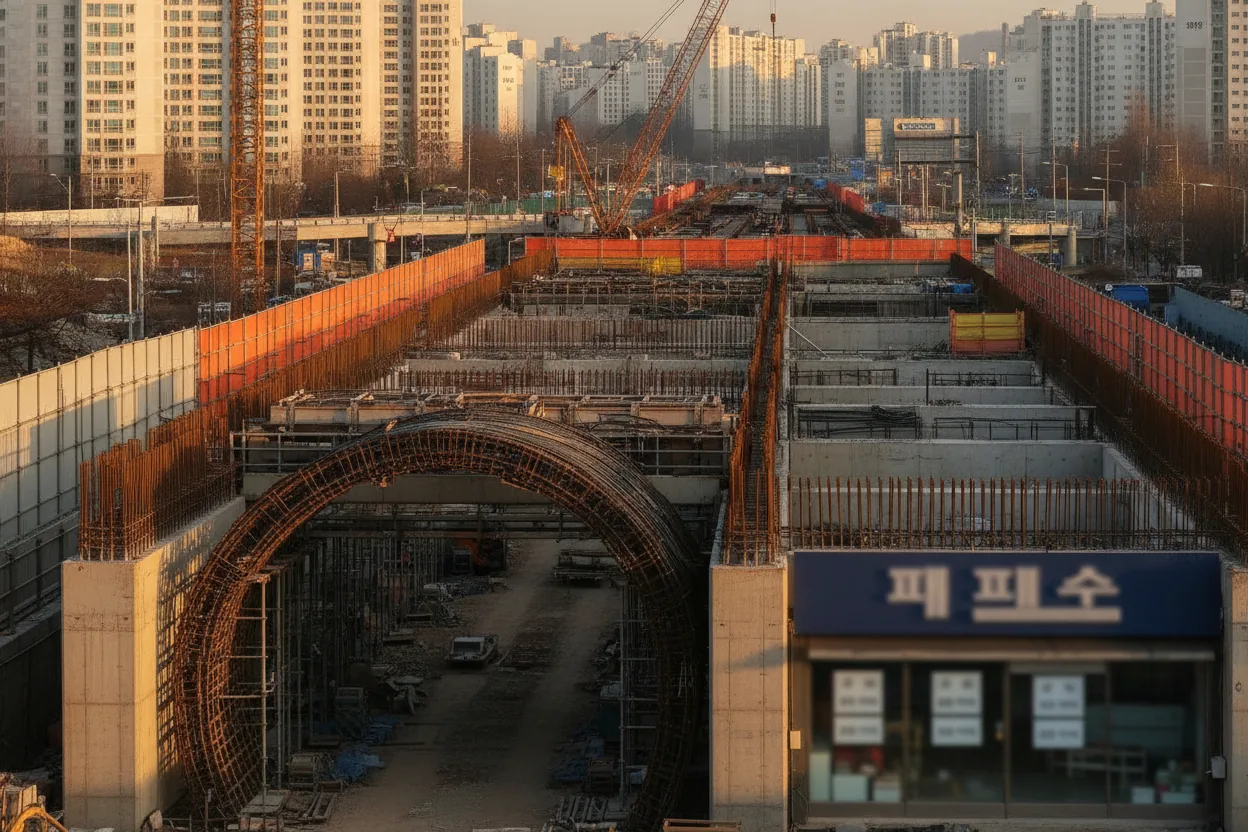
Most coverage of GTX C frames it as an 86.46 kilometer commuter story, a straight line built to cut a 70 to 80 minute slog from Uijeongbu to Gangnam down to 20 minutes. What that framing misses is what happened before a single tunnel was dug: land registries and price listings near the route started moving the moment the groundbreaking photo op ended, a pattern Korean agents already have a name for. A line designed to make Seoul more affordable by letting workers live farther out is, in its early years, doing the opposite near every station it touches. So who is this railway actually built for: the commuter, or the landowner who never has to board a train?
Here's my take. GTX C will genuinely cut commute times across one of the most congested metro regions on earth. It will also hand a windfall to landowners who did nothing but wait near a dotted line on a government map. Both things are true at once, and Korea's infrastructure economy runs on the tension between them. The rest of this piece works through how that tension plays out, station by station and phase by phase.
What Do Commuters Actually Expect From GTX C?
Uijeongbu to Gangnam: Commute Time Before and After GTX C
Current Commute
70 to 80 min
Bus and subway, average 30 to 40 km/h
GTX C at Full Speed
~20 min
Trains designed for ~180 km/h
86.46 km route, Deokjeong to Suwon/Pyeongtaek, through Sangbong, Cheongnyangni, Samseong, Gangnam
Source: Source: Article estimates based on planned GTX C service
Ask a commuter in Uijeongbu what GTX C means and the answer is almost always time. The line connects Deokjeong in the north to Suwon and eventually Pyeongtaek in the south, running through central Seoul stations including Sangbong, Cheongnyangni, Samseong, and Gangnam. Planners have cited travel times that would cut a current 70 to 80 minute bus and subway commute from Uijeongbu to Gangnam down to somewhere near 20 minutes once the line reaches full speed, since GTX trains are designed to run near 180 kilometers per hour, well above the Seoul subway's typical 30 to 40 kilometer per hour average.
That's the assumption most riders carry into this project: a clean number, a fixed date, a promise that finally holds. The record suggests otherwise. GTX A, the first line in this network, opened partial service years behind its original schedule, and early ridership came in below initial projections. Construction on GTX C is generally reported to have begun around the mid 2020s, with completion widely expected sometime in the following decade, though rail megaprojects in Korea have a documented tendency to slip. GTX A itself was first proposed in 2011, broke ground in 2018, and only began partial commercial service in 2024, more than a decade after the initial announcement.
The commuter case for GTX C is real but conditional. It depends on a construction timeline holding across multiple contractors, multiple local governments, and a tunnel route running beneath some of the most expensive and most litigious real estate in the country. Seoul residents have watched enough infrastructure promises stretch from five year plans into twelve year realities that skepticism has become the rational baseline, not the cynical one.
That gap between promised timeline and delivered timeline is exactly what the property market has learned to price around. So what happens to land along a route that takes years to fully deliver on its promise?
Land Prices Are Already Moving Before The Trains Do
GTX A: From Proposal to Partial Service, a 13 Year Timeline
2011
Line first proposed
2018
Groundbreaking
2024
Partial service begins
Total elapsed: 13 years, from announcement to riders on the platform
Source: Source: Article reporting on GTX A project history
Common assumption holds that property near a future station stays flat until the line actually opens, since there is nothing yet to ride. Korean property data tells a different story. When GTX A's route was confirmed, apartment complexes near Dongtan and Yongin saw price appreciation that outpaced the broader Gyeonggi province market by a wide margin in the years between announcement and construction, long before anyone could board a train. A similar pattern is now visible around GTX C stations, where listings near Sangbong, Deokjeong, and Uijeongbu have shown renewed buyer interest since construction began this year.
This isn't speculation in the pejorative sense. It's a rational response to a documented mechanism. Korean transit announcements function as forward guidance for real estate, similar to how a central bank rate signal moves bond yields before the actual policy change happens. Buyers aren't pricing in the train. They're pricing in the certainty that other buyers will also price in the train a year or two from now, once construction visibly progresses past the groundbreaking photo op stage.
Government reaction to this pattern has been reactive rather than preventive. Regulators have periodically imposed speculation zone designations and tightened mortgage lending near new transit corridors specifically to slow this kind of anticipatory buying, a tacit admission that the mechanism is well understood and hard to stop. Land near confirmed but unbuilt infrastructure has become one of the more reliable asset classes in Korean household portfolios, reliable in the sense that the pattern has repeated across GTX A, GTX B, and now GTX C with enough consistency that agents can nearly quote the appreciation curve by station distance.
That curve doesn't move evenly for everyone standing near it. Who actually benefits, and who gets priced out before the shovel even hits the ground?
Faster Commutes Bring Deeper Inequality
GTX C Key Figures at a Glance
| Metric | GTX C | Seoul Subway |
|---|---|---|
| Total route length | 86.46 km | Varies by line |
| Design speed | ~180 km/h | 30 to 40 km/h |
| Uijeongbu to Gangnam time | ~20 min | 70 to 80 min |
| Northern to southern terminus | Deokjeong to Suwon, extending to Pyeongtaek | |
Source: Source: Article details on GTX C route and speed specifications
The intuitive answer is that faster rail flattens the map. If a worker in Pyeongtaek can reach Gangnam in under an hour, geography stops being destiny, and the wage premium of living inside Seoul proper should shrink. That's the policy narrative used to justify GTX funding, framed around decentralizing the capital region and easing housing pressure inside Seoul's expensive core.
The actual data complicates that story. Rather than flattening the map, transit lines in Korea have historically concentrated value at the node points, meaning the stations themselves, while leaving the space between stations largely untouched. A worker living a fifteen minute bus ride from a GTX C station does not capture the same commute time savings or the same property appreciation as someone living within walking distance of the station entrance. The line doesn't spread opportunity across a region. It creates a small number of extremely valuable dots on a map and leaves everything else roughly where it was.
Sit with this for a second, because it's a strange outcome. GTX C is funded partly as an affordability solution, a way to let Seoul workers live farther out where housing is cheaper. But the moment the line's route was confirmed, housing near its stations became measurably less affordable, because everyone understood the same commute math at the same time. The tool built to ease the housing pressure problem becomes, in its early years, an accelerant for it, concentrated in a tight radius around each station.
Renters and lower income buyers in the affected districts often end up displaced by the very project marketed as their commuting relief. Local governments along the route have discussed public housing allocations near new stations specifically to counter this effect, an acknowledgment that the market alone won't distribute the benefit the way the original policy pitch suggested.
Public housing near stations treats the symptom. Does the fix lie there, or is the deeper issue that Korea keeps building single mega corridors into one city instead of building density outward?
Compressed Rail Growth, Uncompressed Costs
Korea's rail expansion mirrors the same compressed development pattern that shows up everywhere else in the country's modern economy. Just as Samsung went from transistor radios to global semiconductor dominance inside a few decades, Seoul's transit network is trying to leap from a car dependent, subway heavy metro area into a European style high speed regional rail system inside roughly fifteen years, spanning GTX A, B, and C combined. Compression creates speed. It also creates strain, and both show up in how these projects get built.
Contractors on GTX projects have cited underground utility conflicts, groundwater management issues near the Han River crossings, and disputes with local residents over construction noise and property value concerns as recurring sources of delay. None of these problems are unique to Korea, but the density of Seoul's underground infrastructure, stacked subway lines, utility tunnels, and building foundations packed into a relatively small urban footprint, makes tunneling here structurally harder than in most comparable capital regions. GTX C runs directly beneath some of the priciest square footage on the peninsula, which means every meter of tunnel carries not just engineering risk but legal risk from property owners disputing construction impact.
There's also a financing layer worth watching. GTX projects blend public funding with private capital participation, a structure meant to speed up delivery by bringing in construction consortiums and infrastructure funds rather than relying purely on government budgets. This model has worked reasonably well for accelerating construction starts, but it also means the return expectations of private capital partners shape project priorities, sometimes favoring commercially dense stations over less profitable but socially useful ones.
The honest read on GTX C right now, in the final months of 2026, is that it's a genuinely useful piece of infrastructure wrapped inside a familiar Korean pattern: announce something transformative, watch capital move faster than concrete, then spend years reconciling the gap between the map that was promised and the timeline that actually gets delivered. That gap is also the answer to the question this piece opened with. The railway is being built for the commuter, eventually, but it's being paid for first by the landowner who bought the dotted line before the concrete existed. The trains will eventually run. The open question is whether anyone still living near the stations by then can afford to ride them.
This article is for informational and educational purposes only and does not constitute financial, investment, or legal advice. Views expressed are analytical observations and should not be relied upon for personal financial decisions. Consult a qualified financial advisor before making investment decisions.