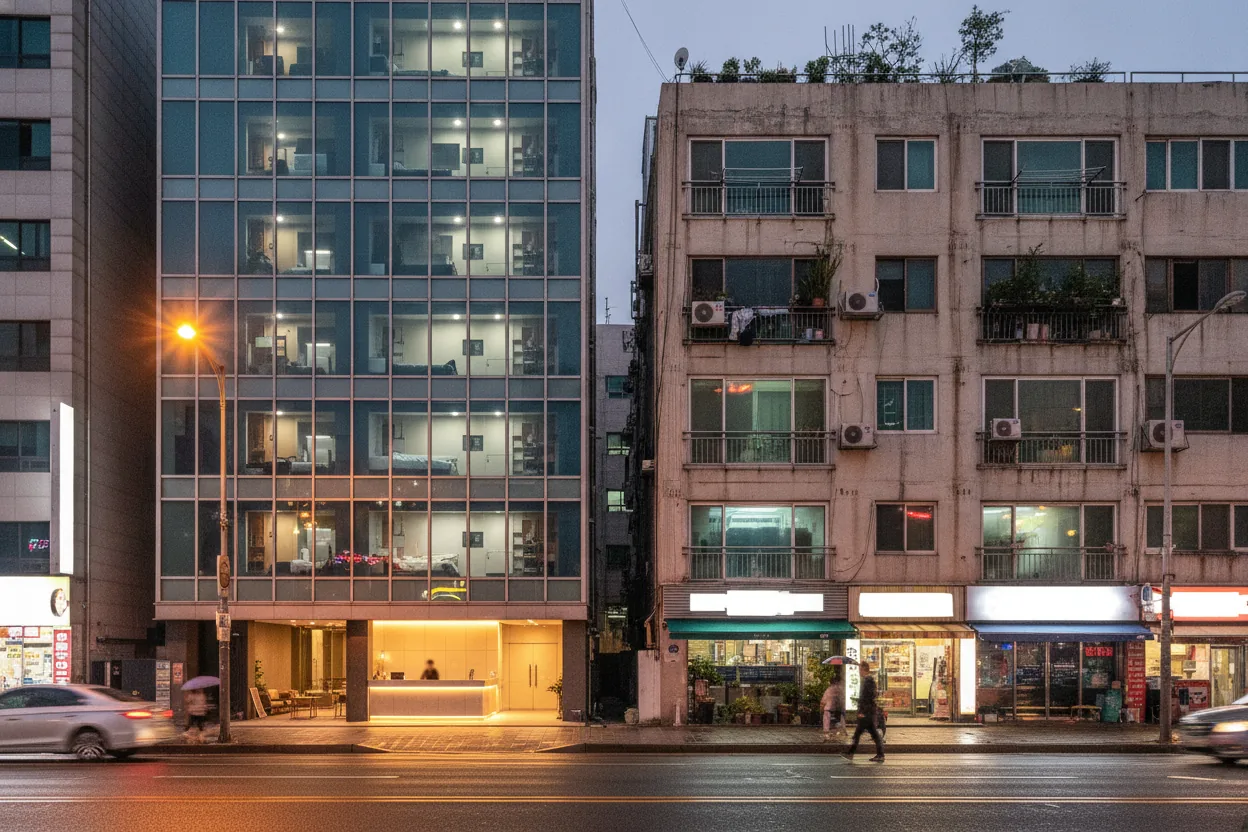
₩1,200,000 a month in Gangnam buys a furnished officetel studio with a front desk that signs for packages. The same money one block over, in an apartment, buys more square meters and a landlord who probably won't rent to a foreigner at all. Same budget, one block apart, completely different outcome. That gap traces back to a zoning quirk: officetels got classified as commercial buildings with residential features, a label that was never supposed to turn into default housing policy. Decades later, that administrative accident is quietly running a huge share of how Seoul's single-person population lives.
An officetel isn't an apartment, and it isn't an office either. It's a legal category invented to dodge both sets of rules, and that origin story explains almost everything confusing about how the product behaves today. Koreans didn't sit down and design a hybrid living arrangement because they wanted one. Zoning law left a gap wide enough to build an entire asset class inside, and someone built it.
A Decades-Old Zoning Decision Still Governs How Officetels Operate
How The Officetel Category Was Born
Source: Based on article narrative, 1988 Seoul zoning policy
Officetel is a contraction of office and hotel, coined around the late 1980s when Seoul hit a specific regulatory bottleneck. Commercial zones allowed office towers. Residential zones allowed apartments. Developers wanted a third option, something that could sit on cheaper, faster-to-build commercial land while still functioning as a place someone could actually sleep in every night.
So regulators classified the officetel as a commercial building with residential features, not a residential building. That one decision determined everything downstream: how it gets taxed, how it gets financed, how many units a developer can cram onto a lot, and how little protection a tenant has compared to someone renting a standard apartment under Korea's Housing Lease Protection Act.
Decades later, that loophole is the load-bearing wall of a huge segment of Seoul's rental supply. Officetels cluster exactly where you'd expect: Gangnam, Yeoksam, Hongdae, Sinchon, areas near business districts or university campuses where land is zoned commercial and demand never really lets up. A structure built to patch an old zoning problem is now the default landing pad for Seoul's floating population of single professionals, remote workers, and short-term residents.
That explains why the officetel exists at all. The next question is what it actually costs to live in one compared to the alternative.
Officetel Rent Runs Higher, But The Math Still Works Out
Officetel vs Apartment: Who Fits Which Rental System
| Feature | Officetel | Apartment |
|---|---|---|
| Zoning Status | Commercial, residential features | Residential |
| Monthly Rent | Higher, visible premium | Lower, for similar size |
| Furnishing | Furnished, bed, washer, induction stove | Usually bare shell |
| Deposit System | Monthly rent, smaller deposit | Jeonse, lump sum in hundreds of millions won |
| Tenant Protection | Less protection under lease law | Covered by Housing Lease Protection Act |
Source: Based on article narrative comparison of Seoul rental norms
A side-by-side comparison in Gangnam tells the story cleanly. A similarly sized officetel rents for noticeably more per month than a comparable apartment nearby. In Hongdae the gap holds the same shape, officetels commanding a visible premium. That premium shifts by building and season, but it shows up consistently for what looks, on paper, like identical square footage.
The premium isn't irrational. It's a fee for not having to furnish anything yourself. Officetels in Seoul are overwhelmingly rented furnished, bed, washing machine, induction stove, sometimes a dishwasher, because the building type was built around turnover, not permanence. A standard Korean apartment often arrives as a bare shell, which means the tenant buys appliances they'll later have to resell or dump when the lease ends. For someone staying eight months on a visa or a short contract, that math flips the premium into a discount.
Then there's the deposit structure. Korea's dominant rental system, jeonse, demands a lump sum that can run into the hundreds of millions of won, a system built around tenants who plan to stay for years and have serious capital or bank financing behind them. Officetels lean toward monthly rent with smaller deposits, closer to what a renter in London or Singapore would recognize. That's exactly why foreign residents and freelancers gravitate toward them even at a higher sticker price. The premium buys predictability in a system otherwise built around long horizons.
That same preference for smaller deposits and flexible terms is what pulls foreign residents toward officetels in the first place. The next question is how easily a foreign national can actually sign that lease.
Foreigners Can Legally Rent An Officetel, But The Process Still Bites
Where The Officetel Premium Goes
Source: Based on article narrative on cost tradeoffs
Nothing in Korean law bars a foreign national from signing an officetel lease. The friction shows up elsewhere: an Alien Registration Card, proof of income or a bank balance, sometimes a Korean guarantor, and a landlord who'd rather not deal with the paperwork of a foreign tenant at all. Nobody writes this filtering into law. It's a pattern property agents will admit to once you ask the second time, not the first.
What makes officetels specifically attractive to this crowd is the growing fleet of managed and short-term rental operators who've built entire businesses around removing that friction. Local platforms like Zigbang and Dabang have expanded into furnished, officetel-style stays, some listings offering English-language leasing, flexible contract lengths, and digital payment, though it varies by listing and operator. These offerings have grown steadily across Seoul's business districts over the past several years, because demand from remote workers, consultants on rotation, and graduate students turned out to be consistent enough to build a product around.
The three-to-twelve-month lease, once a strange request that confused Korean landlords used to one or two year jeonse cycles, is now standard inside officetel buildings specifically. That shift matters: the officetel has quietly become Korea's answer to the global rise of location-independent work, built not through policy design but through an old tax classification nobody expected to still matter decades later.
Platforms and shorter leases solved the access problem for individual renters. The bigger question is why there was enough demand to build an entire industry around solving it.
Single Person Households Explain Why This Building Type Won
Officetels didn't succeed because Seoul lacked housing. They succeeded because Seoul's household makeup changed faster than its housing stock did. Single-person households now make up a large and growing share of all households nationally, while most residential zoning was still built around an assumption of three-generation homes.
A 25 square meter officetel with a built-in kitchenette is a bad fit for a family of four. It's close to perfect for a 29-year-old contract worker at a Pangyo tech firm who eats most meals out, works late, and wants a washing machine without having to negotiate with a landlord about who installs it. Korea's housing stock was built around the first group. Its birth rate and marriage age trends have been pushing the population toward the second group for over a decade.
This is where the officetel story connects to a bigger structural pattern running through the Korean economy. The same demographic compression that produced one of the world's lowest fertility rates also produced a steady, dependable tenant base for a commercial zoning loophole dating back decades. Nobody planned it this way. The officetel just happened to be sitting in the right legal shape when the demographic wave hit.
That steady tenant base also pulled in a second group: investors buying units not to live in, but to rent out. Their experience hasn't followed the same trajectory as the tenants'.
Officetel Oversupply Is Becoming The Investor's Quiet Problem
For Korean investors, officetels have long been sold as a passive income product, the kind of asset a mid-career professional buys as a second property to collect monthly rent against a bank loan. The pitch is simple: buy a unit near a subway station or a university, rent it to a single tenant, collect steady cash flow. For years that pitch worked well enough to keep officetel supply expanding across Seoul and satellite cities like Suwon and Incheon.
The quiet problem is oversupply in exactly the areas where the pitch sounds best. When every developer hears the same story about guaranteed rental yield near a subway line, every developer builds there. Officetel vacancy rates in some secondary business districts have crept upward as a result, worth watching through local listings and vacancy data over time. Rental yields on officetels, once reliably higher than apartment yields thanks to the monthly rent structure, have been compressing in several districts as supply caught up with the tenant pool.
None of this threatens the officetel as a living arrangement for renters. It changes the math for the person on the other side of the lease, the small investor who bought the unit expecting a fixed income stream and now competes with a new tower finished the same year on the same block. The building type that solved a tenant's problem decades ago has started generating a landlord's problem years later. The zoning accident that gave Seoul's single-person households an affordable, flexible place to live is the same accident now eating into the returns of the people who built that supply, and neither outcome was anywhere near the original intent of the rule that started it all.
This article is for informational and educational purposes only and does not constitute financial, investment, or legal advice. Views expressed are analytical observations and should not be relied upon for personal financial decisions. Consult a qualified financial advisor before making investment decisions.