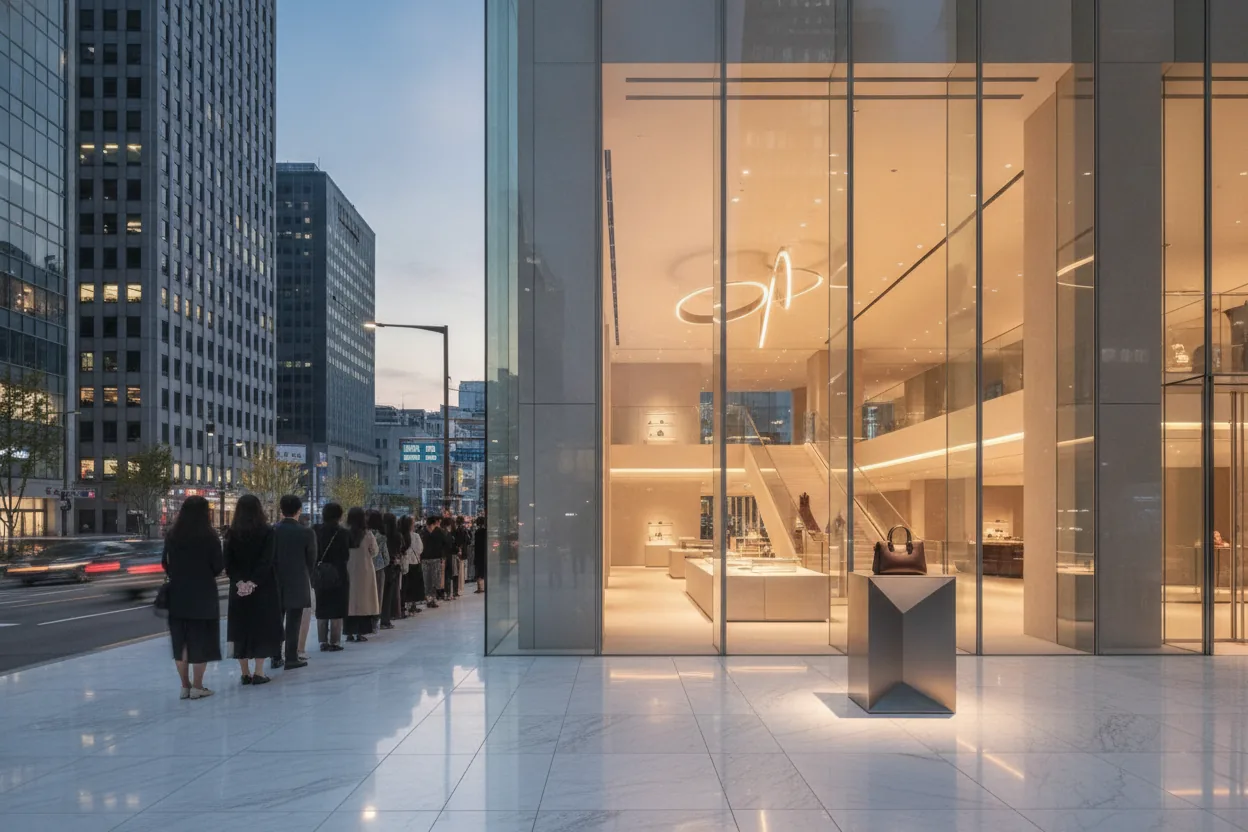
Shoppers once lined up outside Chanel in Gangnam before store opening just to buy a bag ahead of the next price hike, days before the previous one. People racing a markup instead of a trend. That was Korea's luxury market operating like a commodity exchange rather than a retail sector. Now the forecast through 2034 puts annual growth at 2.49 percent, a number that looks like a slowdown next to the 20 percent years but means something else entirely once you dig into it. So what does a market built on scarcity and panic buying turn into once the panic runs out?
The market was valued at 4.93 billion dollars in 2025 and is projected to reach 6.23 billion dollars by 2034. That's real growth, just not the explosive kind. Korea's luxury fashion sector is moving from a demand shock economy, built on scarcity, flex culture, and pent up pandemic spending, into a mature retail market that behaves more like Japan or France than the breakout story it was between 2020 and 2023. The headline number isn't the interesting part, though. The mechanics underneath it are, and that starts with how the boom actually ran out of fuel.
Why Did Korea's Luxury Boom Run Out Of Fuel?
Korea Luxury Fashion Market: Size and Forecast
2025 Market Value
$4.93B
2034 Projected Value
$6.23B
Projected Annual Growth Rate (2025 to 2034)
2.49%
For comparison, Seoul department store luxury sales grew
20%+ per year (2021 to 2022)
Source: Source: Article data, market forecast through 2034
Rewind to 2021 and 2022. Seoul department stores like Shinsegae in Gangnam and Lotte in Jamsil were posting luxury sales growth north of 20 percent year over year, strong enough that Paris headquarters took notice. Chanel, Hermes, and Louis Vuitton raised prices in Korea multiple times a year, sometimes announcing increases days apart, and shoppers lined up before store opening just to secure a bag before the next markup. That's not normal luxury retail behavior. That's a market where price itself becomes the incentive to buy immediately, instead of a reason to wait.
That dynamic was never going to compound forever. International travel reopened. Koreans who'd been locked out of Paris, Tokyo, and Hong Kong for two years went back to buying luxury goods abroad, where prices stayed lower even after Korean markups were factored in. Won weakness against the dollar and euro made overseas luxury shopping less attractive than it used to be, but it didn't erase the arbitrage. Domestic luxury spending growth decelerated sharply starting in 2023, even as absolute market size kept climbing.
There's also a demographic ceiling nobody likes to talk about openly. Korea's core luxury consuming cohort, roughly the younger professional and middle aged population, is shrinking in absolute terms as part of the birth rate decline that shapes so much of this economy's structural story. Fewer young professionals means a smaller pool of aspirational buyers entering the market each year, even as per capita spending among existing wealthy consumers holds firm. A market can mature because consumers get pickier, or it can mature because there are fewer consumers left to buy anything. Korea's luxury sector is living through both at once, and that's how a market worth 4.93 billion dollars in 2025 ends up projected to grow at only 2.49 percent a year through 2034.
Is K Culture Still Doing The Heavy Lifting?
Korea Luxury Growth: From Boom to Maturity
22%
2021 to 2022
Deceleration
2023
Slower growth
2024
$4.93B base
2025
2.49%/yr
2025 to 2034
Growth shifts from panic driven price spikes to steady, mature expansion.
Source: Source: Article narrative on domestic luxury spending growth trajectory
The demand shock faded and the consumer base is shrinking, but Korea's luxury market still has one asset the boom years built: global cultural reach through K pop and K drama. That asset is still structurally important to how luxury brands operate in Korea, but what it actually does has changed. Back in the early to late 2010s, Korean celebrity endorsement was a demand creation tool, introducing brands to audiences with little prior exposure to European luxury houses. Now that same mechanism works more as retention and brand equity. Louis Vuitton staged its first ever Pre Fall womenswear runway show in Seoul in April 2023, on the Jamsugyo Bridge over the Han River, with Jisoo and other Korean stars in the front row. That wasn't really aimed at Korean buyers. It was aimed at the hundreds of millions of fans across Southeast Asia, China, and the Americas watching the livestream, and the clips that kept circulating for weeks afterward.
This matters because it changes what Korean flagship stores actually are. Seoul's luxury boutiques, concentrated in Cheongdam, Hannam, and the Shinsegae and Lotte department store corridors, increasingly function as content production sets as much as retail locations. Dior's Seongsu pop up, Gucci's House of Gucci exhibitions, Bottega Veneta's rotating Seoul installations: all built with Instagram and short form video in mind first, foot traffic revenue second. The commercial logic runs sideways rather than straight down. A viral livestream from Seoul drives brand searches and purchases in Jakarta, Bangkok, and Ho Chi Minh City far more than it drives incremental sales inside the store where the event actually happened.
Inbound tourism recovery adds another layer. Chinese tourist volume to Korea is still climbing back toward pre 2020 levels, but demand patterns have diversified along the way. Southeast Asian and Japanese visitors, plus a steady base of Chinese daigou resellers working through Xiaohongshu, now account for a meaningful share of duty free and department store luxury revenue in Seoul and Jeju. Korean brands aren't just selling to Koreans inside their own borders anymore. The store is domestic. The customer increasingly isn't. That gap, between where the store sits and where the customer actually comes from, is also where capital is moving now.
Where Is The Smart Money Actually Flowing?
Boom Era vs Mature Market: What Changed
| Factor | Boom Era (2020 to 2023) | Mature Market (2025 onward) |
|---|---|---|
| Buyer behavior | Panic buying ahead of price hikes | Deliberate, steady purchasing |
| Sales growth | 20%+ year over year | 2.49% annually through 2034 |
| Travel access | Borders closed, demand trapped domestically | Open borders, buyers shop abroad |
| K culture role | Demand creation, new audience exposure | Retention and brand equity tool |
| Buyer pool | Growing aspirational consumer base | Shrinking due to demographic decline |
Source: Source: Article analysis of Korea luxury market dynamics
If headline growth is slowing, where is capital still concentrating inside a market capped at 2.49 percent? Not flagship stores. Infrastructure: authentication, resale, and the recommendation systems built for a Korean consumer who's become unusually sharp about provenance and pricing.
Korean resale and authentication companies have grown into a genuinely distinct category, not a secondhand afterthought. Soldout, Crezu, and Balaan built authentication heavy marketplaces because Korean consumers, burned by counterfeit scandals and inconsistent gray market imports for years, demanded third party verification before resale could ever scale. It's a distinctly Korean solution to a distinctly Korean trust problem. When consumers don't trust sellers by default, someone builds infrastructure to manufacture that trust mechanically, right down to physical ink stamps and digital certificates attached to individual items.
AI powered personalization is the second concentration point. SSG.com's luxury vertical and Musinsa's premium expansion are pouring money into recommendation engines that treat luxury shoppers less like mass market consumers and more like private banking clients, surfacing inventory based on purchase history, body measurements, even regional pricing differences across Seoul boutiques. The goal is retention economics in a market where new customer growth is structurally capped by the demographic decline described above. Brands can't grow the pie fast through population anymore, so they squeeze more lifetime value out of the customers they already have.
Sustainability and traceable supply chain investment is the quieter third category, and probably the one with the least proven payoff so far. European houses operating in Korea face more pressure than in most Asian markets to show ethical sourcing, partly because Korean consumers under 35 research brand practices more actively before expensive purchases than previous generations did. Whether that actually shows up in purchase decisions or just stays confined to social media commentary is still an open question. What's not in question is the capital shift itself: money that once went entirely into store expansion now splits three ways, toward authentication, personalization, and traceability, inside a market growing at barely a quarter of its old pace.
That shift answers something the panic buying years never had to deal with. When shoppers were lining up outside Chanel to beat a price hike, nobody needed to build authentication platforms, recommendation engines, or supply chain audits, because demand took care of itself. At 2.49 percent annual growth, it doesn't anymore. Korea's luxury market isn't shrinking and it isn't collapsing. It's converting from a market that ran on scarcity and panic into one that has to run on trust, retention, and proof. Slower business. More durable one.
This article is for informational and educational purposes only and does not constitute financial, investment, or legal advice. Views expressed are analytical observations and should not be relied upon for personal financial decisions. Consult a qualified financial advisor before making investment decisions.