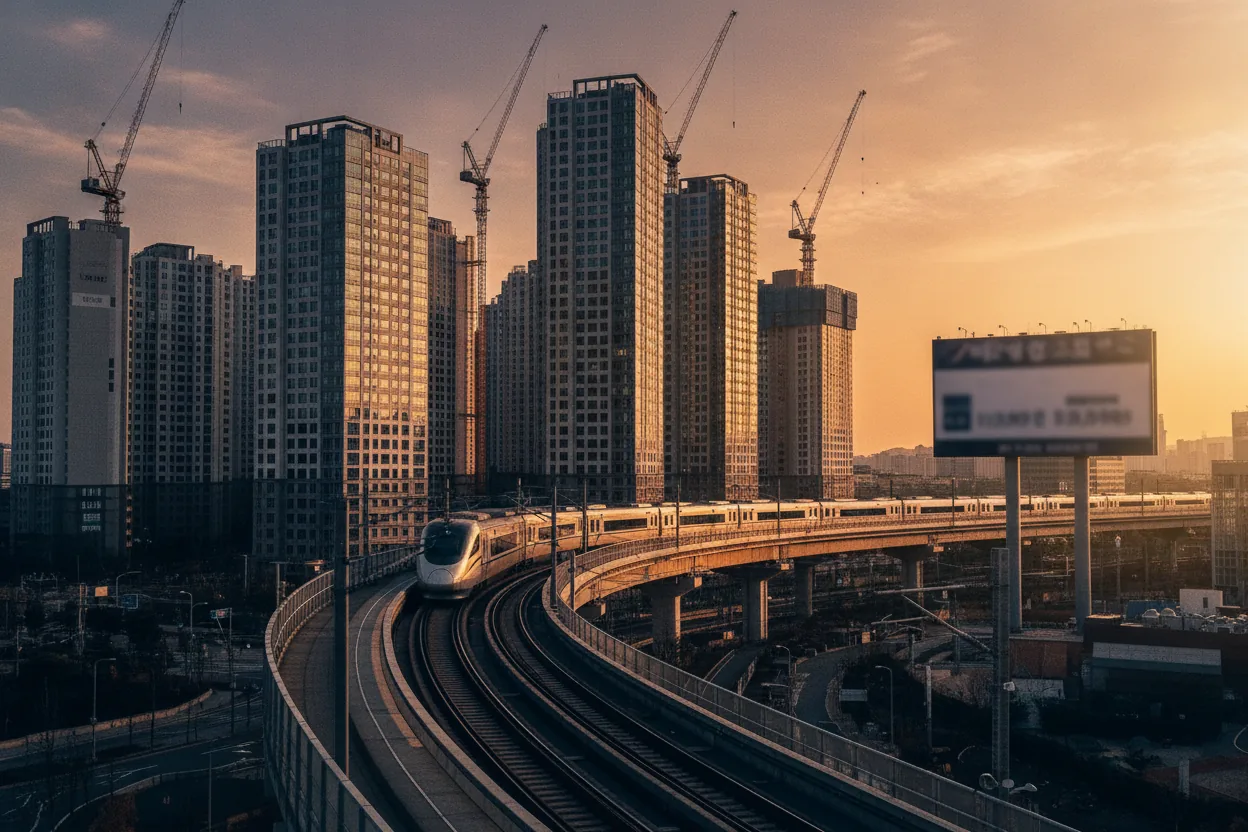
A 65 square meter unit in Hwaseong sold for a notably higher price in February than it did roughly eight months earlier. Nothing changed about the unit itself. What changed was the opening timeline of GTX A. So the question worth asking is simple: is this the start of a wider GTX price boom, or the tail end of one that already happened?
GTX A is the first of Korea's Metropolitan Express Railway lines to actually run trains, rather than exist as a groundbreaking ceremony and a promise. Once you see the pattern, it's obvious: GTX pricing in Korea moves well before the trains do, then flattens the moment the ribbon is cut. The money to be made in GTX linked housing got made already, mostly in 2024 and early 2025, and what's happening now around Dongtan and Bulgwang looks like the tail end of a repricing event. Not the start of one. The real opportunity, if any is left, has shifted to lines B through H, and even there the window is narrower than the headlines suggest.
Why Does GTX A Keep Setting Records Even After Opening?
Dongtan Apartment Price Gain After GTX A Progress
|
October (prior) 1.28B won 65 sqm unit |
→ |
February (after) 1.6B won 65 sqm unit |
Gain across roughly 8 months
+300M won
Bukhansan Hyundai Hillstate 7, Bulgwang dong, 84 sqm
1.3B won
Source: Source: Article data, Dongtan Station Lotte Castle transaction records
GTX A is the line furthest along, connecting Dongtan and Seoul's core business districts, with partial service already running and full connection through central Seoul advancing through 2026. You'd think prices had already absorbed this news. Instead, Dongtan keeps printing new highs, and the Bukhansan Hyundai Hillstate 7 unit in Bulgwang dong followed the same script, climbing to 1.1 billion won after GTX A related anticipation spread beyond Gyeonggi into northern Seoul.
What's actually happening is a staggered repricing, not a single jump. Each phase of GTX A completion, from partial opening to full Seoul Station connection to eventual Seoul to Gangnam speed claims, resets expectations for a slightly wider radius of apartments. The market doesn't price in the whole line at once. It prices in the piece that just became real.
- 1.6 billion won paid for Dongtan Station Lotte Castle, 65 square meters, February
- 1.28 billion won for the same unit type, the previous October, meaning a 300 million won gain across roughly eight months
- 1.3 billion won paid for Bukhansan Hyundai Hillstate 7, 84 square meters, Bulgwang dong
- Eight GTX lines are now publicly identified, A through H
GTX A has become a proof of concept for the entire program. Every time it clears a milestone without collapsing into delay, it validates the pricing logic for GTX B, GTX C, GTX D and beyond, which is exactly why Korean financial press coverage keeps warning that some of this is already priced in. Buyers looking at a station on GTX A today aren't buying early access. They're buying confirmation.
If GTX A is mostly finished repricing, the next question is where that same process is still in an earlier stage. That means looking at the lines behind it.
What Makes Lines B Through H Different From A?
GTX Line Progress Timeline
GTX A: Dongtan to Seoul core
Partial service running, full Seoul connection by 2026
GTX B: Incheon to Namyangju
Construction phased through early 2030s
GTX C: Dongducheon to Suwon/Pyeongtaek
Partially under construction
GTX D, E, F: Concept stage
Under review in fifth national rail network plan
Source: Source: Article data, fifth national rail network plan references
GTX B connects Incheon and Namyangju, GTX C runs from Dongducheon through Seoul down to Suwon and further south (with a planned extension to Asan), and lines D through H exist mostly as concepts tied to the fifth national rail network plan the government is finalizing. The distance between A and the rest isn't just geography. It's credibility. GTX A has trains running. GTX B and GTX C have construction underway in parts. Lines D through H have route maps and political promises, which in Korean infrastructure history is a very different category of asset.
The repricing pattern that hit Dongtan and Bulgwang doesn't repeat uniformly across the remaining lines. It depends on how far along the line actually is, and how much of that progress buyers have already noticed and paid for.
- GTX B links Incheon, Yeouido and Namyangju, with construction phased through the early 2030s
- GTX C stretches from Dongducheon to Suwon and Pyeongtaek, partially under construction
- GTX D, E and F are folded into the fifth national rail network plan under review
- The fifth national rail plan is expected to formally designate additional GTX extensions
- Historically there's a gap of 5 to 8 years between groundbreaking and actual GTX service, based on GTX A's own timeline
Here's the counterintuitive part. The stations generating the most excited commentary right now, the ones tied to lines D through H, are the ones with the least construction reality behind them. Korean property forums and local agents talk about these stations as if service is imminent, but the fifth national rail network plan hadn't been finalized as of this writing. Betting on a station because it appears on a GTX route map is a different trade than betting on a station where tunneling has started. The first is a political bet. The second is a construction timeline bet. Pricing them the same is where a lot of retail buyers get hurt, and knowing which category a station falls into should decide whether it belongs on a shortlist at all.
Knowing which lines have construction underway and which exist only on paper still leaves an open question: for the lines that are real, like A, has the price gain already happened, or is there more left to come? The Dongtan and Bulgwang numbers can actually answer that.
Has the GTX Premium Already Disappeared by the Time You Can Buy In?
How GTX Repricing Unfolds Over a Line's Life
1. Route Announced
Political promise stage, prices mostly flat
2. Construction Underway
Early speculative buying begins
3. Milestone Cleared
Prices jump, staggered repricing by phase
4. Partial Service Opens
Dongtan and Bulgwang record highs, most gains captured
5. Full Line Opens
Ribbon cut, price growth flattens, opportunity gone
Source: Source: Article analysis of GTX A price pattern
Korean real estate industry sources quoted around this GTX cycle keep repeating a version of the same warning: where opening is imminent, or where enough time has passed since groundbreaking, the gain is probably already priced in. That's a polite way of saying the easy money left the building months ago. The Dongtan and Bulgwang numbers aren't proof that GTX still has room to run. They read closer to proof that it already ran, with what remains looking like momentum trading on a story everyone already knows.
The historical comparison worth making is to Korea's earlier subway extension cycles, particularly the Shinbundang Line in the 2010s, where stations near Gangnam saw sharp gains in the two to three years before opening, then plateaued once service actually began. GTX A appears to be tracing a similar curve, except compressed and amplified, because the line is meant to meaningfully cut the commute from Dongtan to Seoul Station compared with existing transit options. That's a claim large enough, if it holds up, to justify genuinely large price moves.
- The Shinbundang Line precedent: gains concentrated before opening, flattening after service began
- GTX A's commute claim: Dongtan to Seoul Station expected to be substantially faster than existing transit
- An eight month gain of 300 million won is consistent with late stage momentum rather than early discovery
- Surrounding infrastructure, schools and retail density, cited by industry sources as the real filter now
- Investment decisions need more than GTX proximity alone to justify them
None of this means GTX A properties will fall. Compressed transit gains in Korea tend to hold once established, because the underlying commute improvement is real and permanent. But holding value and generating further gains are two different outcomes, and the industry voices closest to this market are explicitly separating the two. The practical filter going forward isn't which station sits on a GTX map. It's which station sits on a GTX map and still has a construction or opening milestone left to clear, since that remaining milestone is where any future price movement will come from. Buyers weighing a purchase now should ask which milestone is still ahead before asking which line looks most talked about.
That filter answers the question this post opened with. The Hwaseong sale isn't the start of a GTX boom. It's the tail end of one, and the broader tension inside this GTX expansion is one Korea keeps running into across sectors. A policy tool designed to spread population and housing demand away from central Seoul instead concentrates buyer attention onto a small number of newly legible dots on a map: Dongtan, Bulgwang, and whichever station the fifth national rail plan names next. The infrastructure decentralizes. The capital doesn't. What's left for buyers is the harder, narrower work of identifying which stations on lines B through H still have a real milestone ahead of them, and pricing only that.
This article is for informational and educational purposes only and does not constitute financial, investment, or legal advice. Views expressed are analytical observations and should not be relied upon for personal financial decisions. Consult a qualified financial advisor before making investment decisions.