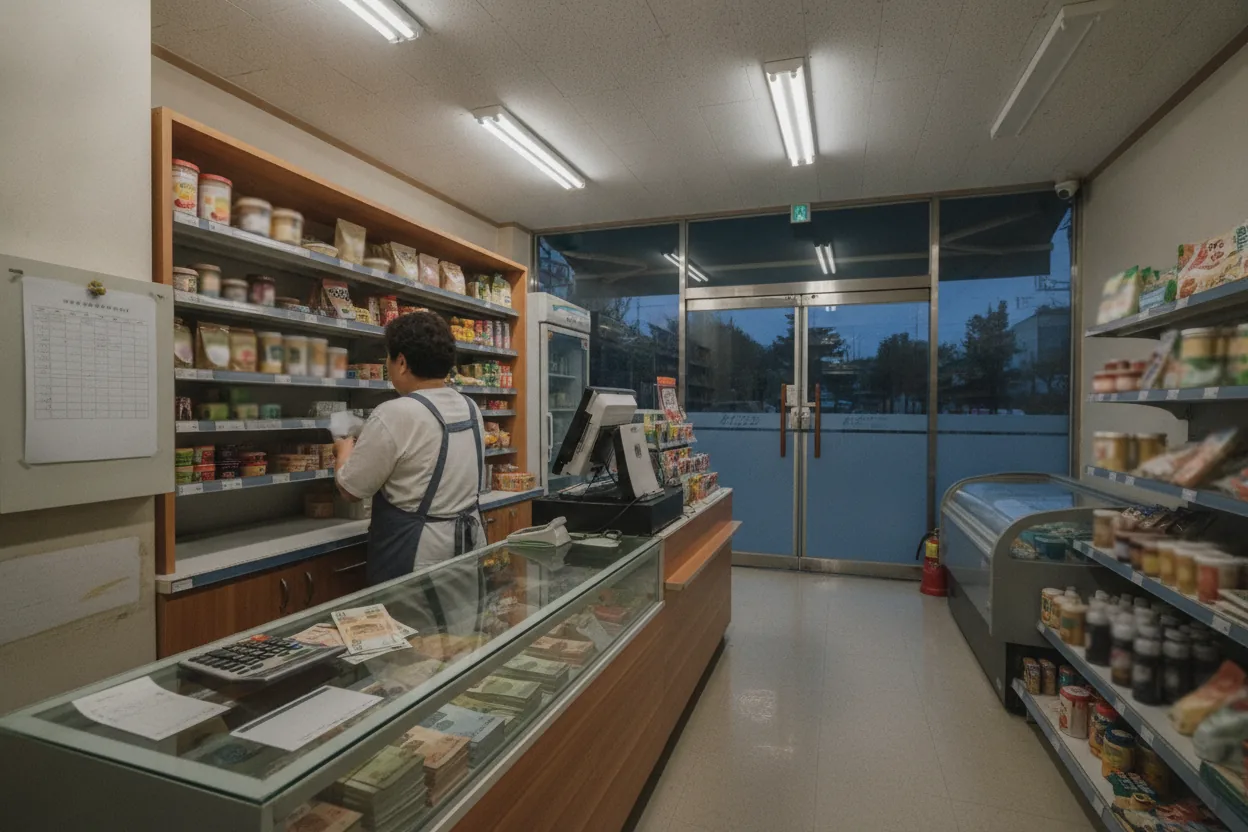
Park runs a convenience store in Incheon, and the number he watches isn't the 2.9% headline that made this year's minimum wage deal the first consensus vote in eighteen years. He watches the juhyu su dang, the weekly paid holiday allowance tied to that same wage floor, because it's the line item that turns a 2.9% increase into something closer to 4 or 5% in actual labor cost. Korea built this allowance to protect part time workers, and it's pushed many of them into shorter shifts scheduled specifically to dodge it. The headline number finally came from agreement instead of deadlock. So why does the system underneath it still produce the same quiet workaround it always has?
Korea's minimum wage committee reached its number through actual agreement between labor, management, and public representatives, rather than the usual outcome where talks collapse and government appointed public members cast the deciding vote. That procedural detail matters more than the 2.9% headline, because Korea's minimum wage fight was never really about the number. It's about who gets to decide, and this year's consensus suggests something is shifting beneath a labor market that has spent a decade arguing itself into exhaustion. The rest of this comes down to what that number actually sets in motion once it leaves the committee room.
Setting The 2026 Number: How The Committee Got There
Korea 2026 Minimum Wage: The Headline vs The Real Cost
Source: Korea Minimum Wage Committee, as reported in article
Start with the arithmetic, because it explains why both sides could live with this year's outcome. The committee set the 2026 hourly rate at 10,320 won, up 290 won from the 2025 rate of 10,030 won. That's a 2.9% increase, which translates into a monthly wage of 2,156,880 won for someone working the standard 209 hours, the figure Korea uses to account for paid weekly holiday hours baked into a full time schedule. Recent annual increases have trended well below 2%, a sharp contrast to the double digit jumps Korea pushed through between 2018 and 2019 under the Moon Jae in administration's income led growth policy. Those earlier hikes, some exceeding 10% in a single year, triggered a political backlash from small business owners that reshaped how cautiously every committee since has approached the number. 2.9% is not generous. It's deliberately unremarkable, and that restraint is part of why labor and management could converge on it without a forced tiebreaker.
What makes 2026 different isn't the size of the increase but the mechanism. Public representatives on the committee, typically economists and government appointed figures who break deadlocks, didn't have to cast a deciding vote this year because labor and management representatives reportedly converged on a figure both sides could tolerate. That agreement on the headline number is also where the story gets misleading, because the number alone doesn't capture what employers actually pay or what workers actually take home. The next layer, the part Park actually watches, shows why.
The Holiday Allowance Most Observers Miss
Korea Minimum Wage Growth Rate: From Double Digit Hikes to Deliberate Restraint
Source: Article description of Korea Minimum Wage Committee history (2018 to 2026)
Park runs a convenience store franchise in Incheon, and he doesn't think about the minimum wage headline number. He thinks about the juhyu su dang, the weekly paid holiday allowance, because that's the line item that actually moves his payroll. Under Korean labor law, any employee working more than 15 hours a week who meets attendance requirements is entitled to a paid day off, compensated at the hourly minimum wage rate regardless of whether that employee actually works that day. This allowance is structurally tied to whatever the minimum wage becomes, which means every 2.9% increase in the headline rate compounds into a larger increase in actual labor cost for employers who schedule part time staff near that 15 hour threshold. This is the part of Korea's wage system most foreign observers miss entirely. The minimum wage announcement gets translated into a single number and compared across countries, but the actual cost employers face is a bundle: base hourly pay, the holiday allowance, mandatory contributions to national pension and health insurance, and in many cases a severance equivalent payment for anyone who stays beyond a year.
Because the holiday allowance recalculates alongside the headline rate, even a modest 2.9% increase compounds into a noticeably larger rise in total labor cost per part time worker, with the exact scale depending on scheduling and attendance patterns at each business. Small business owners in Korea have responded to this structure in a remarkably consistent way over the past five years: they cut hours just under the 15 hour threshold. A policy designed to protect part time workers has pushed a visible share of them into shorter, less stable shifts specifically engineered to fall outside the protection.
The minimum wage goes up. Weekly take home pay for some workers goes down. Who exactly is this policy protecting if the people most exposed to it are being scheduled around it? The same wage floor that creates this workaround for part time workers also reaches into parts of the welfare system that have nothing to do with hourly scheduling.
Welfare Formulas Also Move With The Wage Floor
How Korea's Minimum Wage Decision Process Changed in 2026
Source: Article description of Minimum Wage Committee procedure
Kim is a new mother in Daejeon applying for maternity leave benefits in early 2026, and her payment calculation shifts the moment the new minimum wage takes effect on January 1st. Korea's social insurance architecture uses the minimum wage as a reference point for multiple benefit floors, not just a wage floor for employers. Unemployment insurance payments, maternity leave compensation, and several disability and caregiving subsidies are all pegged, directly or indirectly, to the minimum wage level. This is a structural choice, not an accident. Linking welfare floors to the wage floor means every annual wage committee decision functions as a de facto welfare policy decision, debated by representatives who were appointed to negotiate labor cost, not social spending. When the committee sits down each summer, ostensibly to negotiate an hourly rate for convenience store clerks and factory floor workers, it's simultaneously setting the effective floor for how much a laid off worker receives in unemployment benefits and how much a new parent receives during leave.
Few countries bundle these decisions into a single annual negotiation involving nine representatives each from labor, management, and the public. Germany, for comparison, sets its minimum wage through an independent commission that doesn't touch unemployment insurance formulas at all. South Korea's approach concentrates enormous downstream consequence into one committee meeting that most citizens never watch.
The Ministry of Employment and Labor will take the committee's recommendation and formally finalize it by early August, a procedural step that has never once overturned a committee decision in the system's history, though the ministry technically retains that authority. The number then takes effect nationwide on January 1st, applied uniformly whether the employer is a convenience store in a rural county or a logistics warehouse in Gyeonggi province. No regional adjustment exists in Korea's system, unlike the United States where state and city minimums vary by multiples. Why does a country with such sharp regional income disparity, where wages in Seoul can run double those in some provincial counties, still insist on one national number? That same uniform number lands hardest on the businesses with the thinnest margins to absorb it.
Small Business Margins Absorb The Weight
Walk through any Korean neighborhood dense with franchise convenience stores, and the clearest pressure point in this entire system comes into view. Franchise operators pay royalty fees to headquarters, lease costs that have climbed steadily since the pandemic, and now labor costs rising on a schedule they don't control. Industry associations representing small business owners have argued for years that Korea's minimum wage should differentiate by business size or region, similar to how Japan sets prefecture specific minimums. That proposal resurfaces every negotiation cycle and gets rejected every time, partly because labor representatives view differentiated wages as a path toward a permanent underclass of lower paid regional workers. The 2.9% figure for 2026, modest as it looks next to the double digit hikes of 2018, still lands on business owners already absorbing years of compounded increases layered on top of each other since 2017.
There's a quieter structural story underneath the franchise complaints, though. Korea's small business sector is unusually large relative to its economy, with self employed workers and micro business owners making up a share of total employment that dwarfs comparable OECD economies like Japan or the United States. That means minimum wage policy in Korea does something it does less sharply elsewhere: it functions as a transfer between two groups who are both, in a meaningful sense, economically precarious. Minimum wage workers aren't negotiating against large corporations like Samsung or Coupang in most of these disputes. They're negotiating against convenience store owners and small restaurant operators who are themselves often one bad quarter away from closing. This is the tension that never quite resolves in Korea's wage debate, and it explains why this year's agreement, reached in what appears to be the absence of a public representative tiebreaker for the first time in some years, reads less like harmony and more like exhaustion on both sides finally converging on a number neither loves but both can survive.
The agreement holds for one year, and the consensus that produced it does not change what sits underneath the number. Park will still watch the juhyu su dang more closely than the 2.9%, because that's the line item that decides whether his part time staff get more hours or fewer. Kim's maternity benefit will still move on a formula built for labor cost negotiation, not family policy. Who absorbs the holiday allowance recalculation, whether welfare formulas should stay tethered to a labor cost number, whether a single national wage still makes sense for an economy this regionally uneven: none of it got settled by this year's agreement. It was simply carried forward to a committee that will sit down again next summer, facing the same structure with a new number to argue over.
This article is for informational and educational purposes only and does not constitute financial, investment, or legal advice. Views expressed are analytical observations and should not be relied upon for personal financial decisions. Consult a qualified financial advisor before making investment decisions.