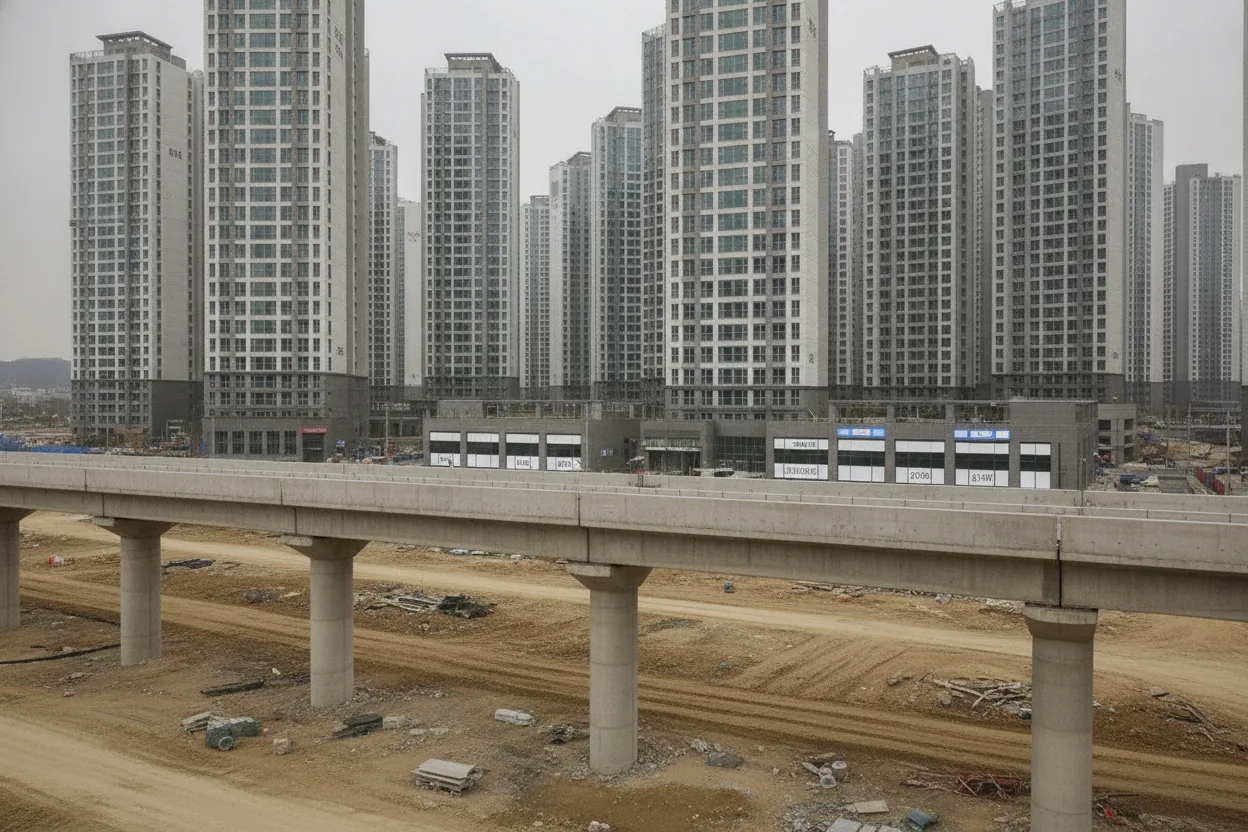
Apartments near planned GTX stations in Gyeonggi Province have risen noticeably over the past two years. Some of those trains have no confirmed construction date, and none will carry a commuter before 2026 at the earliest. Infrastructure pricing is supposed to track delivery: land value climbs as concrete and track actually show up. Here the price moved first and the train hasn't moved at all, which means something other than the railway set the number on the listing.
This isn't a financing story, it's a psychology story wearing an infrastructure costume. GTX, the Great Train Express system meant to connect Seoul to its outer suburbs at speeds near 100 kilometers per hour, has become Korea's clearest live demonstration of how expectation sets asset prices, not delivery. GTX works less like a transit project and more like a pricing mechanism. Understanding it tells you more about how Korean households allocate capital than any transit ministry press release does. So if the price already moved before a single train ran, what's actually being bought, and what happens when that bet gets tested against reality?
What Makes GTX Different From a Normal Subway Line?
GTX Express Rail vs Conventional Seoul Subway
| Metric | Conventional Subway | GTX Line |
|---|---|---|
| Tunnel Depth | ~20 meters | ~50 meters |
| Top Speed | 30 to 40 km/h | ~100 km/h |
| Suwon to Samseong Trip | Over 1 hour | Substantially shorter |
| Earliest Commuter Service | Already running | 2026 or later |
Source: Article content, GTX project specifications
Seoul's existing subway system is already one of the densest and most used in the world, so a new line alone shouldn't be news. What makes GTX different is depth and speed. It runs roughly twice as deep as conventional subway lines and more than double their speed, collapsing commute times that have defined Gyeonggi living for two decades.
- The Suwon to Samseong subway trip takes well over an hour today, and GTX A is projected to cut that down substantially.
- GTX A, B, and C lines together are planned to touch a large number of stations across the region.
- Depth runs roughly 50 meters versus the typical 20 meter subway tunnel, at a target speed near 100 kilometers per hour versus 30 to 40 for ordinary lines.
A sharp reduction on a daily commute isn't just a convenience, it's a reclassification of where someone can live and still call Seoul their workplace. That reclassification is exactly what real estate agents and buyers have been pricing in, years ahead of the trains actually arriving. The next question is how directly that pricing shows up, before the infrastructure itself exists.
Why Are Prices Rising Before a Single Train Has Run?
The GTX Price Cycle: Expectation Before Delivery
Source: Article narrative on GTX pricing pattern
Korean housing markets have a long memory for this pattern. Wherever a subway extension, a new bridge, or a highway interchange gets announced, apartment listings near the future stop reprice almost immediately, often before land has been broken. GTX did this at a larger scale because it touches so many towns at once, and because the commute time compression is so dramatic.
- Dongtan, a planned city in Hwaseong, saw some apartment complexes post notable gains once GTX A construction progressed.
- Uijeongbu and Yangju, both GTX C stops, became subjects of broker driven promotional campaigns years before any track was laid.
- Wangsimni Station in Seoul, a GTX C stop, drew attention from agents in neighboring Haengdang dong who expect spillover gains.
- Repeated construction delays across all three lines haven't reliably cooled buyer enthusiasm the way delays usually do.
That last point should surprise an outside observer. Delays are normally bad news for an asset tied to a specific completion date. In GTX adjacent housing, delays have sometimes barely dented prices, because the asset being bought isn't really the train. It's the story of future connectivity, and stories are harder to downgrade than construction timelines. Once a neighborhood's apartment prices are built on a story rather than a schedule, the same story becomes something multiple neighborhoods try to claim at once. That's what turns this into a political fight rather than just a pricing pattern.
How Did a Train Line Turn Into a Fight Between Towns?
Three GTX Hotspots and What Changed
Source: Article content on Dongtan, Uijeongbu/Yangju, and Wangsimni
Several towns along the planned routes have pushed hard, sometimes publicly, for additional stops or route changes, because a station stop functions as a guaranteed price floor for everything nearby. Losing a stop, or watching a neighboring town win one instead, gets treated less like a scheduling detail and more like a direct transfer of future wealth.
- Gimpo and Bupyeong residents have pressed for extra GTX D line stops to avoid being bypassed entirely.
- Yongin and Suwon have both lobbied for additional station placement tied to GTX A extensions.
- Pyeongtaek officials have argued publicly for inclusion in GTX extension plans despite sitting farther from central Seoul than most listed stops.
- Disputes over which district absorbs construction noise versus which district captures the price benefit have surfaced in multiple city council sessions.
None of this is irrational. A station stop within walking distance can separate an apartment block that trades at Seoul adjacent prices from one that trades at ordinary provincial prices, even if the two blocks sit three kilometers apart. Local governments do this arithmetic as well as any broker does, which is why GTX station placement has become one of the more contested planning fights in Gyeonggi politics over the past three years. If every town is fighting for the same stop because it expects the same windfall, the next question is what happens to household balance sheets once that many bets ride on an infrastructure timeline that keeps slipping.
What Happens When the Hype Outruns the Rail?
Korea's household debt sits among the highest in the OECD relative to income, and a meaningful share of that debt is mortgage exposure tied to exactly this kind of future value bet. Buying an apartment near an unfinished GTX stop is a leveraged wager on a government infrastructure timeline, and government infrastructure timelines in Korea, like most places, slip.
- GTX A's full opening has already been pushed back multiple times from its original target.
- GTX C and GTX B remain earlier in construction, with completion windows still described as the late 2020s.
- Gyeonggi provincial authorities have issued regulatory warnings about speculative buying near GTX stations at various points.
- Prices seem to peak at the construction start announcement rather than at opening day, which is the pattern worth sitting with.
If a station's biggest price jump happens at groundbreaking rather than at ribbon cutting, the actual commuting benefit is almost incidental to the transaction. Buyers aren't really purchasing a faster commute to Samseong. They're buying the right to resell the expectation of a faster commute to Samseong to the next buyer, before the trains ever test that expectation against reality.
Seoul's broader housing market has shown signs of cooling in parts of the city over the past year, even as GTX adjacent Gyeonggi pockets kept climbing on their own separate logic. That divergence is unusual, and it confirms what the price-before-construction pattern already suggested at the start: GTX has built a pricing system partly detached from the capital it's supposed to be feeding into. Dozens of towns along three different lines are each pricing in the full value of a commute time premium that can't belong to all of them at once. The train hasn't moved. The price did. Until the lines actually open on schedule, that gap is the real asset being traded, and it closes the moment any one of these stations opens and the commute either delivers what was priced in or doesn't.
This article is for informational and educational purposes only and does not constitute financial, investment, or legal advice. Views expressed are analytical observations and should not be relied upon for personal financial decisions. Consult a qualified financial advisor before making investment decisions.