Ninety two point six billion dollars in mobile gaming revenue against fifty one point nine billion for consoles. Roughly three billion ordinary phones outearning six hundred thirty million dedicated machines that cost hundreds of dollars apiece. That gap didn't happen by accident. It traces back to a monetization architecture Korean studios engineered on PC bang computers two decades ago, built to separate the cost of play from the cost of progress, and quietly ported to mobile before Silicon Valley or Tokyo noticed what was happening. The real question is how a system built for keyboard and mouse rooms in Seoul ended up rewriting the economics of a global industry that has never really given it credit.
The global games market hit roughly one hundred eighty seven billion dollars in 2024, with mobile pulling in about half of that and still gaining ground on console and PC. Console revenue actually shrank in 2024. Mobile kept climbing. This isn't a story about phones getting sharper cameras or bigger screens. It's about one monetization architecture: the one Korea prototyped two decades ago on PC bang computers, then ported to mobile before anyone in San Francisco or Tokyo fully caught on.
The Gacha Engine Nobody Credits Properly
Mobile Gaming Outearns Consoles Worldwide
|
Mobile Gaming Revenue $92.6B from about 3 billion phones |
Console Gaming Revenue $51.9B from about 630 million machines |
Mobile revenue gap over console
+$40.7B
despite far cheaper devices per user
Source: Source: Global games market data, 2024
Bring up mobile gaming economics and someone will mention free to play. Almost nobody traces it back to where it actually hardened into a science. Nexon and NCSoft were running item based monetization on PC titles like MapleStory and Lineage back in the early 2000s, years before Apple's App Store existed. The insight was structural, not creative: separate the cost of play from the cost of progress, then let probability do the selling.
That insight now runs as the operating system of global mobile gaming. Gacha mechanics, battle passes, limited time banners: all of it descends from the same Korean PC bang logic of variable reward scheduling. Analysts like to credit mobile's growth to "improved monetization strategies" without ever naming what that actually means: a toolkit refined in Seoul gaming studios and exported through titles like Lineage2M and Odin: Valhalla Rising, both of which posted strong grossing runs in Korea and Japan well before most Western analysts adjusted their models.
Krafton's PUBG Mobile and Nexon's various mobile ports didn't invent the mobile gaming boom. They scaled a Korean monetization grammar onto a global device base of billions. The real story isn't what Korea's gaming sector is known for abroad, mostly esports spectacle and StarCraft nostalgia. It's what Korea actually exports: a deeply engineered, probability based revenue system. Korea doesn't just play the mobile gaming game. It wrote several chapters of the rulebook everyone else is now reading from. Nexon and NCSoft profit most directly, sure, but every global publisher running a gacha system today owes an uncredited debt to Seoul.
Easy enough to trace that debt on a balance sheet. Much harder to see in the physical geography of Korean gaming itself, which never had a console foundation to begin with.
Why Console Decline Barely Registers in Seoul
Console Market Structure: Korea vs Global Peers
| Market | Console Penetration | Core Infrastructure | 2024 Console Trend |
|---|---|---|---|
| Korea | Historically low | PC bang network, broadband | Barely registers |
| Japan | High | Console manufacturers, retail | Reads as crisis |
| United States (Seattle) | High | Console/PC hybrid market | Reads as crisis |
| Southeast Asia | Moderate | Mobile first infrastructure | Mixed impact |
Source: Source: Article analysis of Korean gaming infrastructure, 2024
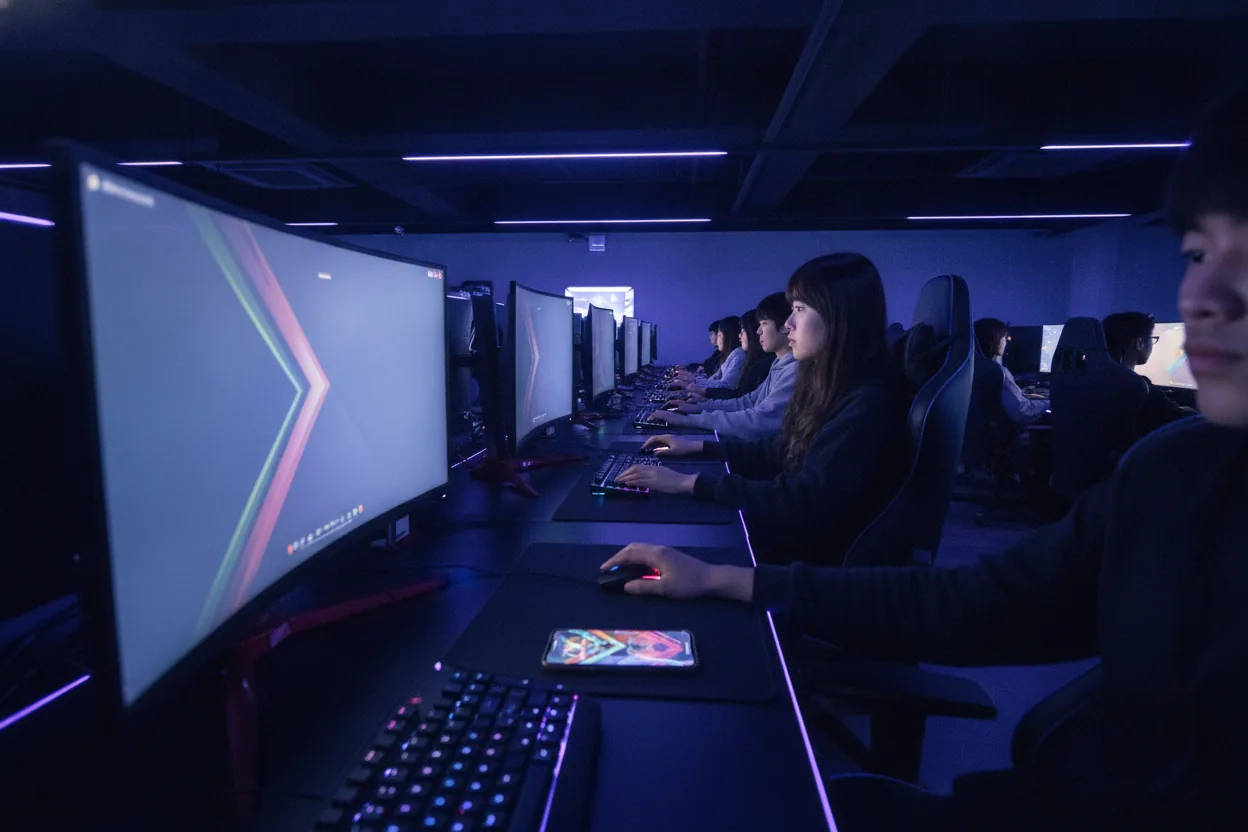
Console gaming's revenue contraction in 2024 would read as a full blown crisis in Tokyo or Seattle. In Korea, it barely moves the needle, because Korea was never structurally a console market to begin with. PlayStation and Xbox penetration in Korean households has historically trailed far behind Japan, the US, and even parts of Southeast Asia. The infrastructure that made Korea a gaming superpower, the PC bang network and near universal broadband from the late 1990s onward, routed the entire industry around console dependency from day one.
A missing market turned into a competitive advantage. Korean developers never had to design for a controller and a living room TV, so they built for keyboard, mouse, then thumb and touchscreen. That design lineage slides almost frictionlessly into mobile, where touch based UI and short session loops matter more than graphical fidelity ever did. Console decline is a Western and Japanese structural problem. Korean studios just happen to be standing on the side of the market that was already growing.
Compare that to how Sony and Nintendo now court live service and mobile spinoffs defensively, trying to backfill revenue that consoles are bleeding. Netmarble and Nexon never had to pivot, because they never fully committed to the console model in the first place. Korea's gaming dominance wasn't built by beating console makers at their own game. It was built by skipping the console phase almost entirely and going straight to the model that turned out to scale globally. Sony and Nintendo are now retrofitting strategies that Korean firms treated as day one defaults, and that lag is exactly why Korean publishers keep setting the pace.
Skipping the console phase explains how Korean studios built their platform instincts. It doesn't explain who they built those instincts for. That answer shows up in the demographics.
How the Demographic Split Explains the Money
Global Games Market Split, 2024
Approximate share of ~$187B total games market
| Mobile: $92.6B, gaining ground |
| Console: $51.9B, shrank in 2024 |
| PC: remaining share, roughly $42.5B |
Source: Source: Global games market estimate, approximately $187B total, 2024
Mobile gaming's user base skews slightly female, with more than half of players identifying as daily users, a profile that's almost the inverse of the traditional console gamer stereotype. This matters a lot for Korea's position in the market, because Korean mobile publishers were early and aggressive about designing for exactly this audience, particularly through idle RPGs, otome style narrative games, and low friction puzzle titles that dominate charts in Korea, Japan, and increasingly Southeast Asia.
Com2uS and Netmarble built entire portfolios around this pattern before Western publishers took it seriously. Summoners War and the Seven Knights franchise leaned into collection and social mechanics that retain daily players far more effectively than session based shooters ever could. High daily active engagement isn't an accident of platform convenience. It's the direct output of design choices Korean studios made a decade ago, betting that habitual, low commitment play would beat occasional, high commitment console sessions on lifetime revenue per user. They bet right.
Here's a wrinkle worth sitting with. Korea's own birth rate crisis, among the lowest in the world, hasn't shrunk its core gaming audience the way you'd expect, because mobile gaming's growth engine was never dependent on young players inside Korea. It scaled through emerging markets in Southeast Asia, Latin America, and India, regions where Korean studios' free to play, daily engagement model translates cleanly no matter the local income level. The domestic population is shrinking. The addressable global audience Korean publishers built for is not, and that decoupling is exactly why Korean gaming revenue keeps climbing even as headlines about the country's demographic collapse keep piling up.
None of that scale happened by accident, and it didn't happen because Korea had the biggest domestic market to build on. It happened because Korean studios designed for a global daily habit loop before anyone else took that audience seriously, then exported the design faster than competitors could reverse engineer it. That's the mechanism behind the ninety two point six billion dollar figure this piece opened with. Not better phones. Not bigger screens. A monetization architecture built in Seoul, refined for players Western and Japanese publishers overlooked, now running underneath a global industry that still rarely says its name. Com2uS and Netmarble are the clearest winners of this bet, and any publisher still designing primarily for domestic demographics is already behind.
This article is for informational and educational purposes only and does not constitute financial, investment, or legal advice. Views expressed are analytical observations and should not be relied upon for personal financial decisions. Consult a qualified financial advisor before making investment decisions.