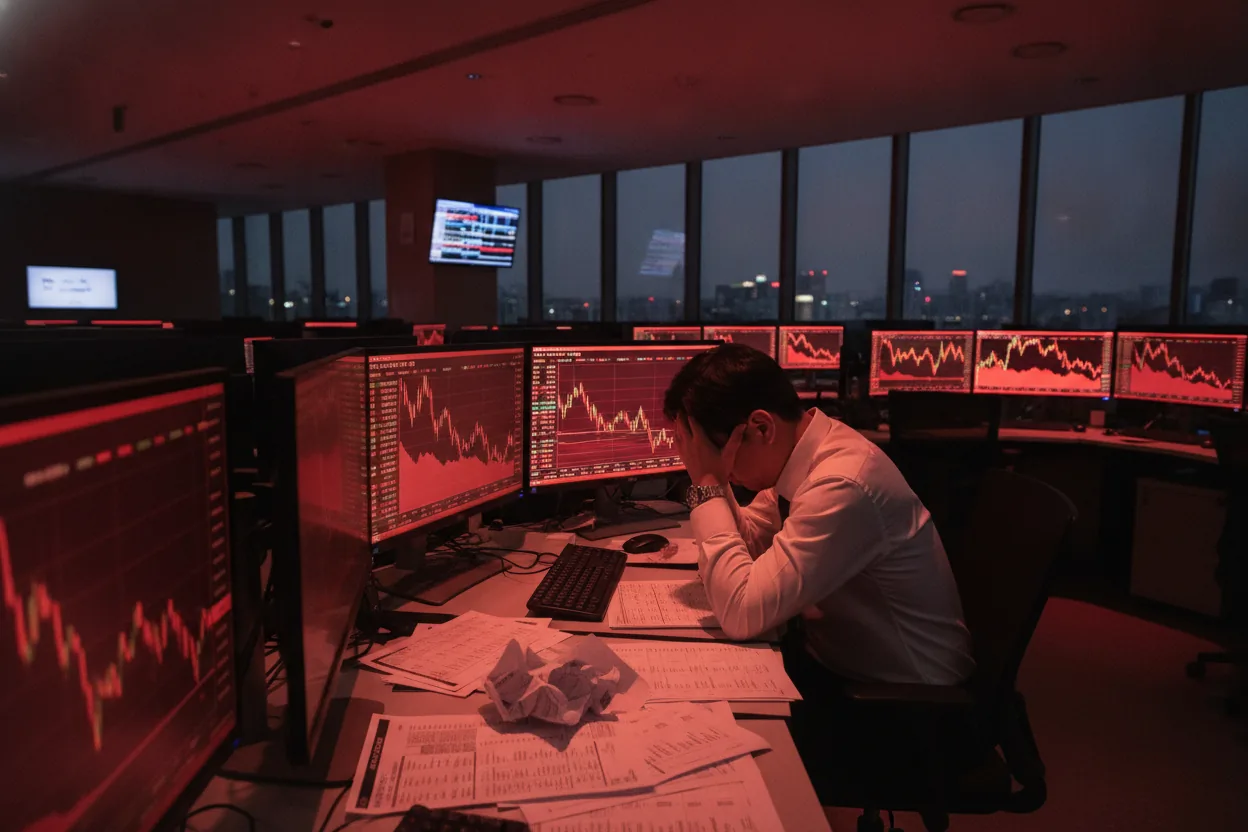
Two trillion won in losses. That's what it took for South Korea's finance minister to stand up in the National Assembly and apologize. Korea built a retail trading market designed to reward speed and leverage, turned stocks into something closer to a live sport than a savings vehicle, and leveraged ETFs were the purest expression of that design. Now regulators are floating curbs to fix a market that already broke, weeks after the households holding these products took the hit. The real question isn't whether Seoul will act. It's whether any rule announced this late can do a single thing for the people who already lost their money.
My take is simple: the curbs being floated now won't save the investors who already got hit, because the damage was never a rules problem. It was a design problem. Korea built a retail trading culture that rewards speed and leverage, then acted surprised when speed and leverage did what they always do during a drawdown. The regulation Seoul is discussing this month is closing a door after the room has already emptied. What follows traces how that design took hold, why the backlash reached inside the ruling party, why regulators sat on known risks for years, and what it would actually take to protect people next time.
How Korea's Retail Trading Culture Became a Systemic Risk
The Two Trillion Won Rout
Losses on leveraged ETFs before regulators moved to act
|
2x to 3x
Daily return leverage offered by these ETFs, in either direction |
Daily
Rebalancing frequency that compounds losses over multi day holds |
Curbs floated only after households had already absorbed the losses
Source: Source: Article, South Korea National Assembly proceedings
South Korea has one of the most active retail investor bases in the world relative to its population, and individual investors here don't treat the stock market the way a typical American retail trader treats an index fund. Korea's major domestic brokerages turned trading into something closer to a live sport, complete with real time rankings, community chat rooms, and products engineered to amplify daily moves rather than track them over years.
Leveraged and inverse ETFs sit at the center of that culture because they let a retail account swing two or three times the daily return of an underlying index, in either direction. In a rising market that feels like a cheat code. In a falling market it becomes a trapdoor. The daily rebalancing mechanism inside these products compounds losses in ways that catch even experienced traders off guard, and a five percent drop is never just a five percent drop when it's wrapped in two times leverage and held for more than a single session.
What makes the Korean case distinct is scale. These products were never a niche corner of the market. Major brokerages marketed and distributed them widely enough that ordinary households, not just professional desks, were holding them heading into the correction. When a two trillion won rout hits a market built this way, it doesn't stay contained to a trading desk in Yeouido. It shows up in the National Assembly, in online forums, and inside the ruling party's own base, which is exactly where the fallout went next.
Korea didn't stumble into a leveraged product bubble by accident. It built a market structure that made one almost inevitable, and the finance ministry is now paying the political price for a design choice made years before this administration took office. Retail investors lose twice here: once on the trade, once on the years of lax framework that let the exposure build in the first place.
The Backlash Reached Inside the Ruling Party
How the Leveraged ETF Rout Unfolded
Real time rankings, chat rooms, and leveraged products marketed as everyday tools
Widely distributed by major brokerages, not confined to professional desks
Daily rebalancing compounds losses beyond a simple percentage drop
Backlash spreads to the National Assembly and inside the ruling party base
Regulation proposed only after losses were already locked in for households
Source: Source: Article narrative timeline
That political exposure isn't theoretical. It's already landed inside President Lee Jae Myung's own coalition. His administration has generally enjoyed sympathetic coverage on online communities aligned with progressive politics. This time, that sympathy cracked. Calls for tighter regulation started showing up inside those same communities, and the pressure has reportedly reached members of the Democratic Party itself.
That's a meaningful signal in Korean politics. Financial regulation rarely becomes a grassroots issue that crosses party lines this quickly, because most Koreans experience market policy as background noise, something for economists and brokerages to argue about. Leveraged ETFs broke that pattern because the losses were personal, widespread, and immediate. A retail investor who lost a meaningful chunk of savings in a leveraged inverse product doesn't care which party introduced the framework. They care that someone in government let it happen.
Read the finance minister's apology in the Assembly less as a policy statement and more as damage control aimed at his own party's flank.
This rout became a political event faster than it became a resolved regulatory one, and that gap between political urgency and regulatory follow through is where retail investors tend to get hurt twice: once in the market, once in policy that arrives too late to matter for their specific losses. The politicians gain cover. The households holding the losses gain nothing.
Why Regulators Waited So Long to Act
Design Problem vs Rules Problem: The Core Contrast
| Dimension | What Happened | Consequence for Retail |
|---|---|---|
| Product Design | 2x to 3x daily leverage, daily rebalancing | Losses compound beyond headline index move |
| Distribution | Widely marketed by major brokerages | Ordinary households exposed, not just pros |
| Regulatory Timing | Curbs floated after the rout, not before | No protection for those already hit |
| Political Response | Finance minister apologized in National Assembly | Acknowledgment without recovery of losses |
Source: Source: Article analysis
That gap between political urgency and real protection isn't new, and it isn't an accident either. Korean regulators have known about leveraged ETF risk for years. Warnings about compounding decay in these products go back a long way, and similar concerns surfaced during past market stress episodes tied to earlier global rate moves. The mechanism was never secret. What changed is that the losses finally hit a scale that made the mechanism impossible to ignore.
Curbing new leveraged product issuance, tightening margin requirements, restricting retail access, these sound like reasonable responses on paper. None of them undo the exposure households already built up before the correction. A rule change announced in August 2026 does nothing for an account that was already down sharply when the market moved against it earlier in the summer. Regulation here is functioning as a signal to voters that something is being done, not as a mechanism that protects the people who already took the loss.
There's also a structural incentive problem underneath this that rarely gets named directly. Korean brokerages generate meaningful fee revenue from high turnover retail trading, and leveraged products generate more turnover than plain index funds because they're designed to be traded actively rather than held. Any curb serious enough to actually reduce systemic risk would also cut into a revenue stream that major brokerages have built real business models around. That tension doesn't disappear because a finance minister apologized in the Assembly this week.
Korea is about to get a regulatory response calibrated to political pressure rather than to the actual risk profile of these products. Brokerages keep their fee engine intact. The next leveraged product cycle, whenever the market rallies again, will likely rebuild the same exposure under a slightly different label.
What This Reveals About Korea's Compressed Market Psychology
The culture, the political backlash, the regulatory lag, none of it happens in a market that moves at a normal pace. Korea moves fast in both directions, on the way up and on the way down, because the system rewards speed everywhere, not just in trading apps. The same compressed timeline that turned HYBE into a global entertainment exporter and Coupang into a dominant national logistics operator also turns retail trading into a high velocity, high leverage activity where patience was never really the default setting.
That's not a moral failing of Korean retail investors. It's a rational response to a system that has consistently rewarded speed over the past three decades, whether in corporate strategy, career advancement, or personal finance. When the entire economic culture is tuned for compressed outcomes, leveraged products aren't an aberration. They're the logical financial instrument for a market that already thinks in short cycles.
The two trillion won figure attached to this rout may get revised as the final accounting settles, and some of the political heat will cool once markets stabilize, as it tends to. What won't change is the underlying incentive structure that made this outcome likely in the first place. So no, the curbs being floated in Seoul right now won't do anything for the households who already lost. That question was answered the moment the losses locked in, weeks before regulators started drafting rules. Korea has apologized for this cycle. The structural conditions for the next one are still fully intact, and that's the real cost nobody in Seoul is pricing in yet.
This article is for informational and educational purposes only and does not constitute financial, investment, or legal advice. Views expressed are analytical observations and should not be relied upon for personal financial decisions. Consult a qualified financial advisor before making investment decisions.