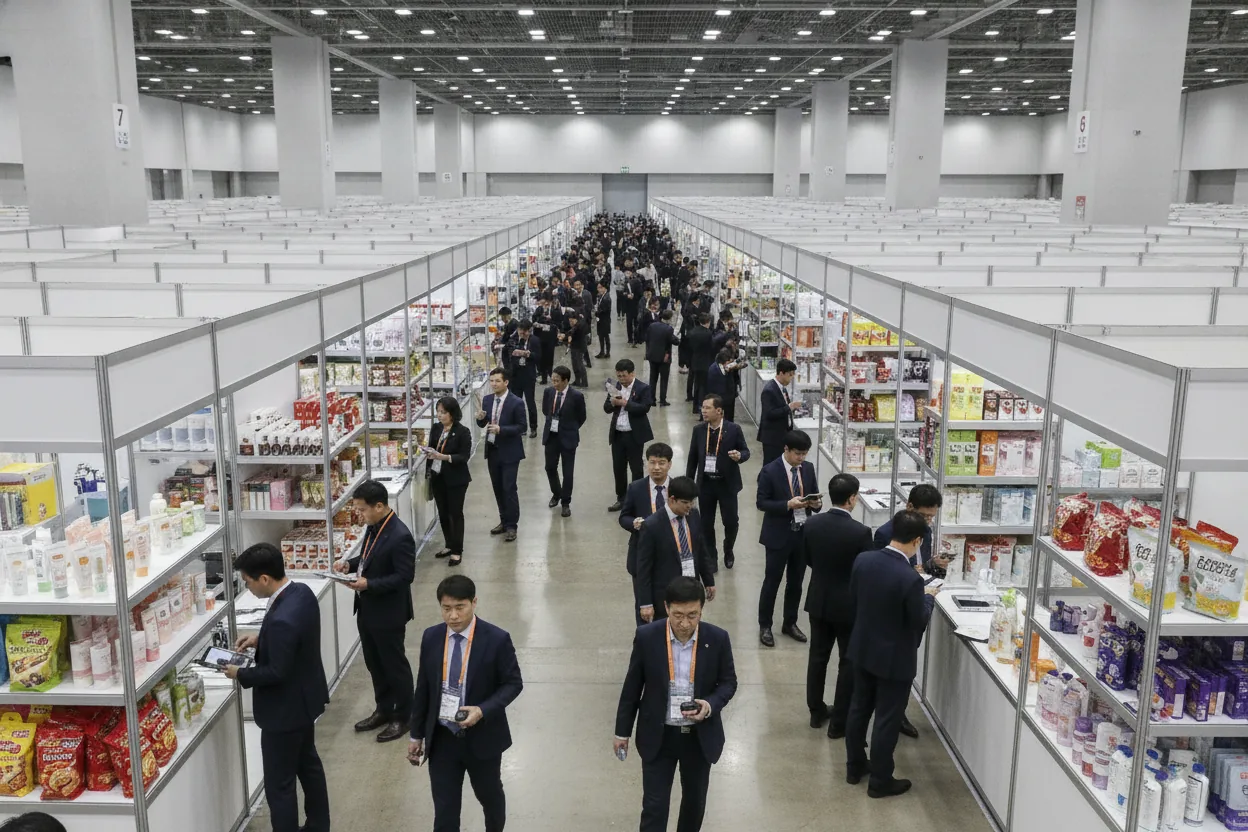
Four hundred booths, three hundred fifty exhibitors, and not one cash register. Sourcing in Market 2026 at Coex Hall C was built to move Korean consumer goods onto container ships, not into shopping bags. The whole event is designed around attendees who walk in with purchasing authority, not curiosity. A hall full of badge scanners and spreadsheets looks nothing like the K-wave export story usually told abroad. So why does an export economy as established as Korea's need a room like this at all, and who is it actually for?
Why Does Korea Need A Trade Show For Products It Already Exports?
Sourcing in Market 2026: The Numbers at Coex Hall C
A Trade Fair Built for Buyers, Not Shoppers
Source: Article: 400 Booths, No Cash Registers: Inside Korea's Coex Export Fair
Walk into almost any supermarket in Hanoi or Manila and you'll already find Korean skincare, instant noodles, or snack packaging on the shelf. So why does Coex need a dedicated sourcing fair for goods that are, on paper, already moving overseas just fine?
The answer sits in who's doing the exporting. Samsung and Hyundai don't need Hall C. They have in-house trade teams, decades-old distribution contracts, and enough scale to negotiate directly with retail chains across Southeast Asia. The exhibitors filling those 400 booths are a different tier entirely: small and mid-sized manufacturers, often family run, making everything from fermented sauces to silicone kitchenware. Good product. Almost no institutional pathway to a buyer in Jakarta.
Korea's consumer goods sector has a structural bottleneck that rarely makes it into the K-wave narrative. Thousands of companies make genuinely competitive products at genuinely competitive prices, but they lack the relationship infrastructure that the big conglomerates spent decades building with state backing. A trade show isn't glamorous. It's a substitute for the network smaller firms never had time to build.
That substitution function explains the event's structure better than any marketing copy could. But it raises a harder question: if small manufacturers need this much institutional scaffolding just to meet a buyer, what does that say about how fragmented Korea's export ecosystem actually is beneath the headline trade numbers? The next section looks at where that scaffolding is pointed, and why the destination matters as much as the mechanism.
What Does The Vietnam And Jakarta Pairing Actually Signal?
Why Small Korean Manufacturers Need a Trade Show
The Export Pathway Gap for Small and Mid-Sized Firms
Source: Article: 400 Booths, No Cash Registers: Inside Korea's Coex Export Fair
Sourcing in Market 2026 doesn't stand alone. It's positioned alongside related sourcing events aimed at Vietnam and Jakarta, part of a broader push into those markets. That pairing isn't incidental programming, it's a map of where Korean organizers believe the next decade of consumer demand actually lives. Vietnam's urban middle class has been one of the fastest growing consumer segments in Southeast Asia in recent years, and Indonesia, with a population north of 270 million and a median age still in the late 20s, offers the kind of demographic runway Korea's own domestic market can no longer provide.
Here's the counterintuitive part. Korea is aging into one of the lowest birth rates on the planet, a fertility rate that has sat below 1.0 for several years with no clear reversal in sight. A shrinking, graying domestic consumer base is exactly the condition that pushes manufacturers to treat export sourcing fairs as the primary growth channel, not a bonus revenue stream. When the home market is structurally contracting, Jakarta and Hanoi stop being secondary markets. They become the market.
That's why a mid-sized Korean beauty or food brand increasingly treats a trade show booth in Seoul the way it once treated a domestic department store contract: as the gateway event that determines the next five years of revenue. The exhibitor isn't expanding into Southeast Asia as an extra line item. It's relocating its growth center of gravity there, because the math inside Korea stopped working.
If domestic demand is no longer the engine, though, what happens to the manufacturers who can't afford a booth, a translator, and a three-day trip to Coex in the first place? That's the gap the next section examines directly.
Who Gets Left Out Of A 400 Booth Show?
Why Vietnam and Indonesia Outrank Korea's Domestic Market
Growth Potential Comparison by Market
| Market | Population Scale | Youth / Age Profile | Consumer Demand Trend |
|---|---|---|---|
| Indonesia | 270M+ (High) | Median late 20s (Young) | Rising |
| Vietnam | Growing Urban Middle Class | Relatively Young | Fast Rising |
| Korea (Domestic) | Shrinking | Aging, Fertility below 1.0 | Contracting |
Source: Article: 400 Booths, No Cash Registers: Inside Korea's Coex Export Fair
Picture a 12-person company in Iksan making specialty gochujang blends, with a loyal domestic following and zero export experience. Booth fees. Travel. Translated packaging. Export certification paperwork. The upfront cost of simply showing up at an event like this adds up fast once logistics and compliance enter the picture, before a single contract gets signed. For a company that size, that's not a marketing expense. It's a bet the owner has to personally underwrite.
There's a filtering mechanism built into every B2B sourcing fair in Korea, and it rarely gets mentioned in the promotional material. The event markets itself as a gateway for Korean consumer goods broadly, but the companies who can actually afford to occupy that gateway skew toward firms that already have some export revenue, some certification experience, some cash cushion. The fair doesn't create access evenly. It rewards companies that were already closer to export ready.
That dynamic isn't unique to Korea, but it collides here with a labor market that makes small manufacturing margins unusually thin. Minimum wage increases, rising input costs, and a shrinking domestic pool of factory labor have squeezed small consumer goods producers for years. A trade show booth becomes a luxury reserved for the companies that survived that squeeze, not a lifeline for the ones still struggling under it.
So who fills the gap? Government-backed trade promotion agencies, KOTRA among them, often subsidize booth costs specifically to pull smaller firms into these events, treating the subsidy as industrial policy rather than charity. Which raises the next question: when the state is this involved in staging a private trade show, is Sourcing in Market really a market event, or something closer to an export policy tool wearing a trade show's clothing?
Is This A Market Or A Policy Instrument In Disguise?
Coex itself is instructive here. It isn't a private events company chasing rental yield. It operates as a quasi-public entity tied to Seoul's broader economic development mandate, and its calendar runs year round with exhibitions that serve national export targets as much as they serve exhibitor revenue. Sourcing in Market sits inside that calendar as one node in a much larger lattice of government-aligned trade infrastructure. The concurrent Korea Grand Sourcing Fair, running alongside the main event, reinforces this. Pairing two sourcing-oriented shows under one roof isn't an accident of scheduling. It's an attempt to concentrate buyer traffic so the state's export promotion apparatus gets maximum return on a single real estate footprint.
This matters because Korea's economic model has always blurred the line between private enterprise and state direction more than most Western observers assume. The chaebol system grew out of targeted government credit allocation in the 1960s and 1970s. Sourcing in Market, at a much smaller scale, descends from that same instinct: the state doesn't just regulate exports, it builds the physical rooms where exports happen.
Walk into Hall C as a foreign buyer and the event feels market-driven: price negotiations, product samples, competitive booths jockeying for your attention. But underneath that, the subsidies, the co-location with VIPREMIUM and JIPREMIUM, the Coex governance structure, is policy architecture dressed as commerce. Neither description is wrong. Both are true at once, and that duality is the actual mechanism, not a contradiction to resolve. What's left is the question of what this mechanism produces once the event itself is over.
What Happens After The Badge Scanning Stops?
A three-day fair generates energy that's easy to see and hard to sustain. Badges get scanned, business cards exchanged, sample boxes shipped home. The real test isn't the floor traffic on November 27. It's whether a Jakarta buyer who met a Korean sauce manufacturer at booth 214 still has that manufacturer's product on a shelf in Surabaya 18 months later.
Trade show organizers rarely publish conversion data publicly, and when they do, the numbers tend to be self-reported by exhibitors with an obvious incentive to round up. That's a gap worth naming rather than papering over with a borrowed statistic.
What can be said with more confidence is the pattern. B2B sourcing fairs function less like sales events and more like filtration systems, surfacing which Korean products have genuine cross-border appeal and which were only ever competitive inside a domestic market that's now shrinking. The fair itself doesn't create demand. It reveals, often brutally, whether a product built for Korean shelves can survive contact with a Vietnamese or Indonesian buyer who has no cultural loyalty to the brand and no patience for a product that only works because it's Korean.
That's the answer to the question the empty cash registers raised at the start: this room exists because Korea's domestic market can no longer absorb what its small and mid-sized manufacturers produce, and because those manufacturers have no other institutional path to the buyers who can. Three days in Hall C decide, for a meaningful slice of them, whether their next decade runs through Southeast Asia or stalls inside a domestic market that no longer has enough people left to buy what they make.
This article is for informational and educational purposes only and does not constitute financial, investment, or legal advice. Views expressed are analytical observations and should not be relied upon for personal financial decisions. Consult a qualified financial advisor before making investment decisions.